
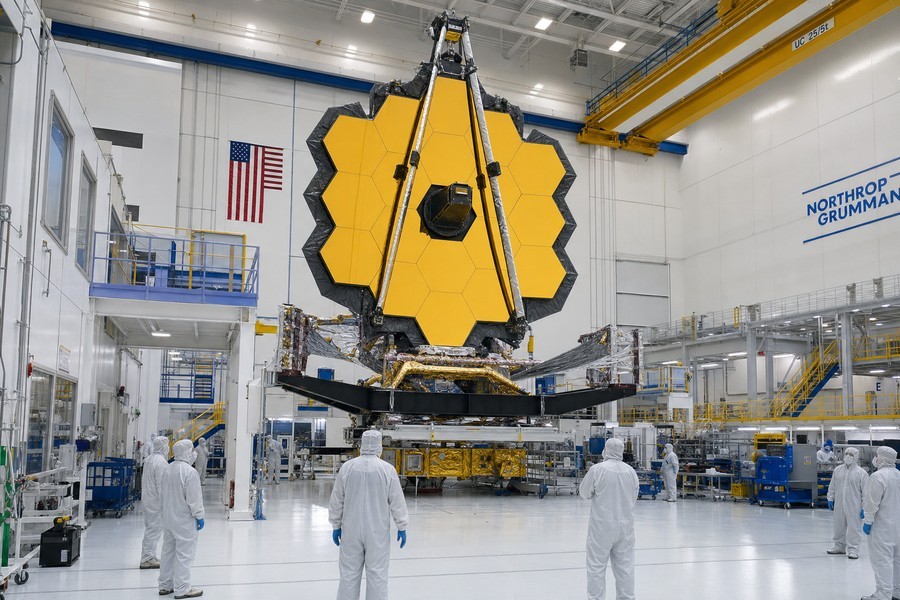
A Giant New Panoramic Telescope Is Getting Ready for Space
A highly anticipated, four-billion-dollar space observatory is almost ready to leave Earth. This massive project is moving much faster than expected and is scheduled to launch nine months ahead of its original timeline. In the near future, the new telescope will lift off on a powerful heavy-lift rocket built by a private spaceflight company, marking a major milestone for space exploration.
Engineers and technicians recently shared that the spacecraft is fully prepared for its journey. Once in space, the telescope will open its protective cover, point its mirrors at the stars, and begin sending valuable information back to scientists on Earth for the first time.
Fueling Up for a Million-Mile Journey
Getting a heavy telescope into deep space requires a lot of power. Workers recently finished filling the spacecraft with a highly efficient fuel called hydrazine. While this fuel is incredibly powerful, it is also toxic and unstable. Space researchers are trying to find safer options for future missions, but this special fuel remains the best choice for now.
The telescope needs a large amount of this fuel to reach its final home, a gravitationally stable spot in space called Lagrange Point 2. This destination is located about one million miles away from Earth, directly in line with the sun. It is a popular spot for space observatories for several reasons:
- Temperature control: The spacecraft can block out the extreme heat of the sun, keeping its sensitive instruments cold and safe.
- Solar power: The telescope's solar panels can constantly face the sun to generate electricity.
- Stability: The gravity of the Earth and the sun pull on the spacecraft in a way that keeps it parked in a steady orbit.
During its journey, the telescope will use its fuel to make small steering adjustments. About one hundred days after launch, it will perform a final burn to settle into its permanent orbit. The spacecraft carries enough fuel to keep it operating and performing necessary maneuvers for at least five years, and likely much longer.
Now that the fueling process is complete, the next major step is encapsulation. This is when the telescope is carefully placed inside the protective nose cone of the rocket that will carry it out of our atmosphere.
Unmatched Speed and Massive Data
This new observatory is designed to take incredibly wide pictures of the universe. To understand how powerful it is, scientists compare it to a legendary space telescope that has been orbiting Earth for over three decades.
The older telescope has collected a total of 400 terabytes of data over its entire 35-year lifetime. In contrast, the new panoramic telescope is expected to produce over 500 terabytes of data every single year. While both telescopes can see the sky with similar sharpness and detail, the new one can scan the heavens much faster.
For example, mapping a large section of our home galaxy, the Milky Way, would take the older telescope about 100 years. The new observatory can complete the exact same map in just one month. A single image from its largest survey will be so massive that displaying it in full detail would require more than 500,000 high-definition television screens. Lined up next to each other, those screens would cover 45 city blocks in a major metropolitan area.
A Wide-Angle View of the Universe
Scientists also compare this new telescope to another famous deep-space infrared observatory that recently started its mission. The deep-space telescope is designed to look incredibly deep into tiny patches of the sky to find rare, distant objects from the beginning of time. However, it has a very narrow view.
The new panoramic telescope has a view that is 50 times wider than the deep-space observatory. This wide-angle view will help astronomers find rare objects closer to home. For instance, the deep-space telescope recently spotted mysterious "little red dots" in the ancient universe. Because its view is so zoomed in, it cannot find many of them at once. The new wide-field telescope will be able to search massive areas of the sky to locate and study these mysterious objects in large numbers.
Searching for Planets and Dark Materials
The new telescope carries advanced instruments designed to solve some of the biggest mysteries in science:
- The Wide-Field Instrument: This tool will scan the sky to take pictures of around two billion different galaxies. This will help scientists study dark matter and dark energy, the invisible forces that shape our universe.
- The Coronagraph: This instrument acts like a high-tech shield. It blocks out the blinding glare of distant stars so that scientists can take direct pictures of the planets orbiting them. Scientists describe this process as using the physics of light waves to perform a kind of scientific magic.
Honoring a Space Pioneer
The telescope is named after a pioneering female astronomer who made history as the very first female executive at the space agency. She also served as its first chief of astronomy. Many people refer to her as the "mother" of the older, famous space telescope because her hard work made that project possible. Decades before the first planet outside our solar system was ever found, she was already laying the groundwork for how to study them.
Project leaders hope that the massive amounts of data collected by this new telescope will inspire a new generation of young students. The hope is that a future scientist, currently sitting in a classroom, will use this data to make discoveries that will change the way we see the universe forever.