
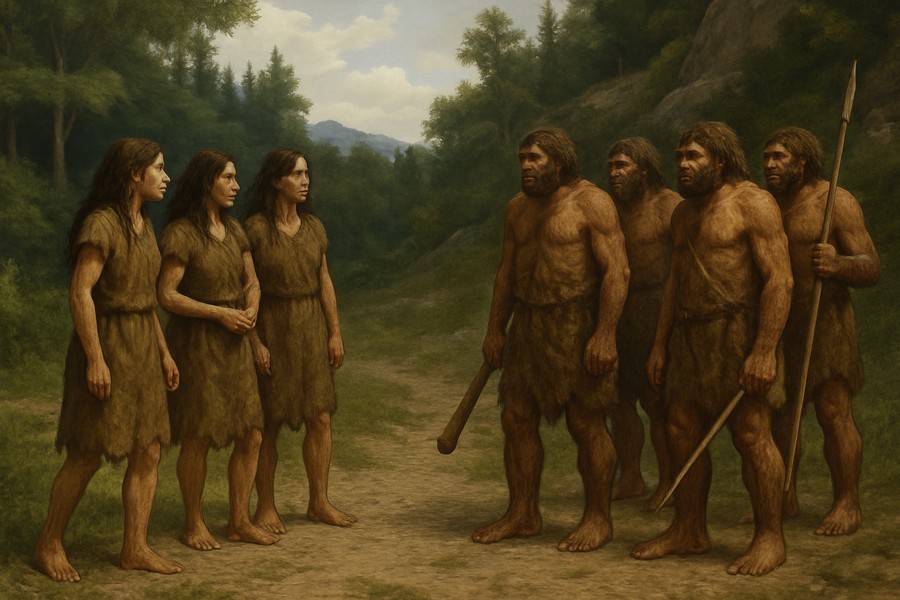
Ancient Love Affair: The Relationship Between Human Females and Neanderthal Males
The history of humans and Neanderthals sharing the same living spaces thousands of years ago is not unheard of. However, the specifics about their intimate encounters remain largely unknown.
Recent genetic studies, however, reveal some intriguing details. They suggest that these romantic alliances were often the result of human women and Neanderthal men coming together.
The Mystery of the Connection
It's hard to say for sure how exactly these relationships formed. Did human females venture into Neanderthal territories? Or were Neanderthal males attracted to larger human communities? Were these interactions peaceful, bewildering, clandestine, or even violent?
Unfortunately, we might never be able to uncover the complete truth due to the constraints of time. But what we do have is the knowledge that whenever Neanderthals and humans mated, there was a preference for male Neanderthals and female modern humans.
The Genetic Puzzle
It's a well-known fact that humans and Neanderthals mated. This is evident from the small yet crucial percentage of Neanderthal DNA found in most modern humans, which includes genes that can help us combat certain diseases and also make us more susceptible to others.
However, one baffling fact is that the Neanderthal DNA is not evenly distributed throughout the human genome. Notably, there's a significant lack of Neanderthal DNA in the human X chromosome, a sex chromosome, compared to the amount of Neanderthal DNA in other chromosomes.
One theory suggests that the genes in those locations might not have been beneficial or potentially harmful. Consequently, individuals with these gene patterns might not have survived well, leading to their elimination through natural selection over time.
Another theory proposes that the difference could be explained by the intermingling patterns of the two species.
Unlocking the Secrets
In a bid to decipher this mystery, researchers turned their attention to the Neanderthal genome and the human DNA that got mixed in during a mating event that occurred approximately 250,000 years ago.
Upon comparison of these genes, they found more human traces on the Neanderthal X chromosome – the same chromosome that, in humans, has less Neanderthal DNA than expected.
The Most Probable Explanation
The most plausible explanation for this mirrored pattern is mating behavior. This is due to the way sex chromosomes are passed down from parents to offspring. Since females have two X chromosomes and males have one X and one Y chromosome, two-thirds of X chromosomes in a population are inherited from the mother, on average.
If human females mated with Neanderthal males more frequently than the reverse, over thousands of years, the result would align with the findings: more human DNA in Neanderthal X chromosomes and less Neanderthal DNA in human X chromosomes.
While the study can't completely dismiss other explanations, the simplest and most probable answer also happens to be the most fascinating. It's not just a matter of survival of the fittest, but rather a reflection of how we interact with each other and our cultural, societal, and behavioral patterns.