
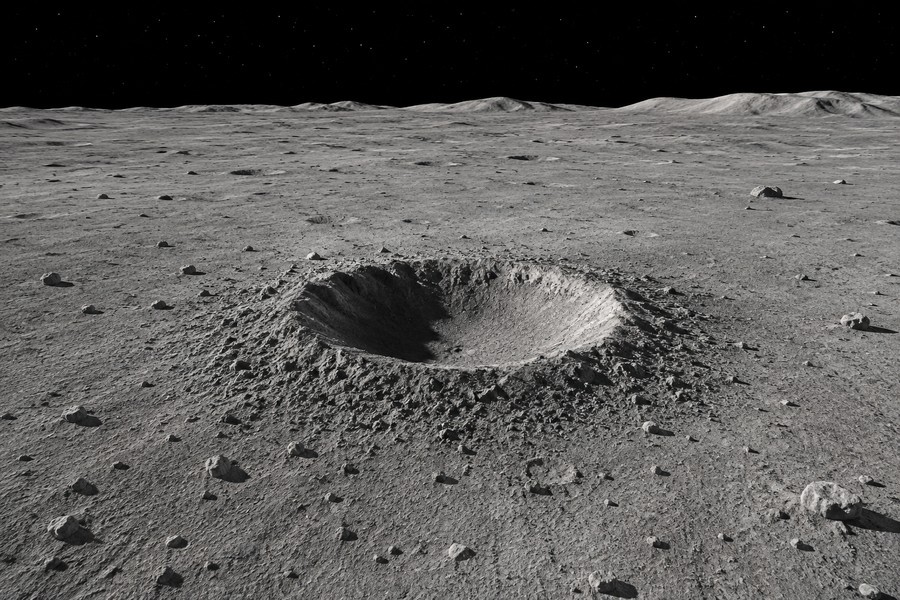
Fresh Pictures Show the Impact Crater Left by a Stray Rocket on the Moon
Space scientists have captured a close-up look at a brand-new crater on the far side of the Moon. The crater was created when a large, empty rocket booster slammed into the dusty lunar surface after spending months drifting aimlessly through space.
A specialized robotic spacecraft that orbits the Moon managed to take highly detailed pictures of the crash site. The images show a distinct scar on the lunar ground, giving experts a rare chance to study what happens when heavy space debris collides with another celestial body at extreme speeds.
The Size and Scale of the New Lunar Crater
The impact of the collision left a noticeable mark on the surface of the Moon. Measurements of the crash site show the following physical characteristics:
- Width: The crater measures about 60 feet (18 meters) across.
- Depth: It is relatively shallow, reaching a depth of less than 10 feet (3 meters).
- Debris Pattern: The collision blasted out a pattern of light and dark streaks that spread across the surrounding soil.
The bright streaks seen around the edge of the hole are made of fresh underground material. When the heavy rocket struck the ground, it dug deep enough to throw up soil that had not been exposed to the harsh environment of space for a very long time. This older, buried dust reflects more light than the surface dirt, making the crash site stand out clearly in the new photographs.
How the Rocket Became Lost in Space
The journey of the runaway rocket began months before the crash. The booster was originally used to launch two private lunar landers into space from a launchpad in Florida. After successfully releasing its payloads, the upper portion of the rocket was supposed to fall back toward Earth and burn up safely in the atmosphere.
However, a technical issue left the booster stranded. Instead of falling back to Earth, it became trapped in a highly stretched, oval-shaped orbit. It drifted through the void of space for months, slowly pulled by the gravity of both the Earth and the Moon.
Eventually, the rocket's path crossed directly into the Moon. It collided with the lunar surface near a well-known crater named after a famous physicist. At the moment of impact, the booster was traveling at an incredible speed of 5,400 miles per hour (8,690 kilometers per hour). Because the crash happened on the side of the Moon facing away from Earth at that moment, astronomers on the ground could not watch the collision happen in real-time.
A Difficult Photo Shoot in Orbit
Taking a picture of the fresh crater was a major challenge for the team operating the lunar satellite. The spacecraft has been circling the Moon from pole to pole for more than seven years. Because the Moon rotates slowly beneath the orbiting satellite, the spacecraft had to wait for the exact moment when the crash site rotated into its field of view.
The process of finding and photographing the crater required international teamwork and precise calculations:
- Trajectory Tracking: Scientists first used public tracking data to estimate where the rocket would land. A specialized space tracking office then refined these calculations to find the exact coordinates.
- Initial Spotting: This tracking information was shared with an international space team operating a different lunar satellite. This second spacecraft took the very first pictures of the area just a day after the crash.
- The Final Close-Up: Using those updated coordinates, engineers tilted the main camera-bearing satellite as it flew about 60 miles (96 kilometers) above the surface. This allowed the camera to capture the crater from multiple angles and under different lighting conditions.
The timing had to be incredibly precise. The satellite travels at high speeds, and if the camera's shutter had been off by just 10 seconds, the target area would have been missed by 10 miles (16 kilometers).
Why This Crash Matters for Future Space Travel
The rocket booster that caused the crash was a massive piece of metal. It measured roughly 39 feet (12 meters) long, 13 feet (4 meters) wide, and weighed about 8,800 pounds (4,000 kilograms). When an object of that size and weight hits the Moon at thousands of miles per hour, it delivers a massive amount of energy.
On Earth, our thick atmosphere acts like a shield. When space junk or meteors fall toward Earth, the friction of the air heats them up until they burn to ashes. This is why we see shooting stars. But the Moon has almost no atmosphere at all. Without air to slow it down or burn it up, any object falling toward the Moon will hit the ground at its maximum speed. Even a tiny bolt or a small rock can cause serious damage.
Studying this crash site is highly valuable for scientists who are planning future missions to the Moon. As different countries and private companies prepare to build long-term habitats and research stations on the lunar surface, understanding the dangers of space debris is critical. By studying how this human-made rocket impacted the soil, engineers can design safer, stronger shelters to protect future astronauts from similar high-speed impacts.