
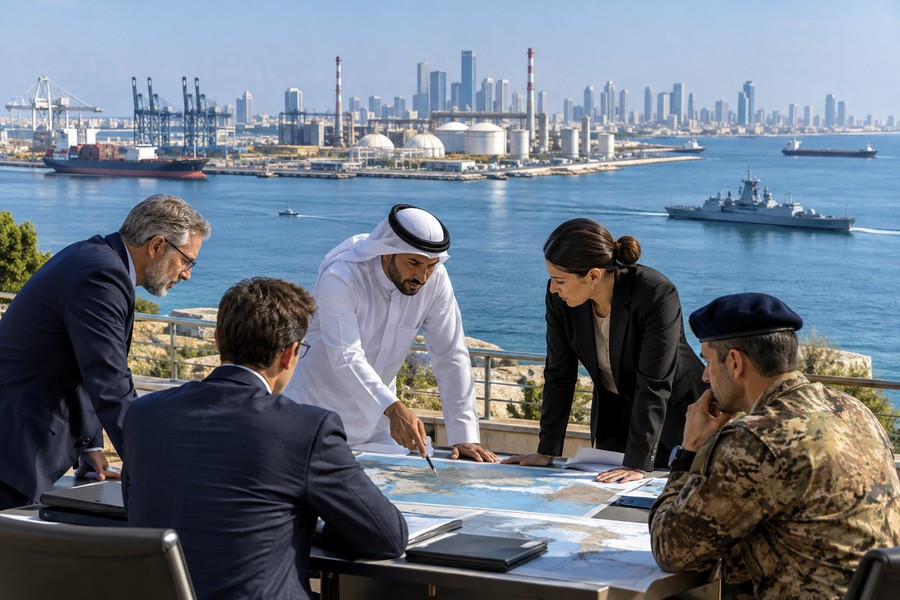
New Research Examines Power and Security Across the Gulf and Beyond
A new collection of research looks at how changing conflicts and rivalries are reshaping the Gulf and the wider region. Its central question is how countries can turn resources and advantages into lasting security and influence.
The studies consider several parts of national power: wealth, location, military strength, public institutions, education, and technology. They examine how these factors affect a country’s ability to protect its interests as conflicts grow and the balance of power shifts.
The Gulf’s Changing Strategic Role
An opening essay argues that international and regional change is shifting power among countries. It says that wealth or military strength alone may not be enough. Countries also need effective institutions, strong relationships, and the ability to respond to crises.
The Gulf is a key part of this changing landscape. Its energy resources and location give it strategic importance, while nearby conflicts and rivalries continue to affect the region. The collection asks how Gulf countries can use their strengths to protect their security and shape events around them.
Protecting Energy and Trade
One study focuses on the economic risks facing Gulf countries during conflict. It examines how they can protect their resources and keep exports moving to global markets. The Strait of Hormuz and the Bab el-Mandeb Strait receive special attention because both are important routes for ships.
Disruptions at sea can affect more than shipping schedules. Higher insurance costs and interruptions to trade may weaken energy security and economic stability. The study argues that energy security should include the safe transport, export, and storage of energy, not just the supply itself.
It also points to steps that could help countries withstand future shocks:
- Build stronger cooperation among Gulf countries.
- Develop more routes for exports.
- Improve the ability to manage crises and shipping disruptions.
Turning Wealth Into National Strength
Another study examines Qatar’s development under Sheikh Hamad bin Khalifa Al Thani. It looks at how the country’s gas wealth was matched with investment in education, health care, infrastructure, and state-owned assets.
The study also considers the use of diplomacy, investment, culture, sports, and media to raise the country’s profile around the world. It describes this period as a major institutional and strategic shift, with effects that continued beyond the end of his rule.
Military Power Has Limits
Two studies explore Israel’s security approach and the limits of military strength. One compares the geographic conditions affecting Iran and Israel after conflicts in 2025 and 2026. It considers Israel’s view of threats, Iran’s strategic depth, and the lack of a strong Arab role as factors that shape what either side can achieve.
The study argues that military advantage does not always lead to lasting political or security gains. Geography can restrict how far force changes the balance between countries.
A separate analysis looks at changes in Israel’s security strategy after the attacks of October 7. It describes a growing focus on using military force to remove threats. But it also points to a lasting gap between battlefield gains and broader strategic aims, along with rising military, economic, and political costs.
Sea Routes and International Trade
A book review examines the importance of narrow waterways, or straits, to world trade and energy security. It looks at how crises or blockages along these routes can affect the global economy.
The review also argues that these waterways should be understood through the interests of nearby countries and communities. With cooperation, they could support regional ties and shared prosperity, rather than serving only as points of competition.
Influence Through Ideas and Technology
One study explores how China presents itself in the Middle East and how people in Arab countries view its ideas about development, politics, and the world order. It finds that China is increasingly seen as an economic and political partner. Some Arab views also make use of language and ideas associated with China, reflecting changes in international influence.
Another study considers whether artificial intelligence and large collections of data can help predict conflicts linked to climate change and natural resources. It introduces the idea of “algorithmic climate security,” which involves using computer systems to anticipate risks.
The study says this approach also raises important questions about who controls the data, who sets the rules for its use, and whether countries and communities have fair access to knowledge and technology.
Building Stronger Institutions
A final analysis looks at efforts by the African Union to fight corruption. It reviews legal and institutional tools created across the continent, as well as the difficulties of putting those tools into practice.
The analysis stresses that creating laws and institutions is only the first step. Countries also need to enforce rules, work together across borders, recover stolen assets, and limit illegal flows of money.
A Shared Challenge
Together, the studies examine how countries can turn their resources, location, institutions, and knowledge into lasting power. They show that wealth and military strength matter, but neither guarantees security or influence on its own.
For Gulf countries, the challenge is to protect their interests, prepare for sudden disruptions, and increase their choices during periods of tension. Their ability to do so will help shape both their own future and the wider strategic environment.