
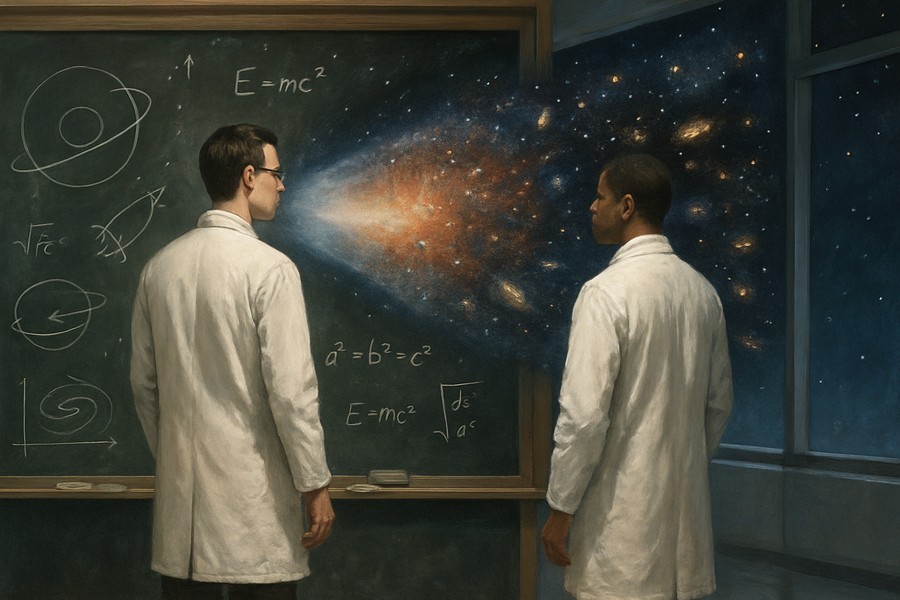
Revolutionary Ideas Transform Our Understanding of the Universe's Origins
One of the deepest mysteries in the realm of physics is the challenge of uniting two successful but incompatible theories: quantum mechanics and general relativity. A fresh perspective offers a promising solution by tying these theories to the most significant event in the universe's history - the Big Bang.
Revisiting the Big Bang with a New Lens
Researchers in Canada have come up with a bold new idea about the universe's rapid expansion during its earliest moments. Their innovative theory, known as quadratic gravity, aligns with a model for quantum gravity and presents a fresh take on Einstein's standard theory of gravity.
The co-author of the study, a theoretical cosmologist, describes this approach as "Einstein raised to the second power." He further explains that the work builds a bridge between formal quantum field theory calculations and actual cosmological scenarios and observations. This connection enables the testing of these theoretical ideas and calculations.
An Overview of the Universe's Initial Stage
The Big Bang is a term used to describe the colossal explosion that laid the foundation for the universe to evolve into what we see today. In the standard view, the universe began small, hot, dense, and generally homogenous and isotropic.
The inflationary scenario, a popular explanation for this occurrence, holds that a hypothetical particle called the inflaton drove a "burst of rapid, accelerated expansion" in the universe's earliest days. However, this theory encounters problems as we trace back to earlier astronomical times, corresponding to higher energy levels in the universe.
Seeking a Quantum Explanation
The research team pondered a way to describe the Big Bang without introducing too many new variables. If they could incorporate quantum effects into this explanation, it would be even better. They settled on the concept of quadratic gravity, which remains mathematically consistent even at very high energy levels, like those during the Big Bang.
Interestingly, the team's calculations showed that the quadratic components of the model naturally sparked cosmic expansion. After this event, the structure of spacetime settled into the familiar effects of general relativity. Additionally, the study's mathematical predictions align well with the latest technologies' observations of the universe, which have been in disagreement with more mainstream inflation models.
A Hypothesis That Can Be Tested
One of the most notable aspects of the team's theory is that it can be tested, which is not typically the case with quantum gravity models. The model predicts a minimum level of gravitational waves produced during inflation, which upcoming detectors should be able to capture.
The senior author of the study, a physicist, pointed out that quantum gravity is often portrayed as "purely theoretical." However, this new approach demonstrates that quantum gravity can indeed be studied and applied to specific cosmological scenarios. These come with specific predictions that can be tested now and in the future.
Awaiting a Game-Changing Discovery
Undoubtedly, if the team's results can be confirmed, both theoretically and empirically, the impact will be groundbreaking. However, like any prediction, nothing can be definitively stated until the new suggestion undergoes independent review and experimentation.
Despite this, it is an exciting time for cosmology. The next-generation detector capable of testing the team's predictions is set to launch in the near future. Other telescopes and observatories are providing astronomers with a wealth of observations. So, even if this latest proposal doesn't prove to be "the one," we might be entering a period that allows us to move the theoretical into the realm of testable ideas. And that, indeed, is thrilling!