
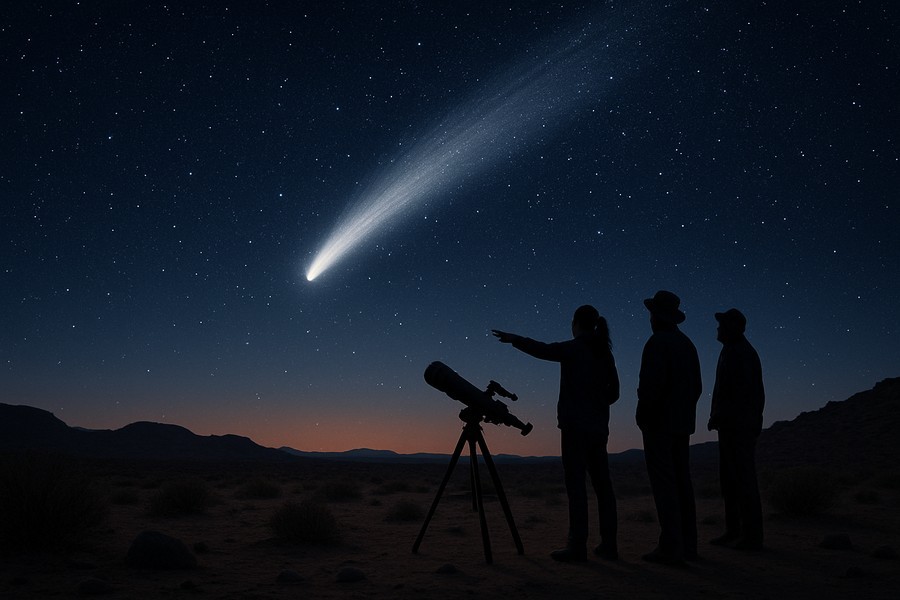
Newly Spotted Comet Could Shine Brightly in the Sky This Spring
Stargazers are buzzing with anticipation over the recent discovery of a comet that could become a remarkable spectacle in the sky around early April. This comet was found by four passionate amateur astronomers using a remote-operated telescope in a desert.
The newly spotted celestial object is part of a group known as the Kreutz sungrazing comets, which includes some of the most dazzling comets ever observed. This group of comets follows a highly elongated orbit around the Sun, and this particular comet is currently headed towards a close encounter with our star. Come early April, it's expected to pass a mere 120,000km from the Sun's surface.
If the comet manages to survive this close encounter, it could offer a breathtaking view in the evening sky. There's even a chance it could be visible in broad daylight, provided it doesn't disintegrate in the meantime.
The Thrill of Sungrazing Comets
What makes these sungrazing comets so thrilling? Over the past 2,000 years, several stunning comets have made unexpected appearances in our skies, shining incredibly close to the Sun. Some have even been bright enough to be seen in broad daylight. The most luminous of these are often dubbed "Great Comets".
One such Great Comet was seen in 1965, which turned out to be the brightest comet of the 20th century. Found just one month before its closest approach to the Sun, it shone as brightly as a full moon and was clearly visible during the day. An even more remarkable comet was spotted in 1882, which at its peak was a hundred times brighter than a full moon and lit up the sky for several months.
Interestingly, all these bright comets from the past two thousand years share a common background. They all originated from a colossal comet nucleus, more than 100km in diameter, which came dangerously close to the Sun's surface at some point in the distant past. After this close encounter, the comet broke apart into two major fragments and a number of smaller pieces.
These pieces have returned several times over the centuries, sometimes even appearing as multiple comets visible in broad daylight. The biggest remaining fragments of this ancient mega-comet returned in the 11th century, becoming the Great Comets of 1106 and 1138. These pieces fragmented yet again, and the resulting fragments have been observed as a series of comets over the past two centuries.
Anticipating the Next Big Show
The Kreutz sungrazing family now contains a vast number of smaller comets, which often disintegrate while approaching the Sun, as well as larger fragments which can create mesmerizing displays. Thousands of Kreutz fragments have been detected over the years, with larger fragments appearing less frequently. The last notable Kreutz sungrazer was seen in 2011, which put on a dazzling show after barely surviving its close encounter with the Sun.
Given the history of these comets, it's expected that we might see two large, spectacular sungrazers in the near future, possibly within the next few years. These would be related to the Great Comets of 1965 and 1882, and fragments of the Great Comet observed by Chinese stargazers in 1138.
Introducing the Newly Discovered Comet
This brings us to the newly discovered comet, which follows an orbit typical of Kreutz sungrazing comets. At the time of its discovery, it was farther from the Sun than any previously discovered sungrazer. This suggests it might be a larger-than-usual fragment—potentially.
The previous record holder for this distinction was the comet spotted in 1965, which became the brightest of the 20th century. However, given advancements in technology over the past 70 years, it's unlikely that the nucleus of the newly discovered comet is as large. Consequently, it's less likely to be as bright.
Still, the fact that it was discovered early suggests it could be a reasonably large Kreutz fragment, or it's already starting to disintegrate. Recent observations have shown it steadily brightening, which supports the former theory.
What Can We Expect from This Comet?
At this stage, it's too early to say for certain. If the comet survives its closest approach to the Sun, it could put on a spectacular display in early to mid-April. It might even become bright enough to be seen in broad daylight. In the days following its closest approach, the comet will move into the evening sky and should be easier to see from the southern hemisphere.
If the comet holds together until its close encounter with the Sun and then breaks apart, it could brighten suddenly and unexpectedly. A late disintegration might be the best-case scenario for a breathtaking spectacle. For now, all we can do is wait and watch.
