
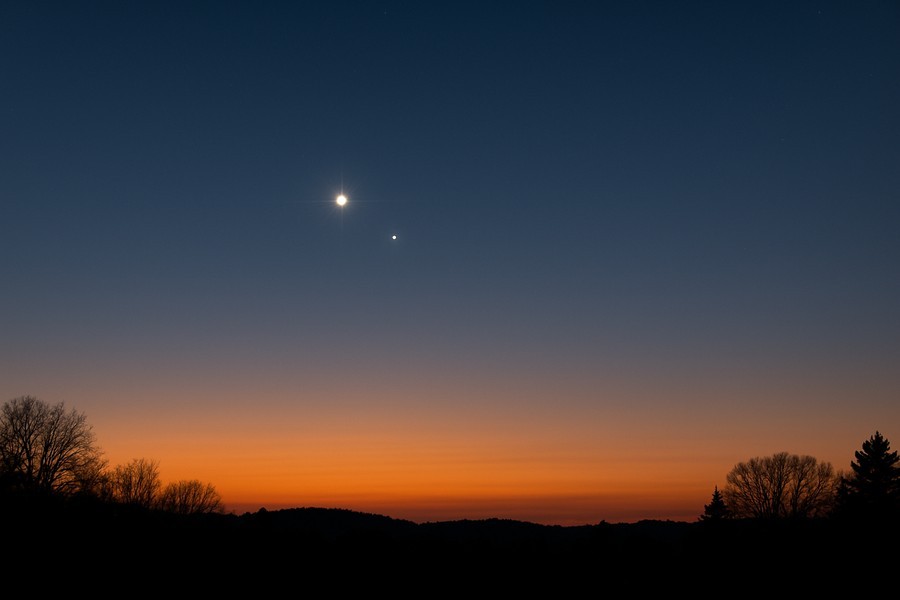
A Glimpse into the Heavens: The Weekend's Celestial Dance
Prepare for a star-studded show as Venus takes center stage, passing Saturn in the evening sky. This stellar spectacle kicks off a weekend of celestial happenings.
Setting the Stage: Venus and Saturn in a Dusk Conjunction
Since the start of the year, Venus has been steadily climbing higher in the evening sky, transitioning from the glare of the sun to its prominent position as the "Evening Star." Meanwhile, Saturn has been gradually descending after dominating the night sky for half a year. This weekend, these two celestial bodies will perform a close pass, coming within approximately the width of an outstretched little finger. To join the audience, simply look westward about 45 minutes after sunset to witness Venus and Saturn's twilight conjunction.
An Encore Performance: Venus Ascends above Saturn
Missed the first show? Don't worry. You have another chance to see Venus and Saturn in conjunction. The roles reverse as Venus ascends above Saturn, further establishing its reign as the "Evening Star." By the end of the month, Saturn will join the sun in a conjunction, making its rise into the pre-dawn sky next month.
Interplanetary Light Show: The Zodiacal Light
Have you ever witnessed our solar system's glow? For the next couple of weeks, if you can find yourself in a dark location, you may be able to spot the zodiacal light. This phenomenon is a result of sunlight scattering off interplanetary dust in the plane of our solar system, particularly in the asteroid belt between Mars and Jupiter. It appears as a triangle of light above the sunset point in the west, roughly an hour after the sun goes down.
The Morning Moon and Spica: A Pre-Dawn Spectacle
The waning gibbous moon at 91% illumination will shine a couple of degrees from Spica, the brightest star in the constellation Virgo. This spectacle will be visible in the southeast late in the night until about an hour before sunrise, when Spica will disappear, leaving a visible "morning moon" hanging above the southwestern horizon.
Farewell to Winter Constellations
As the 98% waning gibbous moon rises in the east after sunset, turn your gaze southwest to see the familiar winter constellations of Orion, Taurus, Auriga, Canis Minor, and Canis Major and Gemini sliding slowly towards the western horizon. Accompanied by Jupiter, these bright winter stars will soon give way to spring's constellations in the early evening sky.
Lunar Spectacle: A Total Lunar Eclipse
In the early hours before dawn, a total lunar eclipse will transform the full "Worm Moon" into a "blood moon." Only the western half of North America, the Pacific region, Australia, New Zealand, and east Asia, will witness the entire event, which lasts for 5 hours and 38 minutes. The highlight will be a spectacular 58-minute-long totality. The moon will be high in the southwest during totality, while farther east it hangs low in the west. No eye protection is needed for one of skywatching's most glorious events.
Planetary Parade: Venus, Saturn, and Mercury
As the sun sets, look westward for a trio of planets on the verge of parting ways. Venus, the most prominent, blazes brightly as it ascends in the post-sunset night sky. Below and to the right of Venus is Mercury, far dimmer and slipping back into the sun's glare. Above both is Saturn, also heading towards the sun's glare.
Almost Full Moon and the Star Regulus
The moon is nearly full and poised for a significant event. As twilight sets in, the 97%-illuminated moon will grow brighter, with Leo's brightest star, Regulus, emerging below it. This is a perfect time to familiarize yourself with the scene, as in just a couple of nights, the moon will turn a coppery-red during a dramatic total lunar eclipse.