
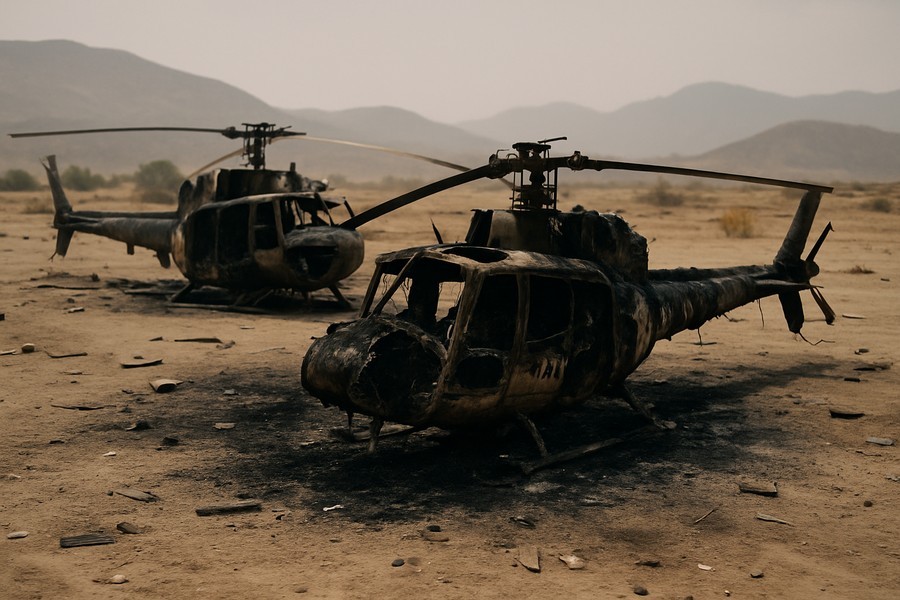
Special Ops Helicopters Found in Ruins at Makeshift Airfield in Iran
Recently, new photographs have surfaced showing the wreckage of specialized military aircrafts at an improvised airfield in Iran. The makeshift airstrip was used as a central operation point for a rescue mission of a downed F-15E Weapon System Officer. The wreckage notably includes two charred remains of MH-6/AH-6 "Little Bird" helicopters, associated with the 160th Special Operations Aviation Regiment, often referred to as the Night Stalkers.
Authenticity of the Crash Site
The images of the crash site seem to be authentic upon initial inspection, however, this could change as further investigations are conducted. The destroyed helicopters, if in AH-6 configuration, were likely transported to the landing site to provide close air support and force protection for the larger force established there.
The Role of the Little Birds
The "Little Birds" helicopters could have been utilized in two ways. If in the AH-6 attack configuration, they could have been used for close air support and force protection. They could have also been instrumental in locating and aiding the extraction of the pilot if they were in the MH-6 assault configuration. These small but mighty helicopters are versatile and can be swiftly transported to forward locations aboard aircraft as compact as a C-130. Their ability to be deployed and airborne within minutes makes them an ideal choice for this type of mission.
The helicopters could have potentially flown directly to the site, refueled from the MC-130J on the ground, and then operated out of the makeshift base. However, the range of these aircraft is limited, even with additional fuel tanks. Despite the risks and limitations, a direct flight over Iranian airspace seems likely given the circumstances.
The Mystery of the Destroyed Helicopters
It remains unclear why the "Little Birds" were left in ruins. The extraction of the force was likely completed in a rush due to the immobilization of two C-130s. If the helicopters were transported on these aircrafts, there may not have been sufficient time or space to load them onto the replacement aircraft. They could have also been damaged by enemy fire or might not have been refueled due to the damaged MC-130s if they flew in directly. Multiple scenarios are plausible.
Nonetheless, the destruction of stranded special operations aircraft is essential as they are often equipped with sensitive sensors, communications, defensive systems, and more. The inclusion of the "Little Birds" in this mission is a testament to the complexity of the operation, which was executed within just a few hours. It also emphasizes their versatility and ability to be quickly deployed.
Location of the Landing Zone
The landing zone has been identified as being just south of Isfahan, placing it approximately 200 miles away from the Iranian coastline and roughly 230 miles from a land border. Given the tactical issues and the distance, it is highly unlikely that the "Little Birds" made this trip on their own.
