
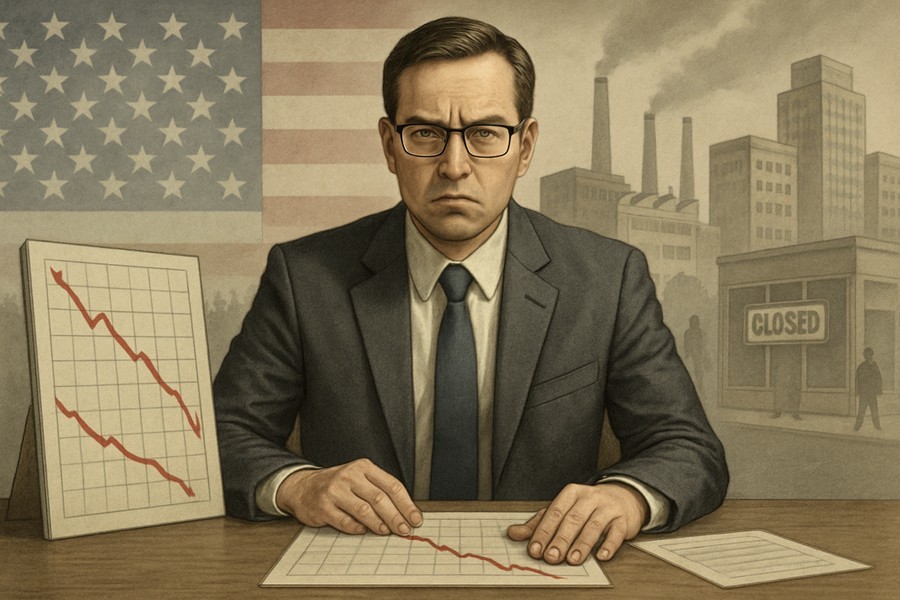
A Renowned Economist Predicts a Downturn in the US Economy
A prominent American economist has voiced concern about the future of the US economy. The economist, who has received a Nobel prize and teaches at Columbia, expressed his worry about the weakening state of the US economy during a recent discussion about his macroeconomic forecast. He cited three main concerns that are casting a shadow over the US economy: tariffs, the decrease in jobs, and interest rates.
"Right now, it's not looking good and the future seems even bleaker," he said, sharing his economic forecast.
Despite his pessimistic views, recent statistics show that the US economy is growing. The Gross Domestic Product (GDP) increased by an impressive 4.4% in the third quarter and is predicted to have grown by another 3% year-over-year in the fourth quarter, based on the latest forecasts from the Atlanta Fed.
However, the economist suggests that there are several hidden factors indicating that the economy may not be on a sustainable trajectory. Here are the reasons for his negative forecast:
1. Tariffs Could Lead to Inflation That Hits Low-Income Consumers Hardest
The future of the current administration's tariffs is uncertain, pending a Supreme Court decision. However, if they remain in place, many economists predict that these import taxes will drive up prices for consumers. Even more concerning, the economist argues, is that the inflationary effects of tariffs are regressive. This means that lower-income consumers are likely to be affected most severely.
A study conducted by The Budget Lab at a prestigious university shows that in the short term, tariffs are anticipated to have the greatest impact on the poorest 10% of US households. It is predicted that their disposable income will be reduced by approximately 3.5 percentage points.
"When you consider who is really paying these tariffs, it's the people with the smallest incomes," said the economist. "It's regressive and it's distortive."
2. A Decrease in Manufacturing and Blue-Collar Jobs
The current administration has claimed that tariffs would stimulate a resurgence in the US manufacturing sector. However, the economist disagrees, stating that the employment data does not reflect any signs of recovery. Manufacturing is one of the largest industries in the US, accounting for about 10% of the GDP.
Employment in the manufacturing sector has been on a decline for over two years, based on data from the Labor Department. "Job losses in blue-collar industries are even more significant," the economist pointed out. "There's a clear discrepancy between their claims and the actual results."
3. Troubling Predictions for Interest Rates
The economist also expressed concern about the current administration's push to reduce interest rates. He referred to recent remarks from the nominated Federal Reserve Chair, who claimed that artificial intelligence could lead to productivity growth in the US. This could potentially allow the economy to grow without causing inflation, suggesting that there might be scope to lower interest rates more than currently anticipated.
The economist found these comments particularly unsettling. Investors are worried that the central bank may lower rates prematurely, which could eventually lead to rampant inflation. Moreover, if the Federal Reserve is perceived to be cutting rates due to political pressure, it could damage its credibility and destabilize inflation expectations.