
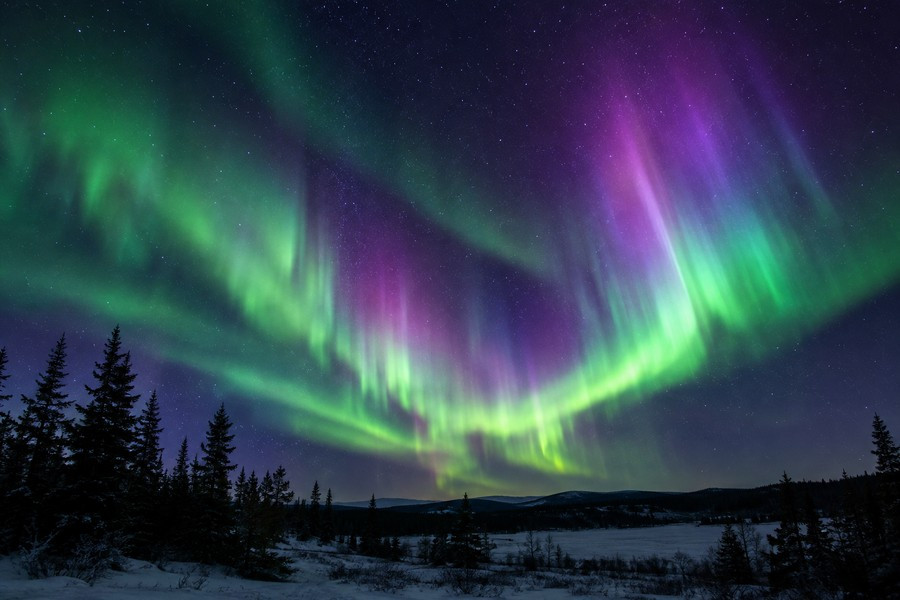
Northern Lights Could Stretch Across Much of the Northern U.S.
People across parts of the northern United States may have a chance to see the aurora borealis, also called the northern lights, during the upcoming weekend. A burst of activity from the sun could create a geomagnetic storm strong enough to make the colorful sky display visible much farther south than usual.
A Solar Storm Is Moving Toward Earth
Space-weather forecasters have issued a watch for a moderate G2 geomagnetic storm. The storm is linked to two large eruptions from the sun called coronal mass ejections, or CMEs.
A CME is a cloud of solar material and magnetic energy released into space. In this case, two eruptions moved away from the sun one after the other. The faster cloud is expected to catch up with the first one as both travel toward Earth.
When these clouds reach Earth, they may disturb the planet’s magnetic field. That disturbance can create the conditions needed for auroras to appear in areas that normally do not see them.
Where the Lights May Be Visible
The best chances are expected across northern states and parts of the upper Midwest. The possible viewing area may stretch from New York west to Idaho.
That broad area includes places far from the Arctic Circle, where the northern lights are usually easier to see. A moderate storm can push the aurora farther south, giving more people a chance to spot it.
Still, the forecast does not promise that every location in those states will see the display. The storm could become weaker or stronger than expected, and local conditions will also play a major role.
- Cloudy skies may block the aurora completely.
- Bright city lights can make the display hard to see.
- The lights may be easier to view away from towns and highways.
- The aurora may appear only for a short time.
- The strongest colors may be visible through a camera before they are clear to the human eye.
What Creates the Northern Lights?
The northern lights begin with activity on the sun. The sun constantly sends energy and tiny charged particles into space. During a solar eruption, it can send a much larger amount of material and magnetic energy toward Earth.
Earth is surrounded by a magnetic field that helps protect the planet from much of this solar activity. When the incoming particles reach that magnetic field, some are guided toward the north and south poles.
As the particles enter the upper atmosphere, they collide with gases high above Earth. Those collisions release energy as glowing colors in the sky. The result can be waves, arcs or shifting bands of light.
Green is one of the most common aurora colors, but strong displays may also include red, pink, purple or blue. The final appearance depends on the type of gas involved and how high in the atmosphere the activity occurs.
How Strong Could the Storm Be?
Geomagnetic storms are measured on a scale from G1 to G5. A G1 storm is considered minor, while a G5 storm is extreme.
The higher the storm level, the greater the chance that auroras will spread away from the polar regions. A G2 storm is classified as moderate. It may be powerful enough to bring the northern lights into view across parts of the northern United States, but visibility will depend on the storm’s actual strength.
The best viewing conditions usually include a dark location, clear skies and an unobstructed view toward the northern horizon. People hoping to see the display should give their eyes time to adjust to the darkness and avoid looking at bright screens for several minutes.
Even when the aurora is not obvious to the naked eye, a phone camera may capture faint colors in the sky. The display can change quickly, so viewers may need patience while watching for movement or brighter bursts of light.