
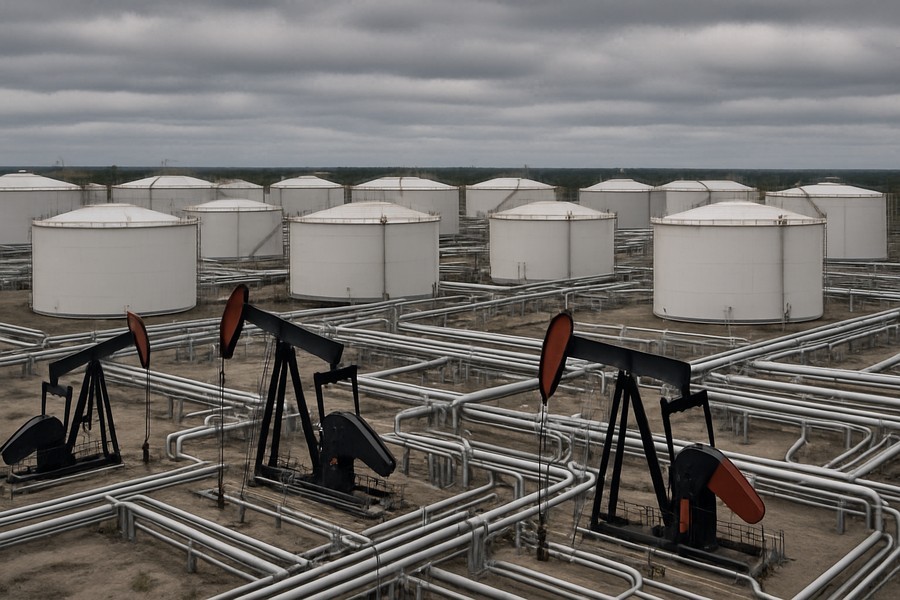
Excess Supply Is Oil's Biggest Challenge, Not Geopolitical Tensions
Despite geopolitical tensions causing some fluctuations, crude oil prices are primarily being dragged down by an oversupply in the market. Previously, the potential for U.S. military action against Iran had caused prices to spike. However, this upward trend was short-lived, and prices fell once again, highlighting the powerful influence of basic market fundamentals over temporary geopolitical events.
Oil Market Fundamentals
Industry experts agree that there is currently a significant surplus of crude oil, with supply far outweighing demand. One leading financial institution has revised its oil price forecasts for the future, predicting a further decrease in prices. This downward revision comes after the value of Brent crude oil fell by around 20% last year.
The institution's forecast of a 2.3mb/d surplus suggests that to bring the market back into balance, lower oil prices may be necessary to curb non-OPEC supply growth and encourage increased demand. These predictions were made in the midst of unrest in Iran, which had been pushing prices upwards temporarily.
The United States' control over Venezuela's oil industry has had a negative impact on oil prices. The U.S. reportedly sold the first batch of Venezuelan crude for $500 million, with more sales expected to follow. This additional supply bolsters the case for a downward trend in prices. However, warnings from oil industry executives about the potential for a swift recovery in Venezuelan oil production have tempered this bearish outlook.
Geopolitical Tensions and Oil Production
Recent drone attacks on three tankers in the Black Sea have raised fears of further supply disruption. These attacks have also led to a dramatic 35% drop in Kazakhstan's oil production. The country has called on the United States and the European Union to assist in securing oil transport in the Black Sea.
The European Union is reportedly planning to further reduce its price cap for Russian oil. This move is intended to decrease Russia's oil revenues by linking Western insurance coverage to the price cap. The new price cap will be $44.10 per barrel. Although the price caps have not significantly affected Russia's budget so far, the EU views them as an effective strategy to damage Russia's economy and pressure it to withdraw from Ukraine.
Fluctuating Oil Prices Amidst Uncertainty
President Donald Trump had sent a signal suggesting the possibility of a military strike against Iran, causing a temporary increase in oil prices. However, this was quickly overshadowed by his subsequent comments that the Iranian government was reducing its repression of protestors, thereby reducing the likelihood of a military strike. This led to a retreat in oil prices, showing that the dominant narrative in the oil market is one of oversupply.
Forecasts for future oil production indicate continued growth, even as OPEC halts its rollbacks of production cuts implemented to boost prices. Despite this, shale drillers have indicated their discomfort with prices closer to $50 than $60, and production growth is slowing. U.S. oil production predictions suggest a leveling off, or even a slight decrease, in the coming years.
Ignoring the Reality of Oversupply
Despite U.S. oil production being a key driver of bearish market predictions, the market seems to be dismissing the fact that rapid growth in production has now stalled. The consensus appears to be that the world already has too much oil. This belief is supported by data showing that approximately 1.3 billion barrels of crude were floating in December, the highest figure since 2020.
However, it's important to note that a quarter of this oil comes from Russia, Iran, and Venezuela - countries facing sanctions. This oil takes longer to find buyers due to these sanctions, but it does eventually sell. As a result, the number of barrels on tankers may not be the most accurate measure of a physical surplus, especially considering newly released data showing record oil imports into China last month and throughout the past year. However, due to conflicting narratives and agendas, predicting oil prices remains a challenging and often unreliable task.