
What Gaza’s Peace Plan Has Delivered After One Year
A year after a peace plan was created to end the war in Gaza, Palestinians are still facing deadly attacks, forced displacement, hunger, and a lack of safe shelter. Israeli forces have expanded their control over parts of the territory, while promised aid and rebuilding efforts have fallen far short.
A Plan Promising Peace and Recovery
The peace plan was designed to create a path toward an end to the war and, eventually, Palestinian statehood. It called for Israeli forces to pull back to about half of Gaza and stop air and artillery attacks.
The plan also required Israel to release 250 Palestinian prisoners and 1,700 other people from Gaza who had been jailed since the conflict began. Border crossings were supposed to reopen so food, medicine, shelter, and other aid could enter more freely.
Hamas was required to release all Israeli captives. A later stage of the plan called for the group to give up its weapons. Its members could receive amnesty or be allowed to leave Gaza safely.
A temporary governing body was created to oversee Gaza until the Palestinian Authority could take control. A proposed international security force, led by the United States, was also expected to replace Israeli troops as they withdrew.
The plan included a major rebuilding effort for Gaza, where homes, hospitals, schools, roads, and other key services have been destroyed.
Money and Projects Have Been Announced
The peace board held its first major meeting in Washington, where member countries promised $7 billion for Gaza. Humanitarian groups have estimated that rebuilding the territory could cost closer to $70 billion.
The board later presented a recovery plan with 66 projects valued at $2.4 billion. The projects were intended to support housing, public services, infrastructure, and economic recovery.
These announcements have not yet brought major changes to daily life in Gaza. Large parts of the territory remain damaged, and many families continue to live in temporary shelters.
Some Parts of the Agreement Were Completed
Hamas released all 168 living Israeli captives. Israel also released Palestinian prisoners. Hamas announced that it would dissolve its government in Gaza, though Israel rejected the announcement as meaningless.
Other parts of the plan have moved slowly or remain unfinished. A Palestinian committee was formed to manage Gaza during the transition. However, the committee has not been allowed to enter the territory and continues its work from Cairo.
The committee is led by Ali Shaath and other Palestinian experts. It reports to the peace board and was supposed to help run public services and prepare Gaza for future Palestinian administration.
Aid Is Still Far Below the Needed Level
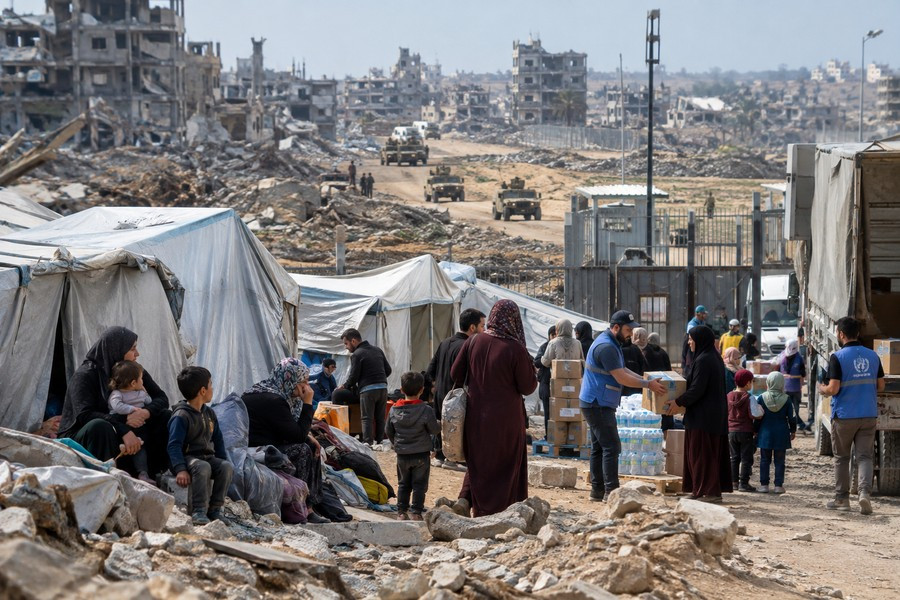
About 227 aid trucks enter Gaza each day, even though the plan called for 600 trucks. The limited flow has made it difficult to provide enough food, water, medicine, fuel, and other supplies.
Israel has blocked or limited thousands of basic items by labeling them as having possible military and civilian uses. These items include tents and ventilators needed by people living in damaged homes and crowded shelters.
About 1.4 million Palestinians, most of Gaza’s population of more than 2 million, are expected to face hunger. That number is higher than the number facing hunger several months earlier, showing that the crisis has become worse.
Fighting and Displacement Continue
The largest failure has been the inability to stop the violence. Israeli attacks have continued almost every day. More than 1,400 Palestinians, most of them women and children, have been killed since the ceasefire began.
More than 74,000 Palestinians have been killed since the war started, while thousands of others are missing and believed to be buried under destroyed buildings. Israel says its attacks target Hamas members. Hamas rejects that claim.
Israeli forces now control about 60 percent of Gaza, exceeding the 50 percent limit set by the peace plan. A marked boundary known as the Yellow Line has moved farther into Gaza, forcing more Palestinians into smaller and more crowded areas.
People who cross the line without realizing it have been shot and killed. Israel’s defense minister has also said that Israeli forces will never completely leave Gaza.
Disarmament Has Reached a Deadlock
The continued attacks and Israeli control have prevented the plan’s second stage from beginning. Hamas has agreed to hand over its weapons to the Palestinian committee but refuses to fully disarm while Israeli forces remain in Gaza and attacks continue.
Israel, in turn, has said it will not continue with the peace process unless Hamas disarms. The two sides remain locked in a dispute, leaving the next stage of the plan stalled.
No international stabilization force has been sent to Gaza. Indonesia, Morocco, Kazakhstan, Albania, Kosovo, and Uganda have offered personnel for a planned force of 20,000 soldiers and 12,000 police members under American military leadership.
Rebuilding Has Barely Started
There has been no major rebuilding effort. Many Palestinians still live in tent camps exposed to extreme heat and heavy rain. Rodents and insects are common, and families have little protection from the weather.
The peace board has also chosen not to work with the United Nations agency that has long provided food, schools, health care, social services, and emergency aid to Palestinians. The agency employs about 11,000 Palestinians and has played a major role in Gaza for many years.
Its international mandate has been extended through 2029, while the peace board is expected to oversee the process through 2027 before its future is reviewed.
After a year, the peace plan has produced prisoner releases, funding promises, and project proposals. But it has not stopped the attacks, delivered enough aid, begun meaningful rebuilding, or created stable government and security in Gaza. For millions of Palestinians, the promised peace has not become a reality.