
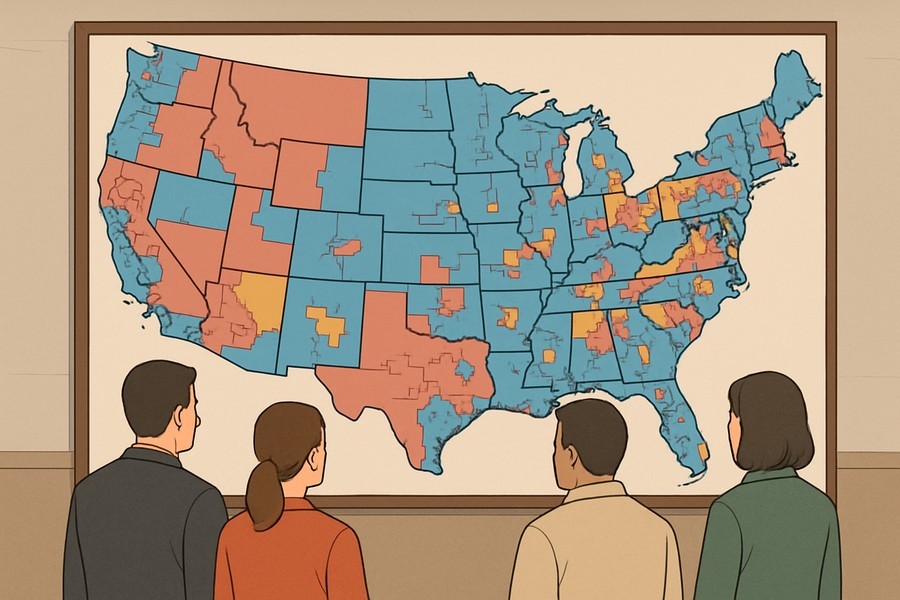
Shrinking Competitive Races: Implications of Redrawing District Boundaries
Recent changes in the political landscape have led to a decrease in competitive races for congressional seats. This shift is primarily due to the redrawing of district boundaries, an initiative largely driven by the last presidential administration. This phenomenon is raising concerns about the democratic process, as it may limit the power of voters in general elections.
Decreased Voter Participation in Competitive Races
Competitive races for congressional seats are becoming increasingly scarce, with over 90% of races expected to be decided in the primaries, which typically see less voter participation than general elections. In fact, less than 5% of American voters are predicted to have a real say in determining the control of the House of Representatives.
This growing disparity in voter influence in congressional races has been worsening over several election cycles. Research shows that in 2024, only 7% of voters elected 87% of the House races. The decreasing number of competitive seats is a significant concern for democracy.
Factors Contributing to Non-Competitive Races
Several factors are contributing to the decline in competitive races. One main factor is the geographic distribution of voters. Over time, voters have naturally grouped themselves in ways that favor one political party over another. Additionally, advancements in technology have enabled lawmakers to redraw congressional districts more accurately, giving one party an edge over the other.
One organization that advocates for election reforms says that 32 states currently do not have a single competitive congressional race. The organization's executive director cites the recent redrawing of district boundaries as a primary reason for this phenomenon.
The reshaping of districts has not given a clear advantage to either political party, but it has significantly reduced the number of competitive districts. The new boundaries have essentially eradicated the districts where Americans can influence who controls Congress.
Implications of the Shift in Competitive Races
Even including districts that lean toward one party or another, the total number of competitive seats is less than 10% of the House. This situation is a stark contrast to the first term of the previous presidential administration, where there were 48 competitive races. The new district boundaries, especially those in states like California and Texas, are largely responsible for this change.
This trend of decreasing competitive races and increasing polarization of state delegations is limiting opportunities for bipartisan dialogue. The primary voters, who now wield significant power, are not representative of the broader American electorate. They are typically older, wealthier, more educated, and more ideologically extreme than the average American.
Efforts to Increase Voter Participation
There are concerns about the democratic implications of this shift in power. The fact that a small number of voters now have significant influence over what party controls Congress is problematic. Efforts are being made to open primaries to independent voters, the fastest-growing part of the U.S. electorate, to counter this issue.
For instance, New Mexico now allows non-affiliated and independent voters to participate in party primaries. However, some states like Louisiana and West Virginia have moved in the opposite direction, restricting some primaries to registered party members only. Currently, 17 states have either completely closed or partially closed primaries.
Despite several ballot measures proposed in states like Arizona, Colorado, Nevada, and Oregon to establish nonpartisan primaries, none have succeeded. Advocates argue that nonpartisan primaries or including independent voters in party primaries would allow more voters to participate in the most influential elections.
Looking Ahead
As more states reduce the number of competitive seats, the future of the democratic process becomes more uncertain. The lack of competition in the upcoming elections might lead to increased dysfunction and division in the next congressional session.