
Health Workers in Lebanon Suffer Fatalities: Accusations of Deliberate Targeting Emerge
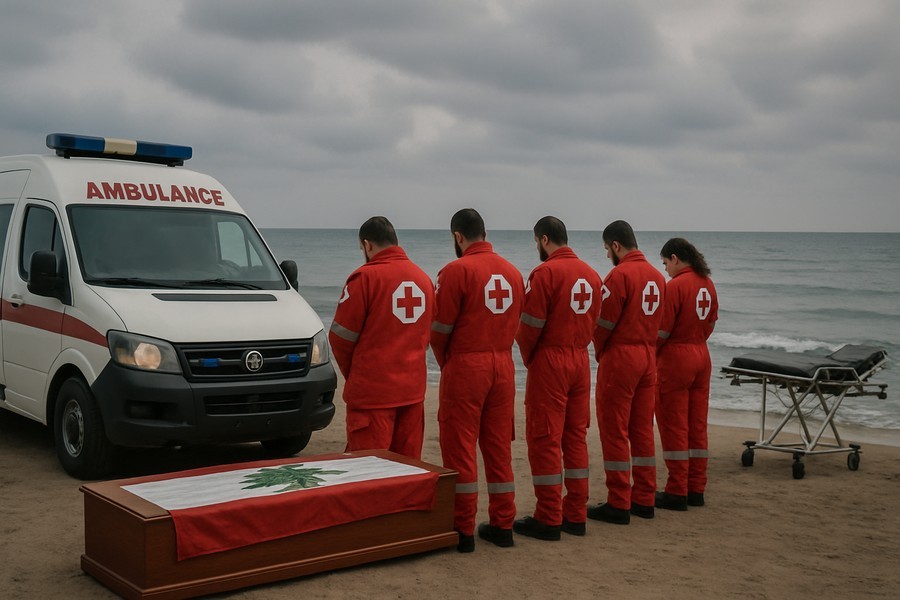
In Lebanon, a somber scene unfolds as many medics don their crimson uniforms and mourn a fellow medic. The person they are mourning, a volunteer paramedic, tragically lost his life during an airstrike while on a rescue mission in the southern part of the country. The heartbreaking loss of this medic is echoed by the cries of his mother, which fill the air during his seaside funeral procession.
The government of Lebanon has reported that this medic was not the only casualty. It claims that over 54 healthcare personnel are among the more than 1,400 lives claimed by Israel during the ongoing conflict. Human rights groups add to the accusations, suggesting that first responders are being specifically targeted, an allegation that Israel firmly rejects.
Protocol and Controversy
In the aftermath of any attack, Red Cross ambulances rush to the scene and immediately relay their coordinates to the United Nations' peacekeepers, who then inform Israel. This procedure was followed on the day the volunteer medic was killed. He had exited his ambulance to aid the injured when another attack struck.
In the wake of this tragic incident, the director of emergency medical services for the Red Cross questioned Israel via the same communication channel. He received no response.
Israel's Defense
Israel's military offered an explanation, stating that their target on that fateful day was a building used for military purposes. They claim that unidentified individuals arrived at the location after the weapons were discharged and before the impact, but these people were not intentionally targeted. They further reinforce that they had no knowledge of any Red Cross personnel being present in the area and certainly had no intention of striking them.
Accusations of a Pattern
Despite Israel's defense, Lebanese officials and human rights groups suggest a pattern of attacks targeting medics. They point out that when ten health workers lose their lives within a 24-hour window, it becomes hard to label these incidents as accidents.
At the end of March, ten health workers were reported to have lost their lives within a single day due to Israeli assaults, according to the Lebanese government and the World Health Organization. The public health minister of Lebanon has begun the process of filing a complaint with the U.N. Security Council.
Previous Incidents
Human rights researchers have documented incidents where health workers were seemingly targeted in past conflicts, both in Lebanon and Gaza. Three such attacks were documented in 2024, which resulted in the loss of 14 paramedics. The researchers conclude that these attacks could constitute war crimes, as health workers are protected under the laws of war. They found no evidence that the ambulances and facilities that were attacked were being used for military purposes.
International organizations are pushing for accountability and an end to attacks on health facilities and workers. The head of the World Health Organization has called for an immediate cessation of such assaults.
First Responders at Risk
Israel's military maintains its compliance with the law, but asserts that legal protections for health workers can be revoked in cases of "misuse." They allege that Hezbollah, a political group, is exploiting medical teams and facilities and transporting weapons in ambulances.
Many of the first responders who have lost their lives in this conflict were associated with Islamic political groups, including Hezbollah, which operates its own ambulance service. Unlike the Red Cross, they do not inform Israel of their movements.
First responders have been working under the threat of what they term "double-tap" strikes. They claim that Israel will often strike a target, then wait for first responders to arrive on the scene before striking again.
Difficult Choices for First Responders
First responders have had to adapt their behavior due to the risks, including sending in fewer personnel initially to assess situations. They deny allegations of transporting weapons and insist that they should be granted legal protection as health workers, regardless of their political affiliations.
At the Red Cross' control room, the dispatchers field around 1,500 calls daily, some of which are distressing. The lead dispatcher recalls a recent call from a woman and her injured children, suffering from severe trauma due to an airstrike. The emotional toll of such calls and the loss of colleagues weighs heavily on these dispatchers, who must continue to perform their duties amidst their personal anguish.
Despite the danger, they hope to keep the lines of communication open, especially when they are dispatching colleagues into potential danger zones.