
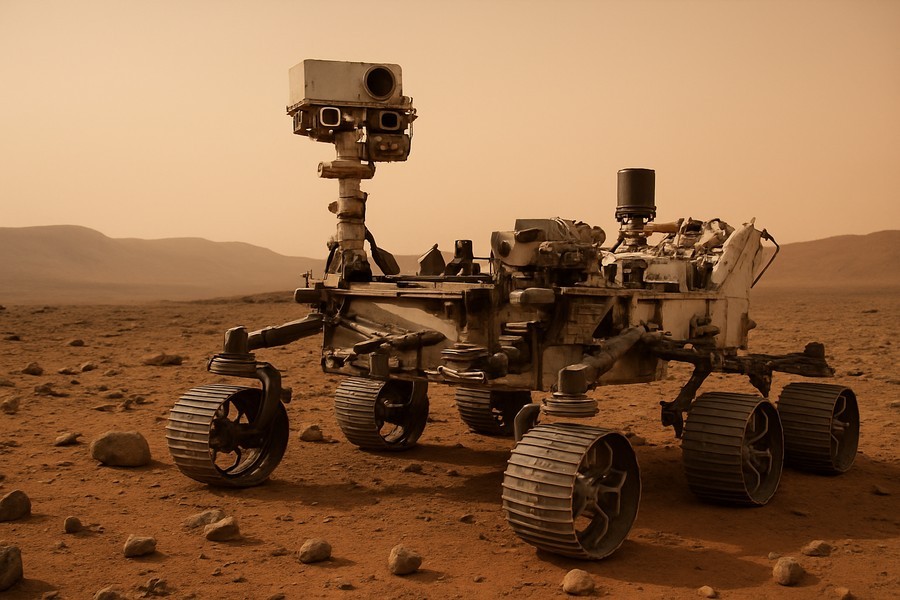
Perseverance Rover Now Self-Navigates on Mars
Have you ever imagined how it feels to drive alone, in a barren, rocky desert, without any roads, maps, or GPS? And what if you were allowed only one phone call per day for someone to tell you your exact location? This has been the reality of the Perseverance rover for the past five years since it landed on Mars. Until now.
Thanks to a cutting-edge technology, the rover can now figure out its exact location without needing human assistance. Let's delve into this exciting world of technological advancement.
Groundbreaking Technology: Mars Global Localization
Perseverance now benefits from a groundbreaking technology known as Mars Global Localization. This technology is designed to help the rover identify its location by comparing panoramic images captured from its navigation cameras with onboard orbital terrain maps. The rover uses the same powerful processor it used to communicate with the Ingenuity Mars Helicopter. The process of pinpointing the rover's location takes about two minutes, with an accuracy of about 10 inches (25 centimeters). This has been a game-changing addition to the rover’s capabilities.
Autonomous Navigation: Like GPS for Mars
Essentially, this technology is like a GPS system for Mars. It allows the rover to determine its own location, significantly enhancing its ability to travel long distances autonomously. This means we can explore more of Mars and gather more scientific data. Moreover, this technology could potentially be used by any other fast-moving rover on the planet.
The upgrade has proved to be highly valuable, given that the rover’s auto-navigation system has been functioning remarkably well. Now that Perseverance can determine its exact location, it can be directed to travel potentially unlimited distances without needing to communicate with Earth.
Challenges of Mars Navigation
Unlike on Earth, where we have a network of GPS satellites, deep space missions - whether manned or robotic - must use other methods to determine their location. The Perseverance rover has been tracking its location by analyzing geologic features in camera images captured every few feet while accounting for wheel slippage. However, tiny errors in this process can compound over the course of each drive, causing the rover to become increasingly uncertain about its exact location.
After each drive, the rover sends a 360-degree panorama to Earth, where mapping experts would match the images with shots from the Mars Reconnaissance Orbiter. The team would then send the rover its location and instructions for its next drive. This process can take over a day. With Mars Global Localization, the rover can compare the images itself, determine its location, and continue on its preplanned route.
Ingenuity’s Contribution
A critical component of Mars Global Localization is the rover’s Helicopter Base Station (HBS), which was used to communicate with the now-retired Ingenuity Mars Helicopter. The HBS is equipped with a commercial processor that powered many consumer smartphones in the mid-2010s. It runs over 100 times faster than the rover’s two main computers, which are designed to withstand the radiation-heavy Martian environment.
The use of more powerful commercial chips in the HBS and the helicopter was a risk, but it paid off. The rotorcraft completed 72 flights, far exceeding its expected five flights. The power of the HBS processor inspired the team to look for ways to harness it for the Perseverance mission.
The team faced challenges in tapping into the HBS computer. To ensure reliability, they developed a "sanity check" where the algorithm runs on the HBS multiple times before one of the rover’s main computers checks to ensure the results match. They discovered minor damage to a fraction of the processor’s memory and developed a solution to isolate those bits while the algorithm runs.
The team’s sanity check and memory solutions are expected to find new uses as faster commercial processors are employed in future missions. In the meantime, the team has already turned their attention to the Moon, where knowing exactly where spacecraft are located is even more critical due to difficult lighting conditions and long, cold lunar nights.
