
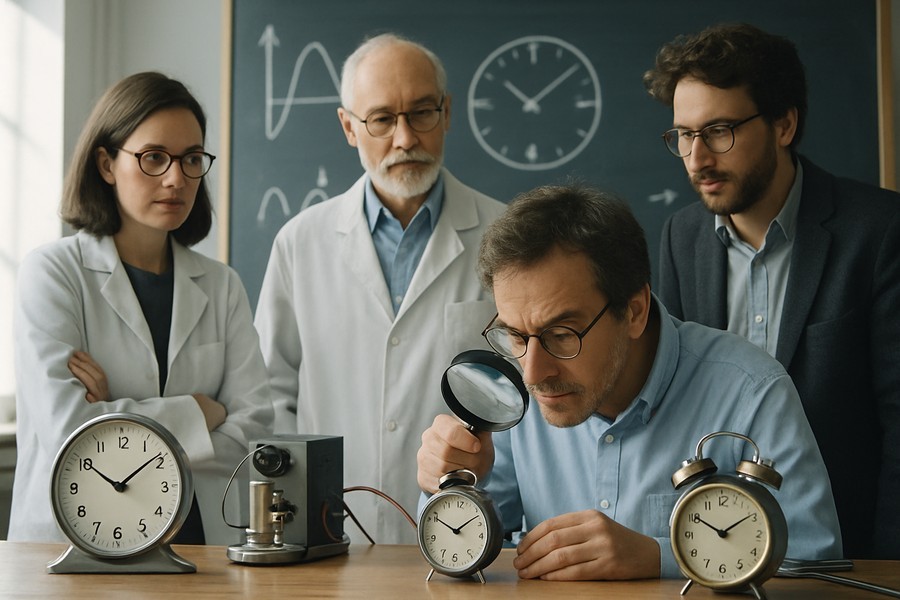
A Glitch in Time: Small Inconsistency in Time Discovered by Physicists
Physicists from around the globe have made an interesting discovery regarding time itself. They've been examining theories known as quantum collapse models and have found that these could lead to some unexpected outcomes for time. Specifically, they've discovered a tiny restriction on how accurately time can be measured. This groundbreaking research might even provide a way to put these models to the test against traditional quantum theory.
Unpacking Quantum Collapse Models
Going back to the 1980s, scientists began formulating theories that wavefunction collapse could occur spontaneously, without needing observation or measurement. Unlike conventional interpretations of quantum mechanics that offer diverse perspectives on the same equations, these quantum collapse models provide predictions that could potentially be tested through experiments.
A team of physicists explored two main versions of these quantum models. One of the models has suggested a link between gravity and wavefunction collapse for a long time. The other model is known as Continuous Spontaneous Localization. The scientists have now established a mathematical link between this second model and the space-time fluctuations caused by gravity.
Imperfection in Time and Limitations on Clock Precision
Their study indicates that if these quantum collapse models accurately depict reality, then time itself cannot be flawlessly accurate. Instead, it would have an incredibly small level of inherent uncertainty embedded within it. This would set a fundamental limit on the precision achievable by any clock.
However, it's important to note that this effect is too minuscule to influence any current technology. Even the most sophisticated atomic clocks would fail to notice it. This level of uncertainty is vastly smaller than anything we can measure at present, hence it has no real-world implications for everyday timekeeping.
Quantum Mechanics, Gravity, and the Concept of Time
Physicists have been attempting to merge quantum mechanics with gravity for several decades. Each theory functions exceptionally well within its own sphere. Quantum mechanics explains the behavior of particles at microscopic scales, while general relativity elucidates how gravity forms the large-scale structure of the universe, including stars and galaxies. However, these two frameworks perceive time in vastly different ways.
In standard quantum mechanics, time is seen as an external, classical parameter that remains unaffected by the quantum system under study. On the other hand, general relativity portrays time as something that can stretch and bend under the influence of mass and energy.
The latest research builds on previous ideas suggesting that quantum mechanics might be part of a deeper theory. It hints at possible connections between quantum behavior, gravity, and the progression of time itself.
It's essential to investigate unconventional ideas in physics. Even radical concepts about quantum mechanics can be tested against precise physical measurements. Comfortingly, timekeeping remains one of the most stable pillars of modern physics. This research serves as a reminder that exploring fundamental questions about the universe, space, time, and matter can yield fascinating results.