
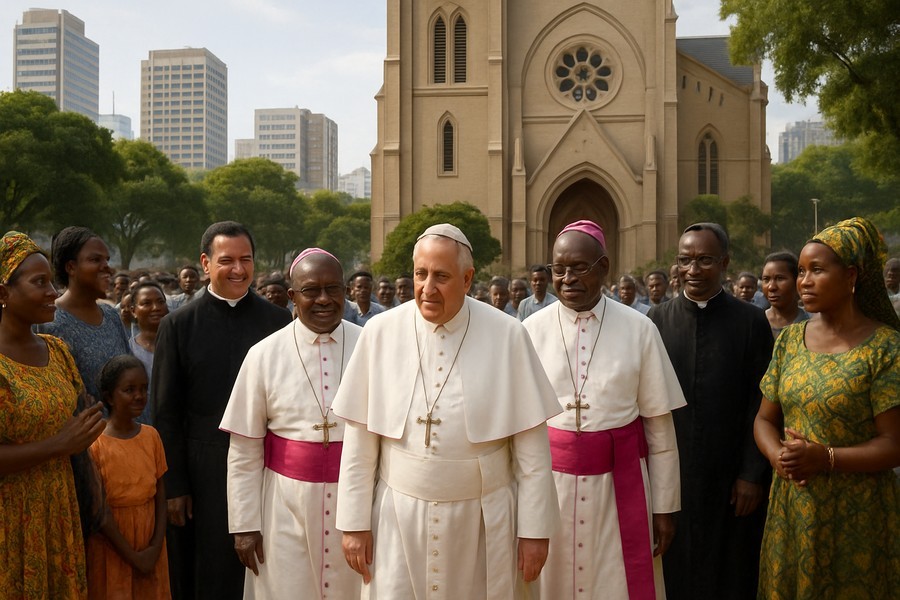
A Historic Journey: The Pope's Extensive Trip to Africa
In an audacious move to highlight Africa's growing significance to the Catholic Church, the Pope has embarked on a remarkable 11-day journey across the continent. This trip, which is his second major foreign trip since being elected, is set to cover four African nations and 11 cities, and is seen as a personal priority for the Pope.
Africa's Rising Importance to Catholicism
With over a fifth of the world's Catholics residing in Africa, totaling approximately 288 million people, it's not surprising that the continent's relevance to the Catholic Church is growing. The church has noticed a striking increase in the number of baptisms in Africa, making it one of the fastest-growing regions for the faith.
An Ambitious Tour
The Pope's extensive journey will span nearly 18,000 km, with most of the distance being covered by 18 flights. The countries on the itinerary, namely Algeria, Cameroon, Angola, and Equatorial Guinea, mostly have large Catholic populations. However, the Pope has chosen to start his tour in Algeria, a non-Catholic country, due to its significant personal meaning to him.
Algeria's Significance
Algeria is the birthplace of St Augustine, and it is noteworthy that the Pope is the first from the order that follows Augustine's teachings. The teachings of this 4th Century North African theologian, such as community and humility, have greatly influenced the present leader of the Catholic Church. The Pope's visit to Algeria includes a stop at Annaba, formerly known as Hippo, where St Augustine was a bishop. Here, he will celebrate Mass, marking the first papal visit to Algeria.
Interfaith Dialogue and Peace
The Pope's visit to Algeria's capital, Algiers, included a tribute to the victims of Algeria's war for independence at the Martyrs' Memorial. He made a call for forgiveness, stating it as the only path to peace. His tour also includes a visit to the Great Mosque of Algiers and the Basilica of our Lady of Africa, both important sites for Muslims and Christians. Promoting dialogue with the Islamic world is a key focus of this trip.
Concerns Over Religious Freedom
However, this visit comes amidst concerns over Algeria's treatment of religious minorities. Algeria, a predominantly Sunni Muslim nation, has been known to imprison Christians and Ahmadi Muslims for what has been termed as "unauthorised worship" or offense to Islam.
Conflict and Hope in Cameroon
Following Algeria, the Pope will continue his journey to Cameroon, a country dealing with conflict between English-speaking separatists and the francophone-dominated government. The violence has resulted in thousands of deaths and many more displaced. The Pope's Mass for peace and justice in the capital of Cameroon's North-West region, Bamenda, is a beacon of hope for reconciliation amidst the turmoil.
Angola and Equatorial Guinea: Peace and Justice
Angola, a country recovering from decades of civil war, is next on the Pope's itinerary. The focus of this visit will be peace and reconstruction. The Pope will also celebrate Mass with some 200,000 faithful in a country where a significant portion of the population identifies as Catholic.
In Equatorial Guinea, a country where over 70% of the people identify as Catholic, the Pope is expected to address issues of social justice. The country's long-serving president has been accused of human rights abuses, allegations the government denies. The Pope's visit includes a visit to a psychiatric hospital and a prison, and a meeting with the country's youth.
Africa: A Place of Faith and Future Growth
This tour is the Pope's first pastoral visit to Africa since assuming leadership of the Catholic Church. The continent is not new to him, but this extensive itinerary is seen as a testament to Africa's role in global Catholic life, portraying it as a place of faith, resilience, and future growth.