
The Portraits That Kept Aberfan’s Lost Children Close
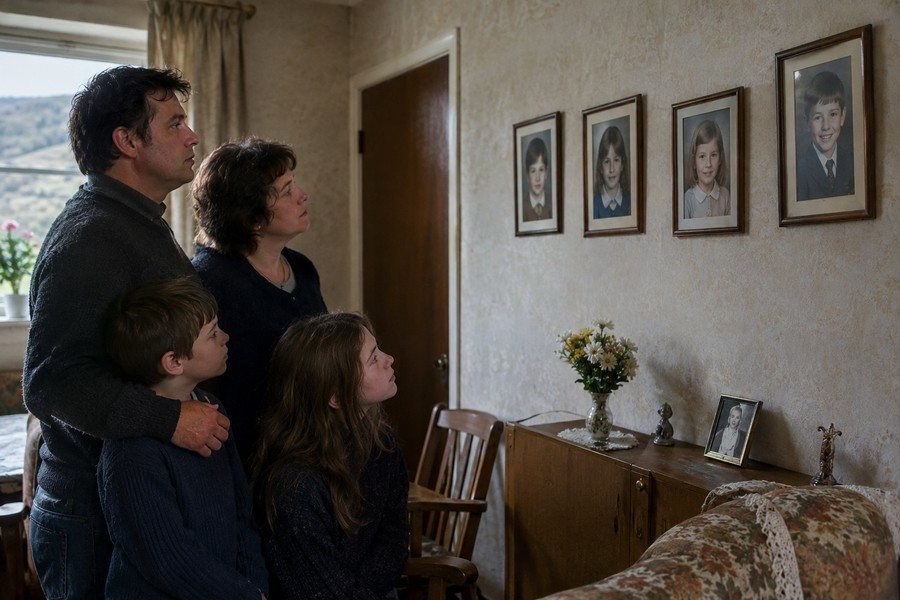
For decades, the faces of Aberfan’s lost children have remained part of daily life in homes across the village. Their portraits have hung in living rooms, hallways, bedrooms, and family gathering spaces.
Some paintings were made from old school photographs. Others were created from memories shared by grieving parents. Families described each child in careful detail, including eye color, hair, favorite clothing, and small personality traits. Some even sent pieces of fabric so the artist could make the clothing look right.
A Tragedy That Changed an Entire Village
A coal waste pile above Aberfan collapsed, sending a huge wave of dark slurry into the village. The mud covered Pantglas Junior School and nearby homes. One hundred forty-four people died, including 116 children.
The disaster left a lasting mark on Aberfan. People still remember it at the memorial garden built where the school once stood and at the cemetery marked by white arched monuments.
But grief can also be found in quieter places. It remains in empty seats at family tables, in bedrooms that once held two children, and in the missing voices that families never heard again.
Memories of Edwina
Jeanette Keane remembers her younger sister Edwina as a gentle and quiet child with a playful side.
On the morning of the disaster, Edwina briefly returned home before school began. She had forgotten to kiss her mother goodbye. When she came back, she said, “Mammy, I forgot to give you a kiss.” Her mother gave her one before Edwina left again.
Jeanette said her mother later felt that she had somehow wanted Edwina to stay home. She carried that painful thought for the rest of her life.
Jeanette’s father found eight-year-old Edwina trapped beneath the wreckage. She was still alive, but the roof above her could have fallen if he tried to pull her free. The men around him warned that rescuing her was too dangerous.
Her father lay beside her and held her hand as she died.
The experience affected him for years. Jeanette remembered hearing him walk back and forth in the hallway during the night, sometimes hitting his head against the wall. The family’s life had changed completely.
The Empty Space Left Behind
Denise Morgan was at another school when she learned that something terrible had happened in Aberfan. Her younger sister Annette had been in the classroom.
As Denise rushed back, she saw a huge black mass covering part of the village. Families waited for news while rescue workers searched through the wreckage.
For surviving brothers and sisters, the loss appeared in ordinary moments. Jeanette and Edwina had shared a bed. After the disaster, Jeanette suddenly slept alone. Denise remembered the same painful change in her own home.
The loss was widespread. Denise recalled that five children had died among the homes on her street. Jeanette remembered four children being lost in her street.
Many people in the village struggled to talk about what had happened. During that period, grief was often kept private. Survivors and families had to carry much of their pain without open discussion or support.
An Artist Offers Help
Far from Aberfan, artist William Richardson watched the tragedy unfold. He lived in Llandudno and usually drew humorous sketches of visitors and performers on the town’s pier.
He had never met the children or their families. Still, the tragedy moved him deeply. He decided to paint portraits of the children who had died as a way to show care and support.
Richardson did not ask for money or public attention. He worked from school photographs and letters written by parents. The letters included details about each child’s appearance, clothing, habits, and personality.
Richardson wanted the paintings to show more than a child’s face. He wanted each portrait to reflect the person behind the photograph.
Over the years, he created about 100 portraits. The paintings were sent to families in Aberfan and became treasured parts of their homes.
More Than Paintings
Richardson’s children remembered growing up surrounded by the portraits. To them, the painted faces became familiar, almost like the faces of old friends.
When Denise received Annette’s portrait, she was struck by how much it looked like her sister. The painting made Annette feel present again.
Jeanette remembered her father crying when Edwina’s portrait arrived. Her parents treated the painting with deep love, as if they could hold the child through the image.
Annette’s portrait remained part of family life during holidays, celebrations, and ordinary days. Denise said that many homes on her street had one of the paintings.
For survivors such as Gaynor Madgwick, who escaped from the school during the collapse, the portraits also helped people begin talking. The images encouraged families to remember the children by name and share stories about who they had been.
Gaynor said the paintings made the children’s presence felt when people entered a home. Jeanette felt the same way about Edwina’s portrait. As long as it was there, she felt that her sister was still close.
Protecting the Portraits
As the people who lived through the disaster grow older, families are thinking about what will happen to the paintings. Many remain in private homes. Some have been passed down to younger relatives, while others have been given to a local museum.
Not every family has found that decision easy. One family placed the portraits of loved ones in a white box and buried them with their mother. The paintings were set facing each other, but the act felt like losing the children all over again.
Jeanette worries about the future of Edwina’s portrait. She wants people to see it and understand the child it represents. Denise feels the same way but cannot imagine giving up Annette’s painting.
To these families, the portraits are priceless. They preserve the faces of children who never had the chance to grow up.
A Lasting Gift
William Richardson never knew the children he painted. Yet his careful work gave their families something deeply valuable. He returned familiar faces to a community living with unbearable loss.
The portraits do more than record how the children looked. They keep memories active, open conversations, and give families a way to bring the children into everyday life.
For many people in Aberfan, the paintings became a lasting connection to sons, daughters, brothers, and sisters who were taken too soon. In a very real sense, the portraits helped bring the children home.