
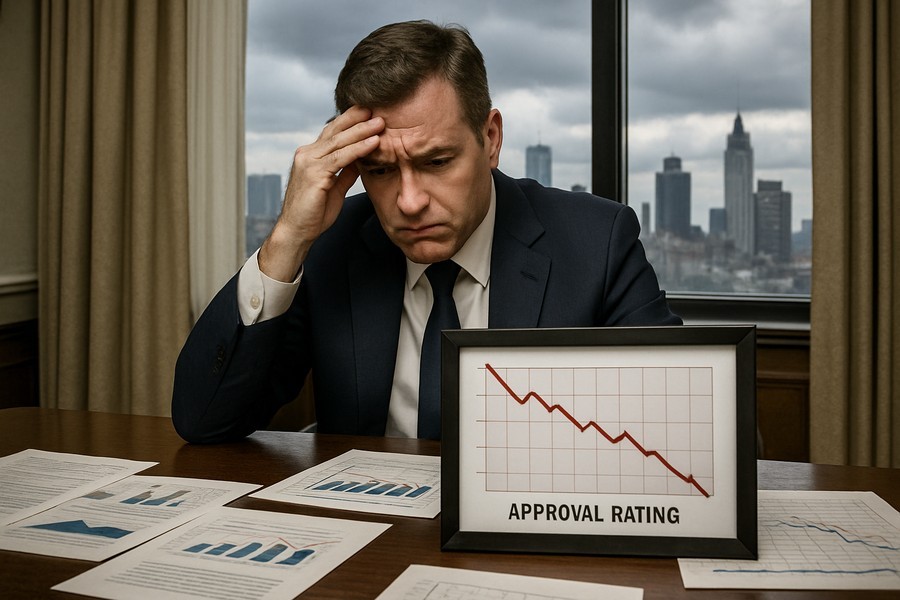
Presidential Approval Ratings Take a Dive Amid Economic and Political Turmoil
The current president's popularity, both in general and regarding his economic leadership, has taken a significant hit, seemingly due to the ongoing conflict with Iran, high fuel prices, and a pessimistic outlook on the economy.
A recent survey involving 1000 participants from across the nation revealed that approval of the president's performance has dipped to 40%, a decrease of 5 points from the last quarter. Meanwhile, disapproval rates have risen by 6 points to 58%. This drop of 10 points in net approval to -18 marks a record low in the current president's two terms in office. The decrease appears to be the most significant since public opinion soured over the government's handling of the global health crisis in 2020.
Disapproval Amongst Party Lines
Both Democrats and independents have shown record-low net approvals. However, the drop in approval from his own party is particularly noteworthy. Republican approval for the president has dipped by 17 points, reaching its lowest point since 2017, with an increase in disapproval by 9 points and a decrease in approval by 8 points. While the president's most fervent supporters remain loyal, with an approval rating of 96%, non-core Republican support has dipped by 19 points to 60%.
Despite the ongoing strife, high inflation, and escalating gas prices, some argue that a 5-point drop in approval isn't as alarming as it may seem. They claim that the president still has the fervent support of 60% of the Republican party. However, others argue that the current circumstances are critical, and the shift in the president's core ratings could be significant.
Impact on Economic Ratings
In terms of the economy, the president's approval has taken a sharp dip, with 39% approval and 60% disapproval, a significant drop from the previous quarter's 43% approval and 54% disapproval. This negative net approval margin, a decrease of 10 points, is the lowest ever recorded in any survey during the president's terms.
Key demographics have shown a marked decrease in economic approval for the president. Approval from independents and Latinos dropped by 9 points, and it decreased by 7 points among white Americans without a college degree. Still, Republican support for the president's economic policies remains strong, albeit at a slightly decreased 77%.
Views on the Iran Conflict
The president's handling of the military conflict with Iran is widely disapproved, with 48% of Americans stating they feel "less safe" because of the war. There's a clear divide along party lines, with 78% of Democrats feeling less safe, while 60% of Republicans feel safer. However, Independents align closer to Democrats, with 58% stating they feel less safe.
Most Americans don't believe the war with Iran is worth the financial cost or the increase in gasoline prices. This negative sentiment is particularly strong among key demographics that supported the president's election, such as Latinos, young men, and independents. However, a slight majority of Americans believe the war is justified to disrupt Iran's nuclear development efforts.
Response to Economic Challenges
With gas prices soaring, most Americans report cutting back on nonessential spending and travel plans. Nearly 80% have taken some form of action due to the financial strain, including increased credit card usage and even decreased spending on essential items.
Majorities also disapprove of the president's handling of inflation and tariffs, with both numbers worsening from the previous survey. His efforts to deport undocumented immigrants are seen negatively, whereas securing the southern border is supported by a slim majority, marking the only issue with positive approval among those asked.