
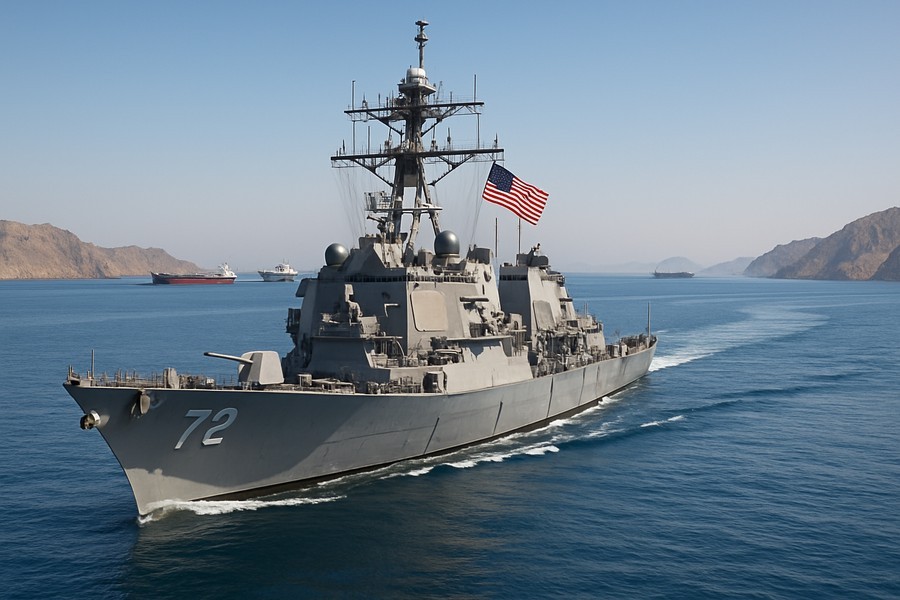
President Stands Firm: The U.S. Can Protect Key Shipping Lane Without Allies
In a surprising turn of events, the President has withdrawn his call for international assistance to guard the Strait of Hormuz against threats from Iran. This reversal comes just a day after he urged other countries to "step up" to ensure the safe passage of oil tankers through this critical waterway.
The President first shared the news on social media before affirming it during an official meeting. He stated that the military aid he was previously seeking from other nations is no longer needed in the ongoing conflict, which was initiated by the U.S. and Israel against Iran.
President's Stand: "We Don't Need Any Help"
"We don't need any help, actually," the President declared during a conversation with journalists, while hosting the prime minister of Ireland. The President's spokeswoman added, "The President has strong bonds with leaders worldwide. However, he has consistently highlighted the imbalanced dynamics brought about by past weak leaderships — including the U.S.'s vast financial support of NATO and unjust trade practices that hurt our farmers and workers."
His attempt to gather support from U.S. allies for a collective effort to safeguard the strait received a lukewarm response. This waterway has been virtually shut down due to Iranian attacks that have put oil supplies at risk.
European Allies Refuse to Join the Conflict
Earlier, the German Defense Minister stated, "This is not our war; we didn't start it." Before the President's meeting, the French President shared that his country would "never participate in operations to open or free the Strait of Hormuz in the current situation" but was ready to play a role once the fighting ceased.
In response to these comments, the President predicted that the French President "will be out of office very soon."
The Impact of the Conflict
The ongoing conflict has caused a surge in gas prices, leading to domestic political issues for the President ahead of the upcoming congressional midterm elections. Nonetheless, the President remains hopeful, stating that "numerous countries have told me they are on their way" to provide support. He also mentioned that an announcement would be made by the Secretary of State, although no such announcement has been made yet.
A Test of the "America First" Policy
This conflict with Iran represents a significant test of the President's "America First" approach to global conflicts. He has been a longtime critic of military alliances, arguing that the U.S. provides protection for other nations without any guarantee of reciprocal aid when needed.
This stance has strained relations with NATO countries that have sent troops to U.S.-led wars in Iraq and Afghanistan, only for them to lose their lives in action. The only time NATO enacted the Article 5 mutual security guarantee was in defense of the U.S. following the terrorist attacks on Sept. 11, 2001.
A Need for Diplomacy
The President's confrontational and public negotiation style hasn't been well-received by European allies. This situation is a far cry from previous diplomatic efforts, such as President George H.W. Bush's coalition of nations against Saddam Hussein, the Iraqi dictator, before Operation Desert Storm commenced.
Unfortunately, no such consultations took place before the U.S.-Israeli attack on Iran. Some efforts to build a coalition are now underway, more than two weeks after the strikes commenced. U.S. diplomats have been instructed to urge foreign governments that they "must act quickly to weaken Iran's capabilities" due to an "elevated risk of attack" on their own nations.
The Path Ahead
The President's recent remarks have been met with skepticism, both domestically and internationally. However, as one prominent figure in the Estonian Parliament's Foreign Affairs Committee stated, "Europeans must understand that to succeed in this very turbulent world today and to safeguard our security and stability, we have to stick together."