
A Gut Toxin’s Hidden Role in Colon Cancer Revealed
Scientists have identified the key point where a harmful gut toxin attaches to colon cells. The discovery may lead to new ways to block damage linked to colorectal cancer, diarrhea, and bloodstream infections.
Finding the Toxin’s First Target
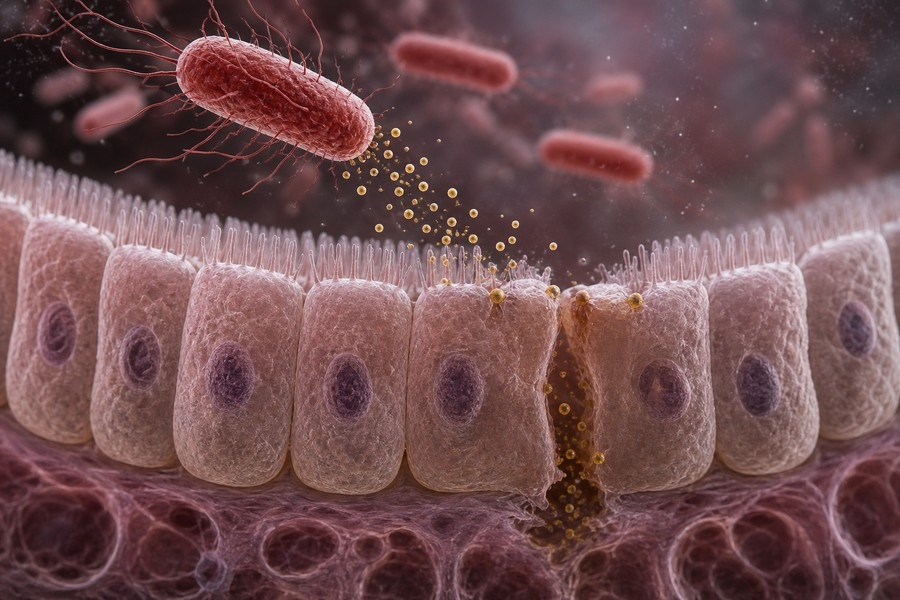
The study focused on Bacteroides fragilis, a bacterium found in the intestines of as many as one in five healthy people. Most people who carry the bacterium do not automatically develop cancer. However, some strains produce a strong toxin called B. fragilis toxin, or BFT.
BFT can weaken the protective lining of the colon. It causes irritation, damages nearby cells, and may create conditions that support tumor growth. Earlier work showed that the toxin can break apart E-cadherin, a protein that helps hold neighboring cells together. E-cadherin also helps maintain the colon’s barrier against harmful substances.
When E-cadherin is damaged, the lining of the colon may become less secure. This can allow bacteria and other substances to come into closer contact with the tissue beneath the surface.
One major question remained unanswered: How does BFT reach E-cadherin? The toxin can destroy E-cadherin, but it does not appear to attach to that protein directly. Scientists believed another molecule helped guide the toxin to its target.
Gene Editing Reveals a Missing Link
To search for that molecule, the team used CRISPR, a gene-editing method that allows scientists to turn off individual genes. They tested colon cells and disabled genes across the genome to see which changes stopped BFT from attaching to the cells.
One gene produced a clear result. When the gene for claudin-4 was turned off, BFT could no longer attach to the colon cells. Without that first connection, the toxin could not reach or damage E-cadherin.
Claudin-4 helps neighboring cells form tight junctions. These junctions act like seals between cells and help control what passes through the intestinal lining.
The results showed that claudin-4 serves as the toxin’s receptor. BFT must first connect with claudin-4 before it can carry out its destructive activity.
An Unusual Way to Attack Cells
The finding surprised the scientists because claudin-4 does not mainly act as a communication switch. Instead, it helps keep cells connected and supports the intestinal barrier.
BFT belongs to a group of enzymes called proteases. These enzymes cut other proteins. Many proteases act directly on their targets, but BFT appears to need a separate docking point before it can reach E-cadherin.
Tests measuring how the molecules interact showed that BFT and claudin-4 form a strong pair. One toxin molecule joined with one claudin-4 molecule, providing direct evidence that the two proteins bind together.
This process appears to be different from the way other known bacterial toxins work. The discovery gives scientists a clearer picture of how a gut bacterium can damage the colon’s protective lining.
A Molecular Decoy Blocks the Toxin
Identifying claudin-4 also suggested a possible treatment strategy. If BFT needs claudin-4 to reach colon cells, scientists may be able to give the toxin another target instead.
The team created a molecular decoy, which is a soluble protein containing parts of claudin-4. The decoy was designed to attract BFT without allowing the toxin to attack the colon’s barrier.
In tests involving mice, the decoy captured the toxin before it could bind to claudin-4 on colon cells. The treated animals were protected from damage caused by BFT.
This approach focuses on stopping the toxin at the beginning of the process. Blocking its first connection may be more effective than trying to repair tissue after the toxin has already caused harm.
- The decoy attracted BFT away from colon cells.
- The toxin was prevented from reaching its normal receptor.
- Mice were protected from BFT-related tissue damage.
- Future versions may use small drug-like compounds or other biological treatments.
More Testing Is Needed
The results are promising, but the treatment is still in an early stage. The mouse experiments showed protection from toxin-related damage, but they did not prove that the decoy can prevent colon cancer in people.
Scientists also have not yet determined the exact three-dimensional shape of the connection between BFT and claudin-4. Even advanced computer tools have not fully explained how the two molecules fit together.
A detailed picture of that connection could help researchers design better medicines. Future treatments might block the receptor, trap the toxin, or prevent the toxin from reaching E-cadherin.
The discovery answers an important question about how BFT harms the colon. It also creates a possible path toward preventing damage before it begins. With more testing, this strategy could support new treatments for diseases linked to toxin-producing gut bacteria, including colorectal cancer, severe diarrhea, and infections that spread through the bloodstream.