
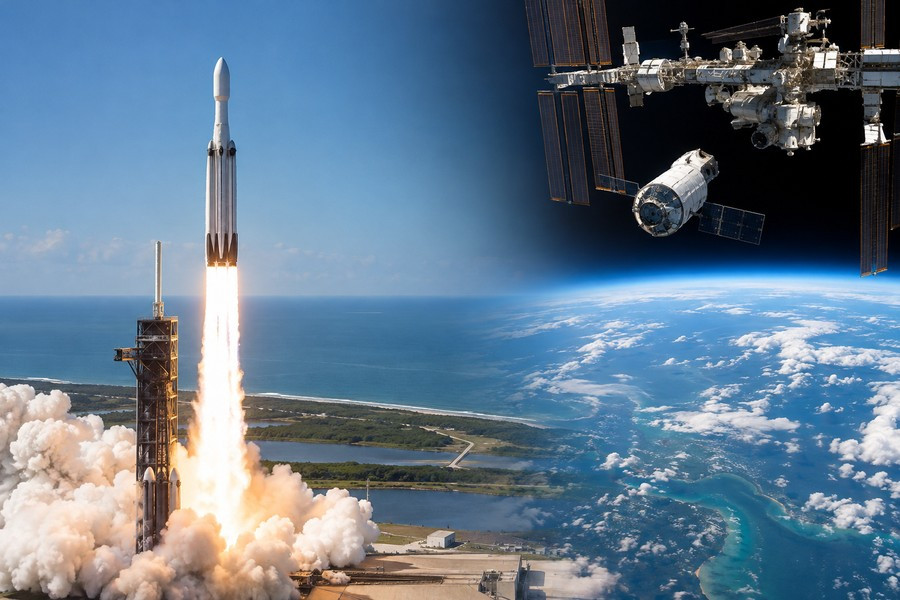
Heavy Cargo Mission Set to Bring Supplies and Science Gear to Orbit
A powerful rocket is scheduled to lift off from Florida with a robotic cargo spacecraft filled with supplies, equipment, and research tools for astronauts living aboard an orbiting laboratory.
The launch is planned for the morning from a coastal space launch site. The rocket will carry about 6,300 pounds, or 2,860 kilograms, of cargo into space. Live coverage is expected to begin shortly before liftoff.
A New Supply Run Begins
The flight is part of a long-running effort to keep the space station stocked. It will be the 35th cargo mission flown under a supply agreement with the national space agency.
After reaching orbit, the cargo spacecraft will travel toward the space station. It is expected to arrive about two days after launch and connect on its own to a port on the side of the station that faces away from Earth.
The spacecraft will attach to the Harmony section of the station. Coverage of the arrival is also expected to begin before the spacecraft reaches the laboratory.
New Solar Equipment for the Space Station
One of the most important items aboard the spacecraft is the final set of new roll-out solar panels. These panels are designed to expand the station’s ability to produce electricity.
The extra power will help support the station’s current systems and future research. The panels can be rolled up for launch and then expanded after they reach orbit. Once installed, they will add to the energy available for experiments, equipment, and daily station operations.
Research That Could Help People on Earth
The cargo includes a wide range of scientific equipment. Some of the experiments will focus on human health and the effects of microgravity, the condition in which objects seem nearly weightless in orbit.
One project will test equipment used to make artificial retinas in microgravity. Scientists hope this work could eventually support treatments that help restore sight on Earth.
The spacecraft will also carry materials for making three-dimensional heart tissue models. These models may help researchers test medicines on a larger scale. Using lab-grown tissue could give scientists more ways to study how drugs affect the heart before treatments are tested in people.
- Materials for studying how a new kind of glass forms in microgravity
- Equipment for producing artificial retinas
- Three-dimensional heart tissue models for medicine research
- Brain organoids for studying diseases that damage the nervous system
- Supplies and hardware needed by astronauts aboard the station
Brain Research in Orbit
Another experiment will examine brain organoids. These are small, lab-grown collections of human cells that can be used to study parts of the brain.
Researchers will use the organoids to look for clues about illnesses that harm brain cells over time. The work could help identify possible treatment targets for diseases such as Alzheimer’s disease, Parkinson’s disease, and multiple sclerosis.
Microgravity can change how cells grow and behave. Studying them in orbit may give scientists details that are harder to observe in laboratories on Earth. The results could improve understanding of disease and guide later medical research.
The Spacecraft’s Return to Earth
The cargo vehicle is expected to remain connected to the space station for about a month. During that time, astronauts will unload food, supplies, research materials, and replacement hardware.
When its work is complete, the spacecraft will separate from the station and begin its trip home. It will bring scientific experiments and other equipment back to Earth for study.
The vehicle will enter the atmosphere and slow its fall with parachutes. It is planned to land in the Pacific Ocean off the coast of California, where recovery teams can collect the spacecraft and its cargo.
A Mission With Many Goals
This flight will do more than deliver basic supplies. It will provide new power equipment for the station, support medical research, and return completed experiments to Earth.
The mission shows how an orbiting laboratory can serve as both a home for astronauts and a research center. Work carried out during the supply run could contribute to better medical treatments, improved materials, and a deeper understanding of how living cells change beyond Earth.