
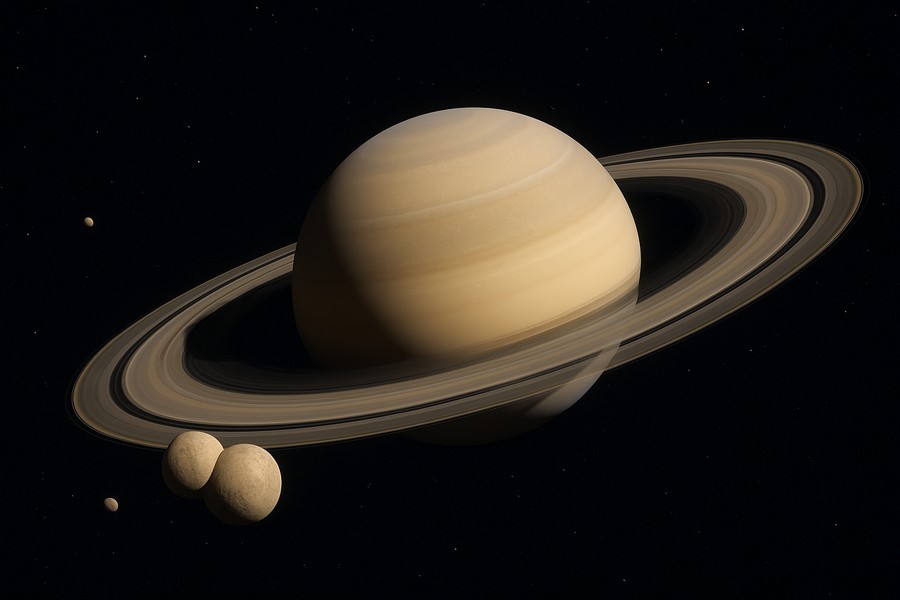
Cosmic Collision: The Mystery of Saturn's Rings and Moons
The beauty of Saturn, the sixth planet from the Sun, has always left humanity fascinated. With its stunning rings and a whopping count of 274 moons, it's a celestial wonder. However, recent studies propose a dramatic story behind its beauty - a colossal collision between two moons, approximately 100 million years ago, that may have shaped the Saturn we see today, including its rings and its largest moon, Titan.
Unraveling Saturn's Secrets
Our understanding of Saturn has evolved over time. The first intimate picture of Saturn was furnished by the Pioneer 11 spacecraft in the late 20th century. After that, other missions provided clearer views of the planet. A spacecraft, in particular, spent 13 years studying Saturn, its rings, and its moons, offering a wealth of data for scientists on Earth to analyze.
However, this wealth of data also revealed some perplexing questions. Some of Saturn's moons displayed peculiar, skewed orbits that didn't quite fit with established theories. Moreover, the rings of Saturn appeared to be much younger than anticipated. Even the planet's internal mass seemed to be more centrally concentrated than previously believed, posing a challenge to the accepted understanding of Saturn's orbital behavior.
A Bold Hypothesis
Recently, a team of astronomers suggested that these oddities might make more sense if Saturn had lost a moon around the time its younger rings were believed to have formed - approximately 100 million years ago. This hypothesis was then examined by running computer simulations to see if an extra moon could have come close enough to Saturn to form rings.
However, any potential collision had to align with the characteristics and distribution of Saturn's current moons. In their simulations, the researchers noticed a consistent anomaly. The smallest of Saturn's major moons, Hyperion, proved to be the most crucial evidence for the history of the system. Adding an unstable extra moon into the simulation repeatedly led to the disappearance of Hyperion, indicating that something was amiss. Moreover, Hyperion's orbit was found to be synchronized with Titan's, but this orbital lock was also likely only a few centuries old.
A Tale of Two Moons
The team then considered a new possibility. What if there were two moons initially, which eventually collided? A 'Proto-Titan' merging with a smaller 'Proto-Hyperion' could clarify why there are so few impact craters on Titan. It would also explain why Titan has an eccentric orbit if a smaller moon had influenced its orbit before the collision.
The debris from the Titan collision could have then coalesced to form Hyperion - a lopsided, irregular moon with an origin story as peculiar as its appearance. The researchers were also intrigued to find that Titan's eccentric orbit often destabilized Saturn's inner moons more than expected. This instability could force smaller moons into dramatic paths, resulting in large scale collisions and subsequently, the formation of rings.
Looking Ahead
While this research provides a plausible explanation for Saturn's unique features, it primarily relies on simulations. The team is now eagerly anticipating NASA's Dragonfly mission, set to reach Titan in the mid-2030s. This mission can provide fresh data, allowing the researchers to verify their hypothesis and unravel the mysteries of Saturn's rings and moons.