
Three Scientific Discoveries Reveal New Clues About Space, Matter, and Life
A Radio Burst From the Early Universe
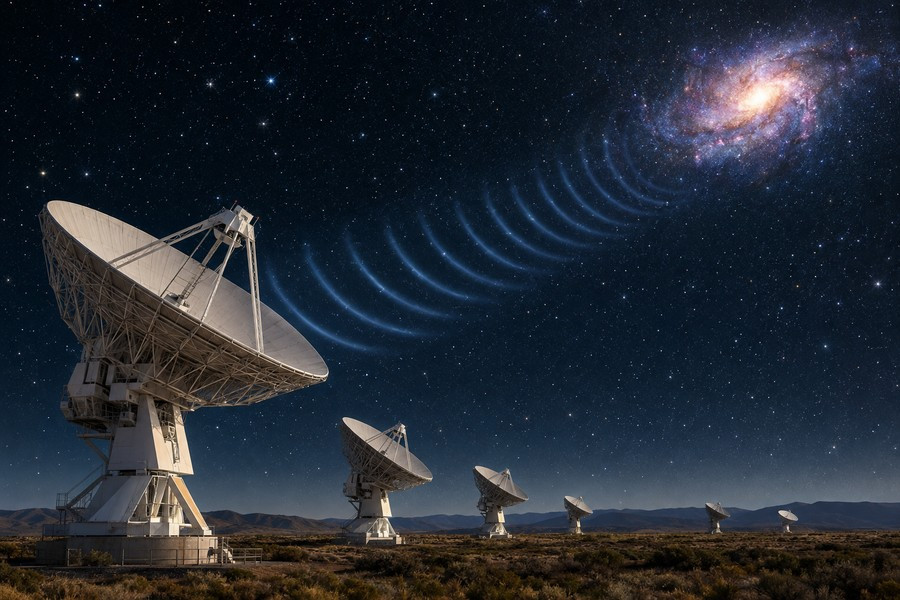
A powerful radio signal from the distant past has given scientists a rare look at the young universe. The signal, called FRB 20240304B, was created when the universe was only about three billion years old. Its radio waves traveled roughly 10 billion light-years before reaching Earth.
The signal came from a galaxy beyond redshift 2. Redshift measures how much light and other waves stretch as they move through space. The farther away an object is, the more its waves usually stretch toward the red end of the spectrum. A higher redshift often means scientists are seeing an object as it appeared much earlier in cosmic history.
Fast radio bursts, or FRBs, are brief flashes of radio energy. They can release an enormous amount of power in a fraction of a second. Some FRBs repeat, while others appear only once. Their wide range of behavior suggests that several kinds of cosmic objects may create them.
This record-setting burst was detected with a large radio telescope in South Africa. A follow-up look with a space telescope helped identify its home galaxy. The galaxy is small in mass, filled with clumps of active star formation, and contains relatively few heavy elements.
Those details point to a possible source: a magnetar. A magnetar is the extremely dense remains of a massive star that exploded. It has a powerful magnetic field and may be able to produce the intense energy needed for an FRB.
The discovery shows that radio bursts can be found from much earlier periods in the universe. More distant bursts could help scientists study how galaxies changed and how matter spread through space. The signals may also carry information about everything they passed through during their long journey to Earth.
A Diamond Moved by a Quantum Force
Scientists have also demonstrated a strange effect at the boundary between the quantum world and ordinary objects. They used a special diamond to move an object roughly one centimeter across with a force linked to quantum spin.
Quantum spin is a property of particles such as electrons. It is not exactly the same as the spinning of a ball, but it gives particles a form of angular momentum. The diamond contained tiny defects called nitrogen-vacancy centers. These defects allowed the electrons inside the diamond to respond to light and magnetic fields.
The diamond was held above a magnetic surface, allowing it to float without physical contact. A laser then changed the spin state of electrons inside the diamond. That change affected the diamond’s magnetic behavior and pushed the entire object downward through a magnetic field.
This is important because quantum effects are usually seen in atoms and other extremely small systems. The diamond was large enough for gravity to play a clear role, making it the largest object ever moved through this kind of quantum spin force.
The experiment could help scientists build more sensitive instruments. Devices based on similar ideas might one day detect tiny changes in gravity, magnetic fields, or motion. It also offers a new way to study how the rules of quantum physics connect with the physics of everyday objects.
A Lost Bovine Species Found in Ancient DNA
Ancient genetic material from a cave in Siberia has revealed an unknown member of the bovine family. The animal has been given the informal name “yak X.” Its remains were found in a cave that was also used by several human groups during the Pleistocene era.
Yak X began separating from living yak populations about 400,000 years ago. By roughly 250,000 years ago, it had become a distinct lineage. The youngest bones linked to the animal are about 27,200 years old, showing that the species disappeared sometime after that period.
The discovery adds another lost animal to the rich group of wild bovines that once lived across Asia. This group included aurochs, steppe bison, wild oxen, and other large animals that no longer exist.
Yak X remained genetically separate from nearby bovine species, even though bison and aurochs lived in the same broad region. This lack of mixing stands out because the human groups who lived in the cave, including Neanderthals and Denisovans, appear to have interbred.
The finding shows how ancient DNA can uncover animals that left behind few clear fossils. It also gives scientists a better picture of how species moved, changed, and sometimes vanished during the Ice Age.
A New Planet Growing From a Dead Star
Planets can be destroyed when their stars expand or die. In some cases, however, the material released during a star’s death may help create a new world. Scientists have found the strongest evidence yet of a second-generation planet forming around a dead star called a white dwarf.
The white dwarf is about 270 light-years from Earth. It began as a star similar to the Sun. After swelling into a red giant, it lost its outer layers and collapsed into a dense stellar remnant.
Material from that violent transformation appears to have gathered into a new planet. The planet is now sending material back toward the white dwarf, where it is being pulled apart and consumed.
The evidence comes from chemical elements found in the light from the white dwarf. Zinc, copper, and niobium are linked to the newer planet-forming material. These elements differ from the silicon and iron common in planets such as Earth.
This discovery shows that planet formation may continue even after a star has reached the end of its normal life. It also suggests that white dwarfs can create new worlds and later destroy them. In space, a star’s death may mark the beginning of another planet’s short life.