
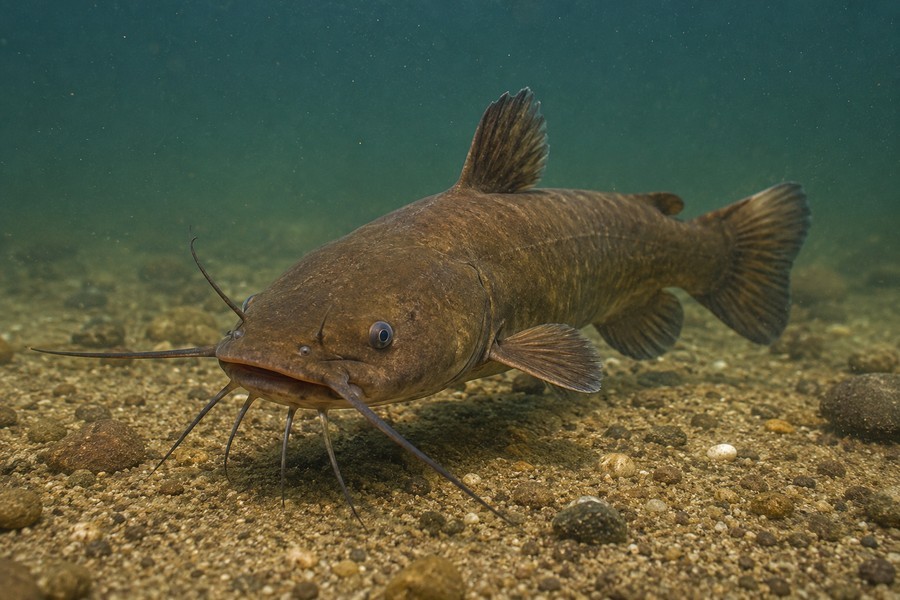
A Rare Contagious Cancer Is Spreading Among Freshwater Fish
An angler fishing in a large lake on the border of the United States and Canada reeled in a brown bullhead catfish with an unusual appearance. The fish looked as though it had black tar smeared across its skin. A local fish biologist who examined the fish had never seen anything like it. Within a few years, these black growths spread rapidly, affecting up to forty percent of the catfish in that same lake.
Scientists studying the fish discovered that the dark growths are actually melanoma. More importantly, they found that this cancer is contagious. It spreads directly from one fish to another as living cancer cells.
Understanding Contagious Cancer
Most cancers develop when a creature's own cells mutate and grow out of control. These cancers cannot spread from one individual to another. However, this newly discovered disease is different. It is a transmissible cancer, which means living cancer cells travel from one fish to another to spread the disease.
This is a major scientific discovery. It represents only the fourth type of transmissible cancer ever found in the world. Additionally, it is the first one ever discovered in a fish, and the first one found in freshwater.
The Search for Answers
When animals in the same area get sick, researchers usually look for a shared cause, such as chemical pollution or a virus. Brown bullhead catfish are very sensitive to pollution, so investigators initially thought dirty water might be the culprit. They tested local waterways for harmful chemicals, especially after a major tropical storm flooded the region. However, they found that fish living in much dirtier waters elsewhere were completely healthy.
Next, experts looked for a virus or bacteria that might be causing the sickness. After years of testing the genetic code of the diseased tissue, they found no microscopic pests. Instead, they discovered something surprising in the DNA of the tumors:
- In a normal cancer, the tumor's DNA is a close genetic match to the animal it grew inside.
- In this case, the tumors from different fish shared hundreds of thousands of mutations with each other, but they did not match the fish carrying them.
- This proved that the cancer cells themselves were jumping from fish to fish, acting like an infectious parasite.
How the Disease Travels
The cancer spread quickly. Within a few years of its first appearance, it had saturated the entire thirty-mile-long lake. Genetic testing suggests the disease did not start in this lake. Instead, the tumors are closely related to healthy catfish found in other nearby states, indicating the cancer came from somewhere else.
The disease is now known to be widespread across several areas, including:
- Maine, New Hampshire, and Massachusetts
- Pennsylvania and New York
- Wisconsin
- Parts of eastern Canada
Even though the cancer is found across a wide geographic range, it is not common in every local waterway. For example, in one region with ninety lakes where these catfish live, the cancer has only been found in one lake. This pattern suggests the disease is not spreading naturally through the water. Instead, it is likely being moved from lake to lake by human activity, much like an invasive species.
What It Does to the Fish
The disease causes physical changes that look like a plague. The dark growths can appear anywhere on the outside of the fish's body. They are often found inside the mouth and on the barbels, which are the whisker-like feelers catfish use to find food on the muddy lake bottom. When the cancer grows on these whiskers, they become short and stubby, making it harder for the fish to feed. Fortunately, the affected lake has plenty of food, so the fish are not starving.
While the disease is tough on individual fish, the overall population seems to be holding steady. This is a better outcome than what happened with other transmissible cancers. For example, a similar contagious facial cancer wiped out ninety percent of the Tasmanian devil population in Australia. In contrast, this fish cancer seems to have stopped rising in frequency, suggesting the fish population will survive the outbreak.
Are Other Contagious Cancers Out There?
Finding this disease raises the question of whether other contagious cancers are hiding in nature. While only four types have been identified so far, they may be more common than we realize. For instance, the contagious cancer in Tasmanian devils started twice on its own. Similar cancers in clams and mussels have started at least ten different times in different species.
Detecting these diseases requires advanced genetic testing, which is rarely done on wild animals. Often, creatures like catfish simply do not get much attention. To help track the disease, researchers are now looking at photos shared by anglers on social fishing applications. These crowdsourced pictures help scientists spot outbreaks and track how far the disease has traveled.
Managing the Outbreak
Deciding how to handle this disease remains a challenge. In some cases of wildlife disease, experts recommend letting nature take its course, as animal populations can eventually adapt and recover on their own.
Some existing rules prevent anglers from moving bait and water out of the affected lake, which helps stop the spread. However, these rules were originally written to stop invasive plants and animals, long before anyone knew a contagious cancer was lurking in the water. Increasing public awareness is difficult, and there are currently no warning signs posted at boat launches to alert people about the disease.