
Unveiling a Hidden Aspect of Water That Challenges Physical Norms
Water, the life-sustaining liquid we all depend on, is far more complex than most of us realize. Despite its familiarity, it continues to confound scientists with its peculiar properties. Notably, the discovery of a concealed critical point in supercooled water is now challenging scientific norms.
Unmasking Water's Hidden Critical Point
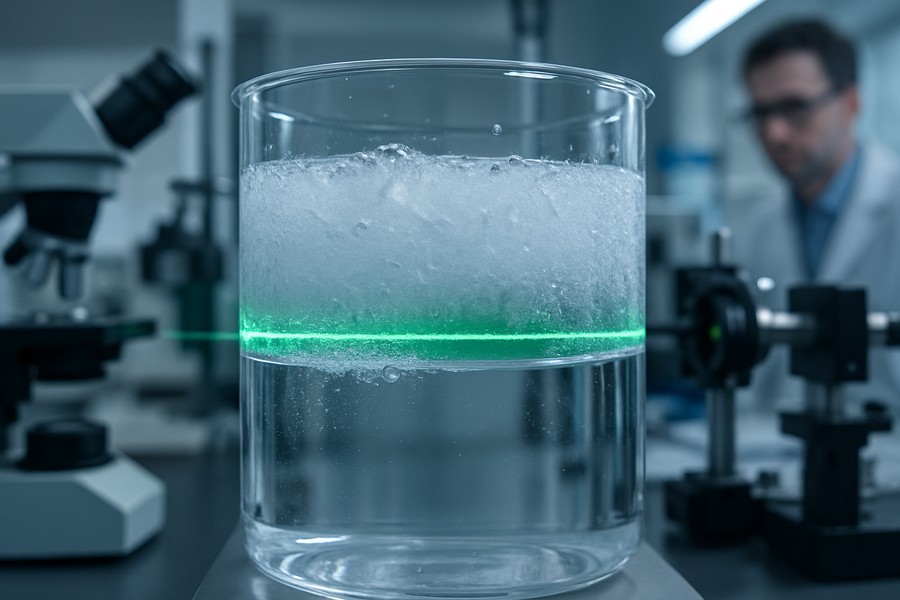
Researchers have long hypothesized the existence of a hidden critical point in supercooled water. However, finding solid proof of this has been an uphill battle. The breakthrough came when scientists utilized a cutting-edge X-ray free-electron laser to observe water in its supercooled state.
The studies revealed that water can transition into two separate liquid forms under extreme cold and pressure before merging into one. This finding could potentially explain why water behaves so differently from other liquids.
The Peculiar Behavior of Water
Water is essential for life on Earth, yet it still holds many mysteries. It has long been known that water exhibits unique properties that set it apart from other liquids. Its high surface tension, heat capacity, boiling point, and density are just a few examples. The question is, why does water behave so differently?
A researcher from the University of Stockholm, Anders Nilsson, has dedicated over a decade to studying water's mysterious properties. In his quest, he has been searching for a phenomenon known as the liquid-liquid critical point (LLCP).
Understanding the Liquid-Liquid Critical Point
Water's high critical point is well documented. At around 374 degrees Celsius and under 218 times atmospheric pressure, the distinction between liquid and gas vanishes. However, researchers theorize a similar critical point exists in supercooled water. Supercooled water remains liquid at temperatures significantly below its normal freezing point. One reason for this belief is the fact that water reaches its maximum density at 4 degrees Celsius before reversing course - an anomaly that could potentially be explained by a sub-zero critical point.
The Hunt for the LLCP
In 2020, Nilsson and his team discovered that supercooled water can exist in two distinct phases - a high-density liquid and a low-density liquid. This finding supported the hypothesis that these two phases merge at the LLCP. However, identifying the exact point is tricky because water freezes quicker than most measurement methods can capture.
Unveiling the LLCP with Modern Technology
In a recent study, Nilsson and a team led by Kyung Hwan Kim at the Pohang Accelerator Laboratory used ultra-fast bursts from an X-ray free-electron laser to observe supercooled water as it transitioned into ice. They found that water's LLCP occurs at around 210 kelvins, or -63 degrees Celsius. This finding confirmed theories dating back over a hundred years.
"The special part was that we were able to use X-ray technology incredibly quickly before the ice froze. We could observe how the liquid-liquid transition disappears and a new critical state emerges," Nilsson said. "For decades, theories have speculated to explain these remarkable properties, one theory being the existence of a critical point. Now, we have found such a point."
The Importance of this Discovery
Observing water's LLCP is only possible under immense pressure, approximately 1000 atmospheres. However, as conditions change, the two distinct phases eventually merge into one. This fluctuation likely extends across temperatures and pressures, even under normal environmental conditions. It could explain why water is so peculiar.
Now that scientists have pinpointed this critical point, it could have extensive implications in various fields. Therefore, understanding the hidden complexities of water is not just a scientific curiosity; it is a crucial step in unraveling the mysteries that surround us.