
Unearthing Extinct Life: A Fossil Goldmine in China
Scientists have made an exciting discovery, unearthing nearly a hundred unique animal species in a quarry located in southern China. These creatures managed to survive a devastating extinction event that took place half a billion years ago, profoundly altering the course of life on Earth.
This find provides a valuable snapshot into one of the most catastrophic events in the history of our planet. This event marked the abrupt end of an era known as the Cambrian explosion, the most significant proliferation of life that Earth has ever seen.
Finding Fossils in Unlikely Places
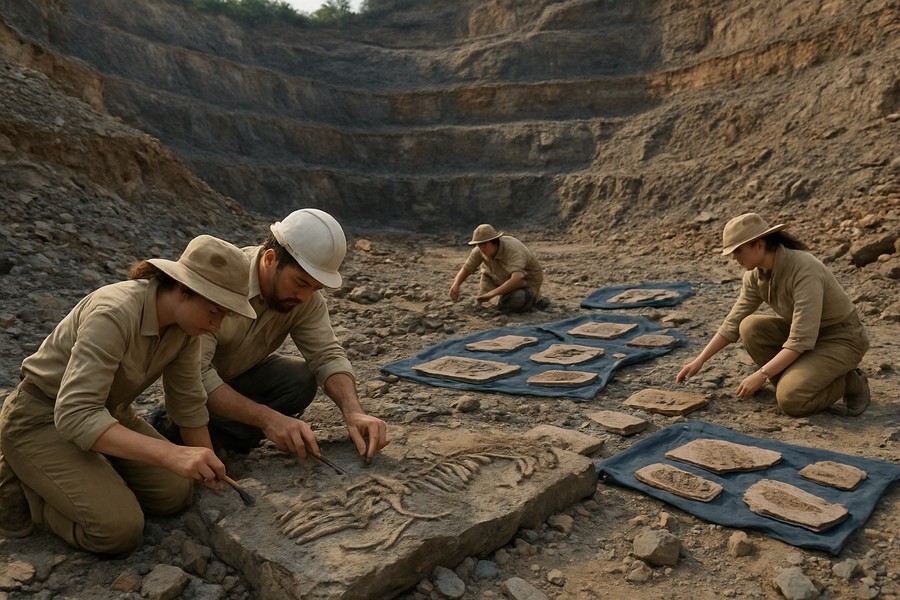
The excavation site, nestled in the Hunan province of China, proved to be a veritable treasure chest of fossils. The researchers have collected an impressive sum of over 50,000 specimens from a quarry measuring 12 meters in height, 30 meters in length, and eight meters in width.
In such a confined space, the team discovered over 150 distinct species, 91 of which are entirely new to science. Among them, they found ancient relatives of worms, sponges, and jellyfish. The quarry also yielded a wealth of arthropods, a group that includes modern ancestors of crabs and insects.
Life After the Big Bang of Evolution
Scientists believe that the life forms first emerged on Earth over 3.5 billion years ago. However, for the most part, life was nothing more than a layer of slime for the majority of Earth's history. That all changed approximately 540 million years ago with the Cambrian explosion, sometimes referred to as evolution's "big bang."
During this time, most of the major groups of animals that we know today, including vertebrates which would eventually evolve into humans, began to evolve and populate the world's oceans. This rapid proliferation of life is thought to have been fueled by an increase in the Earth's atmospheric oxygen. Unfortunately, this period came to an abrupt end when up to half of all animal species died off 513 million years ago in an event known as the Sinsk event, thought to be caused by a decrease in oxygen levels.
Survivors of the Sinsk Event
The recently discovered fossils, which date back to approximately 512 million years ago, represent the first significant discovery of soft-bodied organisms that lived immediately after the Sinsk event. These fossils, named the Huayuan biota after the region they were found in, provide a glimpse into life after this mass extinction.
Interestingly, some of the animals found in the Chinese quarry have also been discovered at the Burgess Shale site in Canada, which originates from an earlier period of the Cambrian explosion. This suggests that these early life forms were capable of traversing vast distances, even during these primordial times.
A Deeper Look into Mass Extinctions
The Sinsk event, though not as well-known as the "Big Five" mass extinctions, is no less significant. Evidence suggests that over the last 540 million years, there have been 18 or more mass extinction events. These catastrophic periods warrant further study to better understand their immense destructiveness.
For example, scientists have long debated whether dinosaur populations were already declining before a massive asteroid hit the Earth 66 million years ago, causing another mass extinction. However, recent research indicates that dinosaur populations in North America were still thriving before this cataclysmic event.
In conclusion, the discovery of the Huayuan biota offers a fascinating look into life's resilience and adaptability in the face of global extinctions. It also highlights the need for further exploration and study of these significant events in Earth's history.