
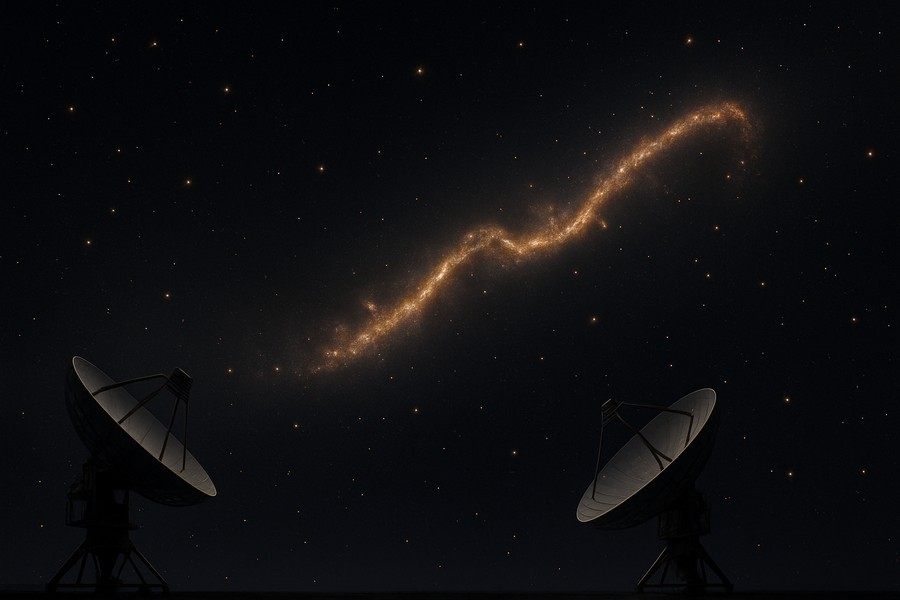
Unraveling the Mystery of a Massive Rotating Cosmic Structure
A team of international scientists has made an astonishing discovery of a huge and unusual structure in the cosmos, which is found at a whopping distance of 140 million light-years away. This unique cosmic filament is made up of a series of galaxies that are so thin they almost resemble a razor. The way this filament is rotating is causing researchers to reconsider their theories about how galaxies are formed.
The study that revealed this information gives us a fresh way to look at how galaxies get their spin and evolve, which helps us better understand the forces that mold the colossal structures in the universe. The discovery was made possible thanks to data collected from advanced telescopes.
Understanding the Dual Motion of the Galactic Structure
The discovery of this new cosmic structure is remarkable, not just due to its massive size, but also because of its unique combination of spin alignment and rotational motion. It's like the teacups ride at a fair – each galaxy is spinning like an individual teacup, while the entire filament (or the platform of teacups) is also rotating.
This interesting double motion provides special insights into how galaxies get their spin from the larger structures they are part of. This could help us learn more about how the rotation of galaxies changes over time and at different distances.
The galaxies within this filament are aligned so that their spins are not random, but mostly in the same direction, reflecting the rotation of the filament. This alignment is challenging the usual theories of galaxy formation and offers a new way to examine the forces at play in these massive cosmic structures. It's like the universe itself is passing its spin to the galaxies it contains.
The Role of Cosmic Filaments in the Evolution of Galaxies
Cosmic filaments are some of the biggest structures we know of in the universe, spanning millions of light-years. These long strands of galaxies and dark matter make up the "cosmic web" and act as pathways for galaxies and other matter to move along. The discovery of this rotating filament adds to our understanding of how galaxies are formed, giving us a unique look at the relationship between large cosmic structures and the evolution of galaxies.
The filament is like a fossil record of cosmic flows. It helps us understand how galaxies get their spin and grow over time. By studying the galaxies in this filament that are rich in gas, researchers can follow the flow of matter and momentum through the cosmic web, which helps us learn about the processes that control the evolution of galaxies, the formation of stars, and the overall growth of the universe.
The amount of gas in these galaxies is important for understanding how stars are formed, since hydrogen is the primary ingredient for creating new stars. By looking at these hydrogen-rich galaxies, scientists can see how cosmic gas travels through filaments and into galaxies, giving us a better idea of how spin and other factors affect the shape and spin of galaxies. This also gives us hints about how galaxies were formed and evolved in the early universe, which is still largely a mystery.
The Technology Behind the Find
This remarkable discovery wouldn't have been possible without the advanced tools and technologies available to astronomers today. The research team used data from an advanced radio telescope with 64 connected satellite dishes. This allowed the team to carry out a deep sky survey called MIGHTEE, which revealed the giant rotating cosmic filament. Additional optical data from other instruments helped complete the picture, showing not just the structure of the filament but also its rotational movement.
This discovery demonstrates the power of combining data from different observatories to understand better how large structures and galaxies are formed in the universe. Such studies can only be done by large groups with diverse skills, and this project was made possible by a research grant that funded the co-lead authors of the study.