
A Speeding Star Breaks Records Near the Center of Our Galaxy
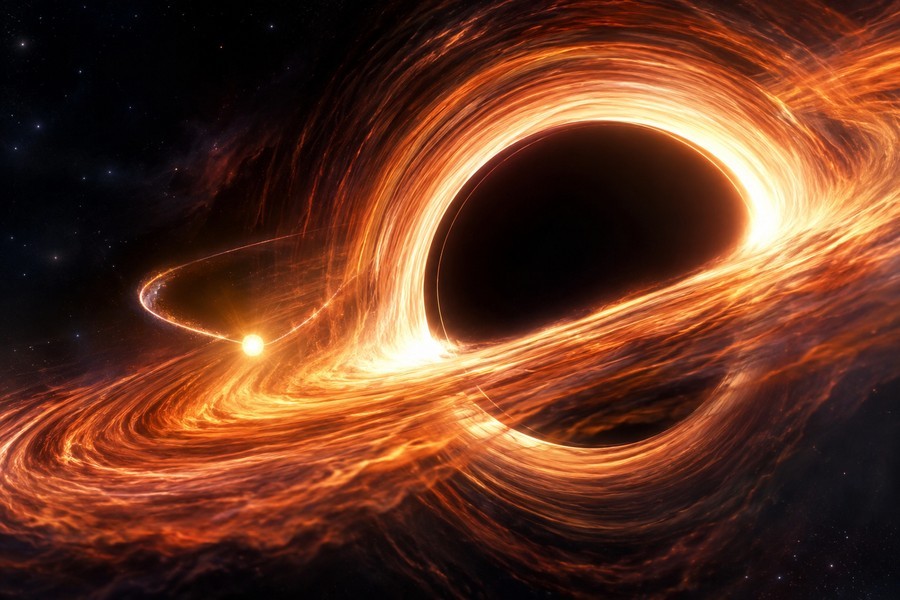
Deep inside the middle of the Milky Way galaxy, a wild cosmic chase is happening. Scientists have found a faint star that is moving faster than any other star we know of. This star is orbiting a giant black hole, which sits like a heavy weight at the very center of our galaxy.
The star is known as S301. It travels at a mind-boggling speed as it swings around the black hole, which is called Sagittarius A*. At its fastest point, the star reaches speeds of about 15,500 miles per second. That is equal to 25,000 kilometers per second. To put that in perspective, this star is traveling at more than 8% of the speed of light.
An Unusually Close Neighbor
What makes this star so special is not just its speed, but also its path. S301 has an extremely tight orbit around the giant black hole. It takes only 8.7 years for the star to make one complete trip around it.
During its journey, the star gets incredibly close to the black hole. At its nearest point, it is only 12 times farther from the black hole than the Earth is from the sun. While that might sound like a long way to us, in the vastness of space, it is incredibly close. No other known star has ever been seen getting this close to this giant gravity trap.
A Giant Gravity Trap
The black hole at the center of our galaxy is massive. It has a mass that is about 4.3 million times greater than our sun. Because it is so heavy, its gravity is incredibly strong.
This extreme environment gives scientists a way to test the laws of physics. Specifically, they want to study Albert Einstein's famous ideas about gravity, known as the theory of general relativity.
According to these physics theories, a spinning black hole does not just pull things in. It actually drags the fabric of space and time around with it as it spins. This strange effect is called frame dragging.
- Imagine a heavy spoon spinning inside a jar of thick honey.
- The spinning spoon drags the honey around with it in a swirl.
- In a similar way, the spinning black hole drags space itself.
Because S301 travels so close to the black hole, this dragging of space should slowly push the star's orbit out of alignment. Scientists believe they will be able to measure these tiny changes in the star's path within about ten years. If they can do this, they will be able to measure exactly how fast the giant black hole is spinning. This would be a major test for our understanding of gravity.
A Relic of a Broken Partnership
Researchers first spotted S301 recently using a highly advanced telescope system located in South America. To make sure of what they were seeing, they looked back at older data collected over several years to trace the star's exact path.
The star’s orbit is not a perfect circle. Instead, it is shaped like a long, stretched-out oval. This strange shape tells a story about how the star might have ended up in such a dangerous place.
Scientists think that S301 was not always alone. It likely started out as part of a binary system, which is a pair of stars that orbit each other. Long ago, this pair of stars drifted too close to the giant black hole. The black hole's immense gravity tore the partners apart.
- The black hole captured S301, trapping it in a tight, fast orbit.
- At the same time, the black hole flung the partner star away into deep space at an incredible speed.
Looking to the Future
The discovery of S301 is just the beginning. Scientists plan to keep a close eye on this speeding star using even more powerful telescopes that are being built right now.
The star is expected to make its next close pass by the black hole in about a decade. By watching the star complete two full orbits, astronomers hope to gather enough data to finally unlock the secrets of the black hole's spin. This could open up a whole new way of looking at the most mysterious objects in our universe.