
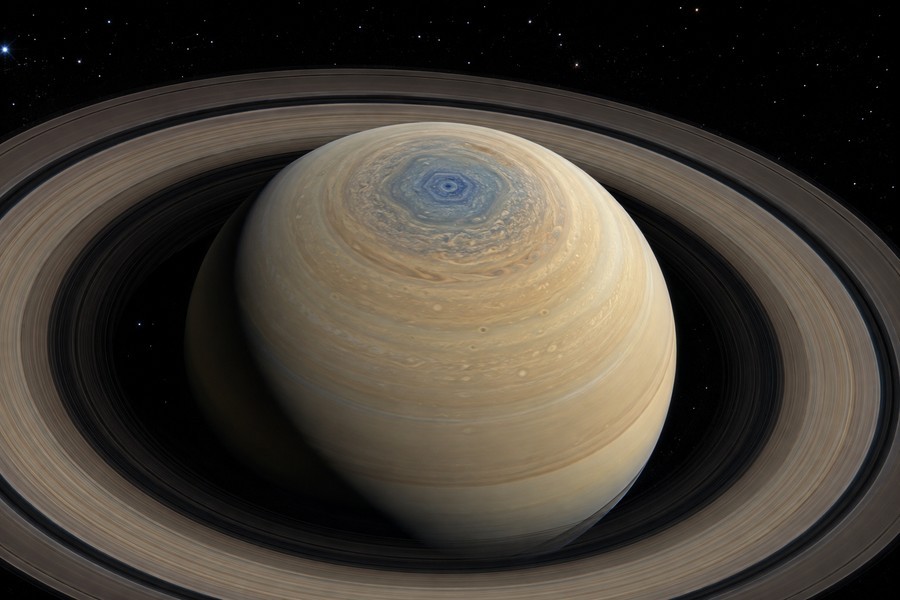
A Giant Ten-Sided Cloud Pattern Has Been Discovered on Saturn
Space researchers have made an unexpected discovery in the upper atmosphere of Saturn. A massive, ten-sided wave pattern is currently swirling through the icy ammonia clouds at the planet's south pole. This giant, spinning shape is known as a decagon, and its discovery has surprised scientists who study the solar system's gas giants.
The newly spotted cloud formation is constantly moving and shifting. It appears to be even larger and more unstable than the famous six-sided cloud pattern, or hexagon, that sits at Saturn's north pole. That northern shape was first photographed about forty years ago, and for a long time, it was considered one of the most unusual sights in space.
Two Different Shapes on Opposite Poles
While many planets in our solar system experience storms and windy weather that create wavy patterns in their atmospheres, Saturn is unique. It is the only planet we know of where these atmospheric waves form straight-sided geometric shapes. The discovery of this ten-sided pattern shows that the northern hexagon is not as rare as scientists once believed.
The two shapes sit on opposite ends of the planet and behave differently. While they both exist along strong atmospheric wind currents called jet streams, their movements are not the same:
- The Northern Hexagon: This six-sided shape remains almost completely stationary, barely moving from its position.
- The Southern Decagon: This ten-sided shape is constantly on the move, slowly drifting eastward at a speed of about 6 miles per hour (10 kilometers per hour).
Tracking a Changing Shape
This new atmospheric feature was not always visible to observers on Earth. It was recently detected by a powerful space telescope after previous viewing attempts came up empty. Scientists believe the ten-sided wave pattern likely formed during a period when Saturn's southern half was tilted away from Earth, keeping it hidden from our view.
The scale of this new weather system is enormous. It is still actively changing, and just one of the ten sides of the shape measures more than 10,000 miles long (about 16,700 kilometers). This makes the entire structure far larger than our own planet.
What This Means for Planetary Science
By comparing the behavior of the northern hexagon and the southern decagon, researchers hope to gain a much better understanding of how weather patterns function on gas giant planets. There are still many unanswered questions about why these shapes form and how long they can survive.
For example, the northern hexagon has been visible for more than four decades. This is longer than a single year on Saturn, which takes about 30 Earth years to complete. It remains to be seen whether the new ten-sided shape will be just as long-lasting, though observations confirm that the pattern is still actively swirling for now.
Scientists also wonder if these Saturnian shapes are related to the geometric clusters of cyclones that have been observed on Jupiter. To study the wind speeds inside the new southern shape, researchers utilized a massive ground-based telescope located in South America. Over the next few years, Earth's view of Saturn's southern hemisphere will improve, which should allow astronomers to capture clearer images and hopefully solve this planetary mystery.