
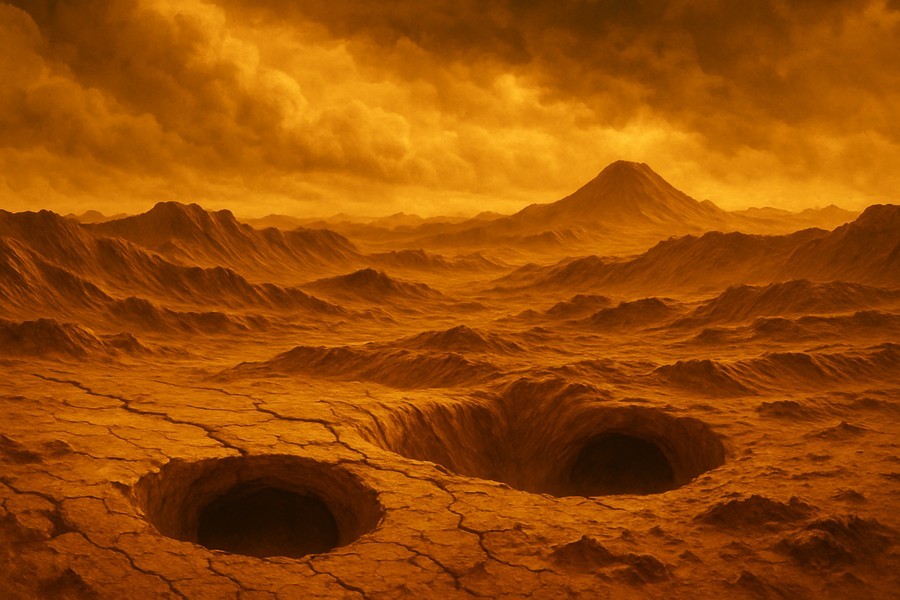
Unraveling the Mysteries of Venus' Underground Structures
Venus, often referred to as Earth's wicked sibling, shares many similarities with our planet. Despite the similarities in size and location within the solar system, Venus is far from being a viable home for life as we know it. This hostile environment can reach scorching temperatures over 900 degrees Fahrenheit, it's consumed by clouds of sulfuric acid, and the atmospheric pressure on the surface is nearly 100 times that of Earth, akin to being 3,000 feet underwater.
Yet, beneath these extreme conditions, there could be vast structures known as lava tubes, according to a group of multinational researchers. Their findings, which are awaiting publication in a scientific journal, suggest that these intriguing formations may exist on Venus, just as they do on Earth, the Moon, and Mars.
Extreme Conditions of Venus
Lava tubes are often left behind by volcanic activity when the liquid lava recedes. While the extreme conditions on Venus make it unlikely for these tubes to serve as potential shelter for space explorers, there is a growing body of evidence that suggests their existence on the planet.
This is primarily because the gravity on Venus' surface is about 91 percent of Earth's, which allows for structurally stable tubes that are up to 0.62 miles wide. "Our findings indicate that lava tubes with a few hundred meters in width could be stable, aligning with the observed sizes of Venusian channels," the researchers claimed in their paper.
Next Steps in Venus Exploration
The team of scientists is now encouraging future missions to utilize higher-resolution imaging and advanced geophysical investigation techniques to search for pit chains (rows of circular depressions found on multiple planetary bodies), skylights (vertical openings leading to underground channels), and subsurface voids.
They employed a widely used method, known as Finite Element Limit Analysis (FELA), to approximate the maximum sizes of lava tubes that could exist on the surface of Venus. These results bolster previous attempts to model the planet's "explosive volcanism."
It's not the first time that evidence of these tubes has been discovered. A study last year came to a similar conclusion, suggesting that Venus could very well be home to these massive structures. "Earth's lava tubes are smaller, Mars' tubes are slightly larger, and the Moon's tubes are even bigger," noted a researcher at a meeting last year. "Venus, however, breaks this trend, displaying extremely large tube volumes."
Challenges in Confirming Lava Tubes
Confirming the existence of these vast channels could be a monumental task. Apart from the harsh local environment, Venus is enveloped in a dense layer of clouds, making it exceptionally difficult to study its surface from orbit.
Regardless, there are plans in the pipeline to explore the planet's surface. A mission, tentatively planned for a future decade, will deploy an orbiter and atmospheric probe to explore Venus. Another mission aims to scan the planet's surface with high-resolution near-infrared and radar instruments.
While the former mission managed to secure funding for an additional year, the latter's future is not as certain. Budget proposals threatened to terminate both missions, but recent legislative decisions have kept the prospect of exploring Venus' alleged lava tubes alive.

