
A New Way to Watch Over Our Bridges Using Drones and Artificial Intelligence
Bridges are some of the most important structures in our modern world. They connect cities, cross deep rivers, and help millions of people get to where they need to go every day. Because we rely on them so much, these structures must remain strong and safe. However, just like everything else, bridges age. Over time, the heavy weight of traffic, freezing winter weather, and hot summer sun can cause serious wear and tear.
As bridges get older, they start to show signs of damage. They can develop tiny cracks that slowly grow larger. Sometimes, chunks of concrete begin to break away, which is known as spalling. Other times, water starts to leak through the joints, which can rust the metal supports inside. To prevent accidents, engineers must inspect these structures regularly. Traditionally, this has meant sending workers out to look at the bridge up close. This manual work is not only slow and expensive, but it can also be dangerous for inspectors who have to climb high above roads or water.
The Challenge of Tracking Damage Over Time
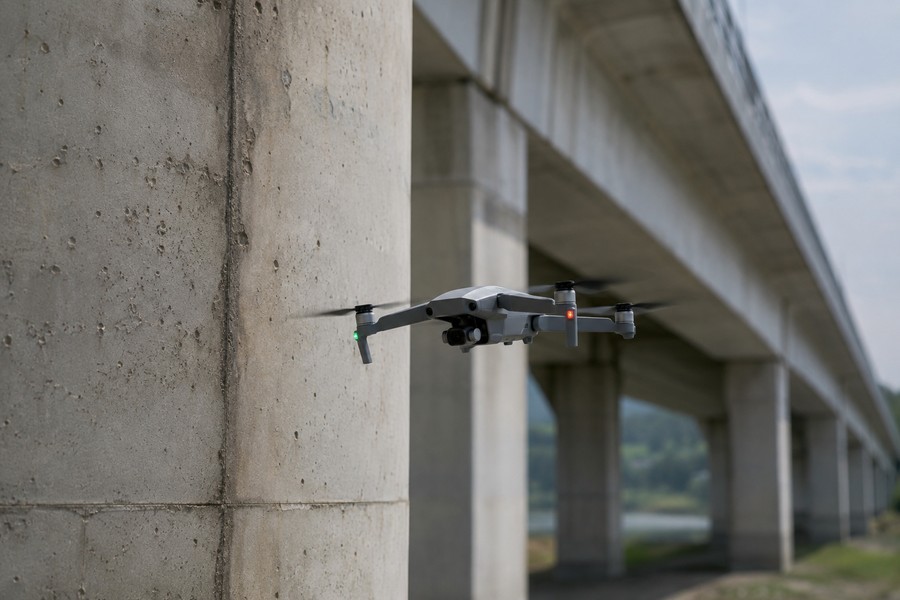
In recent years, inspectors have started using flying drones to take pictures of bridges. This makes the job much safer and faster. However, using these pictures to track damage over long periods of time is still difficult. If a drone takes a picture of a crack in the spring, and another drone takes a picture of the same spot in the autumn, the photos will look different. The drone might fly at a different height, the sun might create different shadows, or the camera might be tilted at a different angle. Because of these differences, it is hard for engineers to look at the two photos and know for sure how much the damage has changed.
A Smart System That Remembers the Bridge
To address this problem, researchers have created a new computer system that uses artificial intelligence (AI) to automatically track bridge damage over time. This system works by combining drone photos with smart computer programming to create a digital map of the bridge.
Here is how the new process works:
- First, during the very first inspection, a drone flies around the bridge and takes many photos from different angles.
- Next, the computer uses these initial photos to build a highly detailed three-dimensional (3D) model of the bridge. This model acts as a digital reference of the structure.
- When inspectors return months later to take new photos, the AI system automatically matches the new pictures to the original 3D model.
- Even if the new photos are taken from different distances or angles, the system can figure out exactly where each photo belongs on the bridge.
To make the system even more useful, the researchers connected it to satellite positioning data. This allows the computer to convert the pixels in a photograph into real-world measurements. Instead of just seeing a line on a screen, the system can tell engineers the actual size of a crack or how much concrete has peeled away.
Testing the Technology in the Real World
The researchers wanted to make sure their new system worked in real-world conditions, so they tested it on a concrete bridge that is currently in use. They monitored the bridge for 120 days using drone cameras. During this time, the AI system tracked various types of wear and tear, including cracks, water leaks, and concrete damage.
Even though the drone took photos from different angles during each visit, the computer system remained reliable. When the researchers compared the computer's measurements to traditional hand measurements, they found that the computer's maximum error was only 4.61%. This showed that the automated system was able to measure damage closely compared to traditional human measurements.
Why This Is a Step Forward
This new method has several advantages over older ways of inspecting bridges. In the past, if engineers wanted to use 3D models, they often had to build a brand-new model every single time they inspected the bridge. This required a massive amount of computer power and took a lot of time. The new system only needs one main reference model. New photos are simply aligned to this existing model, which saves time and computer energy.
This technology helps engineers focus on how damage changes over time, rather than just looking at a single moment. By watching how a crack grows month by month, engineers can predict when a bridge will need repairs before it becomes a safety hazard. This approach is called predictive maintenance, and it could help transportation departments save money by fixing small problems before they turn into expensive emergencies.
While the system works well on flat parts of a bridge, the researchers noted that it might be less accurate on highly curved surfaces. However, it is still capable of inspecting the vast majority of bridge parts that inspectors need to check during routine visits. In the future, this same technology could be adapted to monitor other important structures, such as tunnels, water dams, and elevated train tracks.