
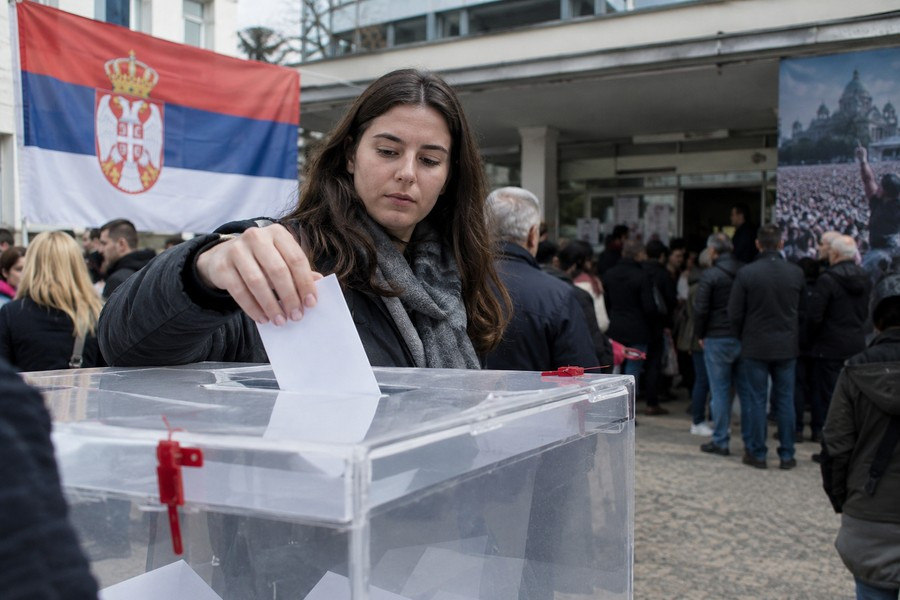
Serbia’s Election Tests a Longtime Leader as Students Demand Change
Voters in Serbia are choosing a new parliament in an election shaped by a powerful student protest movement. The demonstrations aim to remove longtime leader Aleksandar Vucic, who has controlled the country’s government as both prime minister and president for more than a decade.
Student Protests Reshape the Campaign
The election follows nearly two years of student-led protests. Demonstrators accuse the government of corruption and say leaders have used public power to benefit themselves instead of serving ordinary people.
The protests began after a train station canopy collapsed in the city of Novi Sad. Sixteen people died in the disaster. Many protesters blamed poor construction, weak oversight and government corruption for the collapse.
Since then, the student movement has grown into one of Serbia’s largest public campaigns in decades. It has attracted support from people across the country, including citizens who had previously stayed away from politics.
Young Serbians have played the leading role. The group had long been viewed as one of the least politically active parts of the population. The protests have changed that, bringing large numbers of young people into public life.
Vucic Seeks to Keep His Political Power
A defeat for Vucic would create a major political change in Serbia, a Balkan nation of about six million people. It would also resemble the defeat of Hungary’s longtime leader Viktor Orban in a recent election.
Vucic remains a strong candidate, however. Many voters credit him with helping Serbia move beyond years of economic hardship. They also point to a long period of modernization, including new construction and investment.
During the campaign, Vucic has promised several benefits for voters, including:
- Higher pensions for older citizens
- Better pay for public workers
- More funding for public health care
- Financial help for young couples
He has also tried to balance Serbia’s relationships with major powers. China has become an important investor, while Russia remains a traditional ally and Serbia’s main supplier of natural gas. At the same time, Vucic has kept open the possibility of Serbia joining the European Union.
Growing Tensions With Europe
Serbia’s relationship with the European Union has become more difficult during Vucic’s time in power. European leaders have criticized the country for making too little progress on judicial independence, the rule of law and corruption.
The student movement has placed these domestic concerns at the center of its campaign. Its main goals are to investigate corruption, strengthen schools and universities, protect the courts from political pressure and rebuild public institutions.
Foreign policy has received much less attention. The movement has not focused heavily on Serbia’s ties with Russia, possible European Union membership or the need to improve relations with Kosovo, which declared independence from Serbia.
A New Kind of Political List
The student movement is running a list of 250 candidates. Most are not well known nationally. The group includes university professors, actors, farmers and other people who have not previously held major political positions.
The list is led by cardiologist Ilija Srdanovic. Its campaign is built around ending corruption and restoring trust in government rather than promoting a detailed foreign policy program.
The movement faces a major challenge: turning public anger into votes. Vucic’s Serbian Progressive Party has a loyal and organized base of supporters. Critics say the party relies on a system in which access to jobs, services and other benefits can depend on political loyalty.
To win, the student-backed candidates must bring together opposition voters, people who usually do not vote and citizens who have not yet decided which side to support.
A Close Race and High Turnout
Public surveys show a tight contest. One survey gave Vucic’s party about 47 percent support and the student list about 40 percent. Other surveys have placed the student candidates ahead.
These different results make voter turnout especially important. A strong showing by younger voters and people who usually skip elections could change the outcome.
The government has faced growing criticism since the station collapse. Activists and rights groups say pressure on opponents has increased. They describe a political climate marked by intimidation, accusations and attacks against critics.
Vucic and his party deny claims that they have used repression, allowed corruption or spied on political opponents. The former president has also accused the student movement of receiving support from foreign agents in Croatia and Montenegro. Student leaders reject that accusation.
Voting Under Close Watch
Polling places opened in the morning and are scheduled to close in the evening. Early results are expected soon after voting ends.
The election will show whether Serbia’s established political system can withstand a movement led by students and supported by people demanding stronger public institutions. A victory for Vucic would preserve the current direction of the country. A win for the student list would open a new chapter in Serbian politics, with corruption and government accountability placed at the center of power.