
Unlocking the Secrets of Bolivia's Giant Reflective Salt Flat
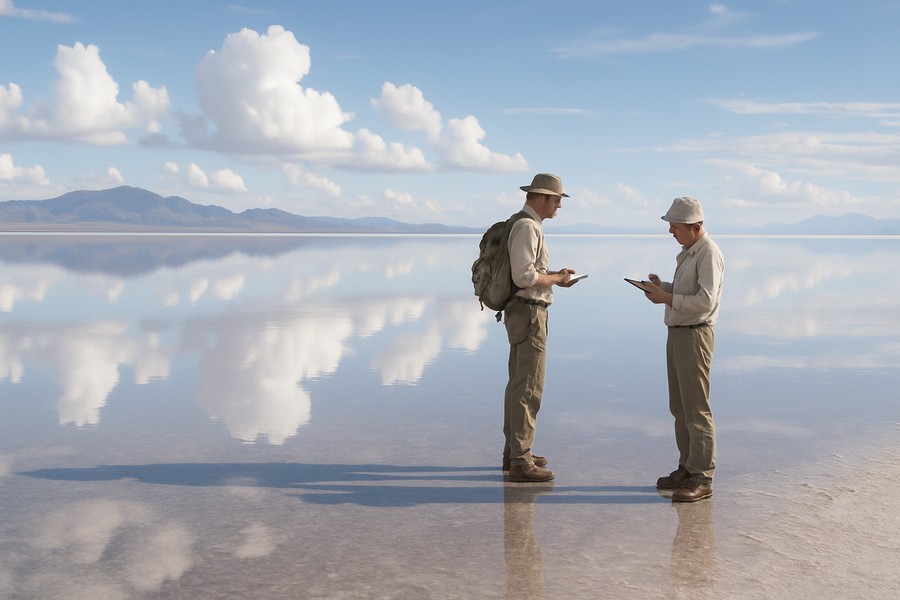
There's no place on Earth quite like Bolivia's Salar de Uyuni. This vast expanse of salt is renowned for transforming into a gigantic mirror when a thin layer of water covers it. Tourists flock here to take awe-inspiring photos of the sky and landscapes mirrored on the ground. However, whether this place truly holds the title of the "world's largest natural mirror" has been up for debate, until now.
A recent study has delved into this unique phenomenon, examining just how reflective this salt flat really is. The results are more complex than you might think.
The Challenge of Studying the Mirror Effect
Most of the evidence for Salar de Uyuni's mirror-like quality is anecdotal, based on photographs taken by visitors. Researching this phenomenon is challenging due to the salt flat's vast size and its inaccessibility during the rainy season. To tackle this, scientists devised a two-pronged strategy.
Firstly, they harnessed data from Sentinel-3 satellites equipped with radar altimeters. These devices emit radar pulses and then measure the signal that bounces back. A stronger return signal implies a smoother surface. They scrutinized over 390,000 radar measurements collected from 2016 through 2024.
Verifying the Data with Field Tests
To ensure the satellite data was accurate, the research team conducted field tests during the wet season's peak in February 2024. The field tests were scheduled to coincide with a Sentinel-3 satellite passing directly overhead. On the ground, they used an optical tool to measure the water's surface and a drone to capture images of the sun's reflection, providing visual proof of the surface's smoothness. These ground measurements confirmed that a strong radar signal from the satellite corresponded to a mirrored surface.
The Findings: A Complex Mirror
So, what did this investigation reveal? It turns out that Salar de Uyuni is not a completely uniform mirror as initially thought. "The Salar de Uyuni is not a vast uniform mirror for the radar altimeter," the researchers noted. "Therefore, it is also likely that it is not a large mirror for optical wavelengths, as suggested in the literature."
Instead, they found that the salt flat's surface changes depending on the location and time. The most mirror-like conditions occur after substantial rainfall and before the water evaporates. The researchers discovered a strong link between high rainfall periods and the mirror effect, confirming that it is directly influenced by the region's weather patterns. They also concluded that the best time to witness this reflection is from late January to early March.
The Role of Wind
One surprising finding was that wind doesn't disrupt the mirror effect. You might expect that a breeze would cause ripples on the surface, breaking the reflection. However, this isn't the case. The researchers suggest this is because the water is so shallow that it prevents waves from forming, even with a breeze.
These findings provide a better understanding of this unique natural spectacle, shedding light on what makes Bolivia’s Salar de Uyuni such an incredible place to visit.