
The Fast-Moving Star Revealing a Giant Black Hole at Our Galaxy's Core
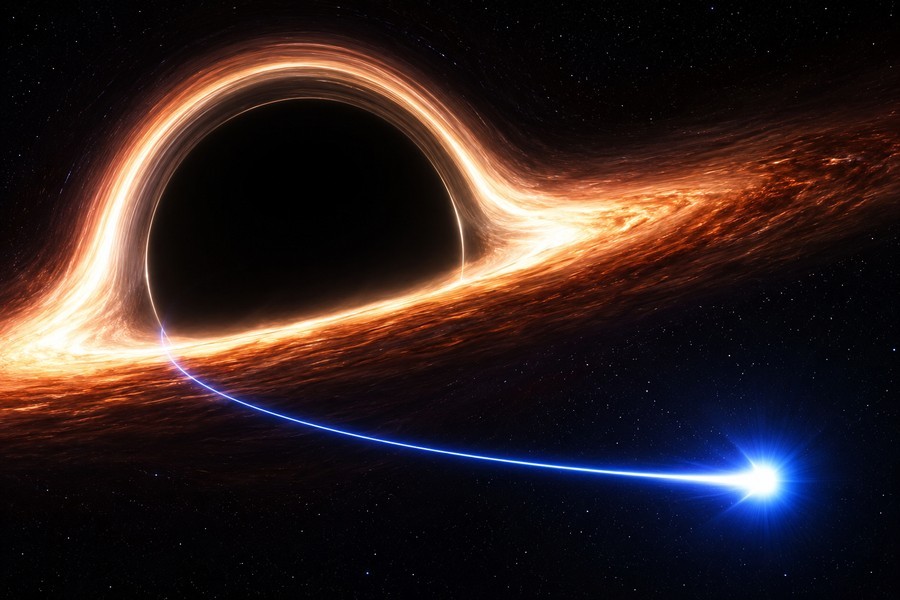
Deep inside the Milky Way, about 26,000 light-years from Earth, a young blue star is performing an incredible cosmic dance. It plunges toward an invisible object, speeds up to an astonishing velocity, and then swings back out into space.
At its fastest, this star travels at about 7,650 kilometers per second. That is roughly 2.55 percent of the speed of light. To put that into perspective:
- At this speed, a spacecraft could travel from the Earth to the Moon in less than one minute.
- The star moves fast enough to cross the entire diameter of the Earth in under two seconds.
This extreme speed allows scientists to study gravity in ways that are normally impossible on Earth.
The Invisible Weight at the Center
The star, known to astronomers as S2, is orbiting a supermassive black hole at the very center of our galaxy. This giant black hole is called Sagittarius A*. It does not emit any light of its own, making it completely invisible to normal telescopes.
For nearly thirty years, two independent teams of scientists watched this star and its neighbors. By tracking their paths, researchers were able to do something remarkable: they weighed the invisible object.
Just like we can calculate the Sun's gravity by looking at how the Earth orbits it, scientists calculated the mass of the black hole by studying the star's path. They discovered that an object with four million times the mass of our Sun is packed into an incredibly small space. A cluster of dead stars or smaller black holes would be unstable and collapse, leaving a single massive black hole as the only plausible explanation.
Seeing Through the Cosmic Dust
Peering into the center of the Milky Way is not easy. Huge clouds of space dust block normal visible light, hiding the crowded center of the galaxy from our view.
To solve this problem, astronomers used infrared light, which can pass through the dust clouds. However, they still had to deal with the blurry effect caused by Earth's atmosphere.
Over the decades, scientists developed advanced technologies to get a clearer picture:
- Speckle imaging: Taking many very quick photos and combining them to capture finer details.
- Adaptive optics: Using mirrors that change shape in real time to cancel out the blur of the atmosphere.
- Interferometry: Combining the power of multiple large telescopes to act as one giant telescope, improving image sharpness by more than a thousand times.
These tools turned a blurry smudge of light into clear, individual stars that could be tracked night after night.
A Swift Sixteen-Year Journey
Most stars take a very long time to orbit the center of the galaxy. For example, our Sun takes over 200 million years to complete just one trip. But S2 is different. Its orbit takes just under 16 years, which is short enough for scientists to watch a complete loop during their careers.
The star's orbit is shaped like a long, stretched-out oval. At its furthest point, it moves slowly. But at its closest approach, it comes within 120 times the distance between the Earth and the Sun. At this close distance, the immense gravity of the black hole whips the star forward at its maximum speed.
Testing Einstein's Theories of Gravity
Because the star gets so close to such a massive object, its path became the ultimate test for the laws of physics. While normal gravity rules can explain most of the star's journey, the extreme conditions at its closest approach require the use of advanced physics.
Scientists observed two major effects predicted by Albert Einstein:
- Gravitational redshift: As the star's light climbed out of the intense gravity of the black hole, it lost energy. This caused its wavelength to stretch and shift toward the red end of the spectrum.
- Orbital rotation: The star does not trace the exact same oval path every time. Instead, the entire orbit slowly rotates over time, creating a flower-like rosette pattern. This shift is very small, but it matches predictions.
A Long-Term Triumph of Science
For a long time, tracking these orbits was the best evidence we had that a supermassive black hole existed at the center of our galaxy. This work was so important that it earned the scientists involved a prestigious global physics prize.
Later, a global network of radio telescopes managed to capture an actual image of the glowing gas and the dark shadow of the black hole itself. This image did not replace the orbital data; instead, it confirmed the findings on a much smaller scale.
The story of this fast-moving star shows the value of patience and steady improvement in technology. By watching a single point of light move across the sky for decades, humanity was able to confirm the existence of a dark giant at the heart of our galaxy.</