
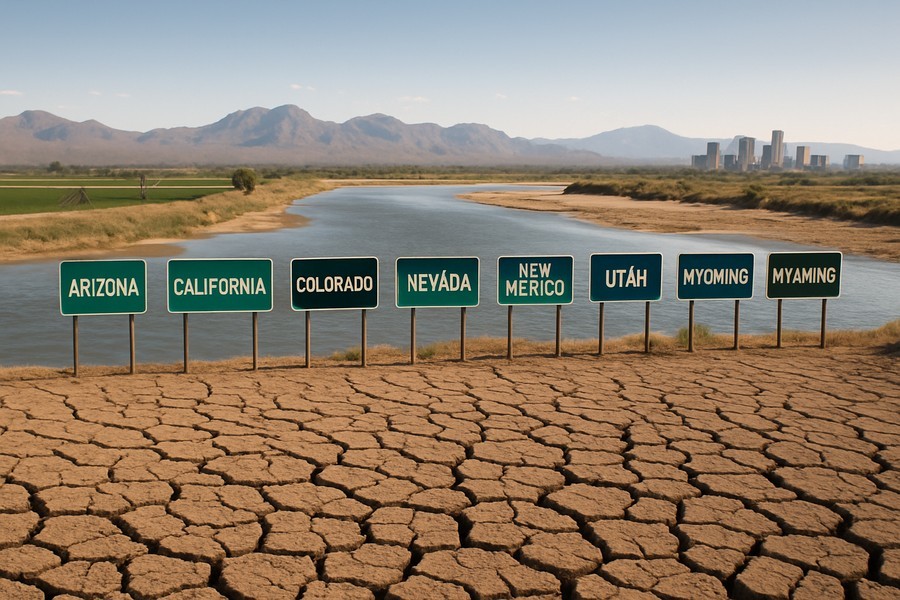
Missed Deadline Prolongs Dispute Over Colorado River Among Seven States
For the second time, the seven states in the Western U.S. that rely on the Colorado River for their water needs have failed to reach consensus on a plan to address the severe drought and water shortages they are facing.
The governors of Arizona, California, and Nevada have come forward, urging the Upper Basin states - Colorado, New Mexico, Utah, and Wyoming - to make more concessions. They highlighted the vital role the river plays in their economies and communities and the extensive water conservation efforts made in recent years to stabilize the basin’s water supplies.
They asserted the importance of shared responsibility among all seven states in conserving water resources.
Proposed Reductions in Water Allocation
Arizona, California, and Nevada have proposed to reduce their Colorado River allocation by 27%, 10%, and 17% respectively, to contribute to the conservation efforts. However, the situation in the Colorado Basin remains critical, as indicated by the state's low snowpack.
One of the state's senators, who played a key role in negotiating a river contingency plan in 2019, emphasized the urgency of addressing the problem collectively and swiftly. He warned of the potential impacts on communities, farms, and economies, and cautioned that litigation would not resolve the issue of prolonged dry spells.
Frustration Over Lack of Progress
The manager of a major water authority in Southern Nevada also expressed his exasperation at the stalemate. He stressed that the actions taken over the past two decades were more about preparing for the worst-case scenario rather than increasing the water level in Lake Mead.
The states had previously missed a November deadline set by the U.S. Bureau of Reclamation to develop a strategy for dealing with water shortages after this year, when the current guidelines will no longer be in effect.
The Importance of the Colorado River
The Colorado River is the lifeblood for over 40 million people across these states, along with Mexico and Native American tribes. It is fundamental not only to farming but also to the provision of water and electricity for millions of homes and businesses. The water primarily originates from winter mountain snowfall in the Upper Basin, which accumulates significantly more than it uses. In contrast, Lower Basin states, including those with heavy agricultural activity, are the larger consumers.
Major metropolitan areas such as Denver, Salt Lake City, Albuquerque, Las Vegas, Phoenix, and Los Angeles are also heavy users of the water. Chronic overconsumption, drought, and rising temperatures due to climate change have reduced the water flows.
Allocation and Conservation of Water
The allocation and conservation of water, particularly during dry periods, have been the focus of agreements among the states for many years. The original 1922 Colorado River Compact was based on water quantities that no longer exist today, mainly due to the persistent drought.
The current round of negotiations among the states has been ongoing for over two years. If no agreement is reached, the federal government might have to intervene and develop a plan, which could potentially lead to dissatisfaction among the parties and even result in litigation.
Declining Snow Cover and Depth
Recent scientific findings have shown that snow cover and snow depth in the West are at their lowest in decades. Some areas have experienced their warmest December through early February. Normally, the snow cover at this time of the year would be approximately 460,000 square miles, equivalent to the size of California, Utah, Idaho, and Montana. However, this year it has shrunk to the size of California alone, roughly 155,000 square miles.