
Alien Communications Hindered by Cosmic Weather, Research Indicates
Scientists who are on a quest to find extraterrestrial life believe that aliens could be trying to communicate with us. However, tumultuous conditions in space might be disrupting these messages.
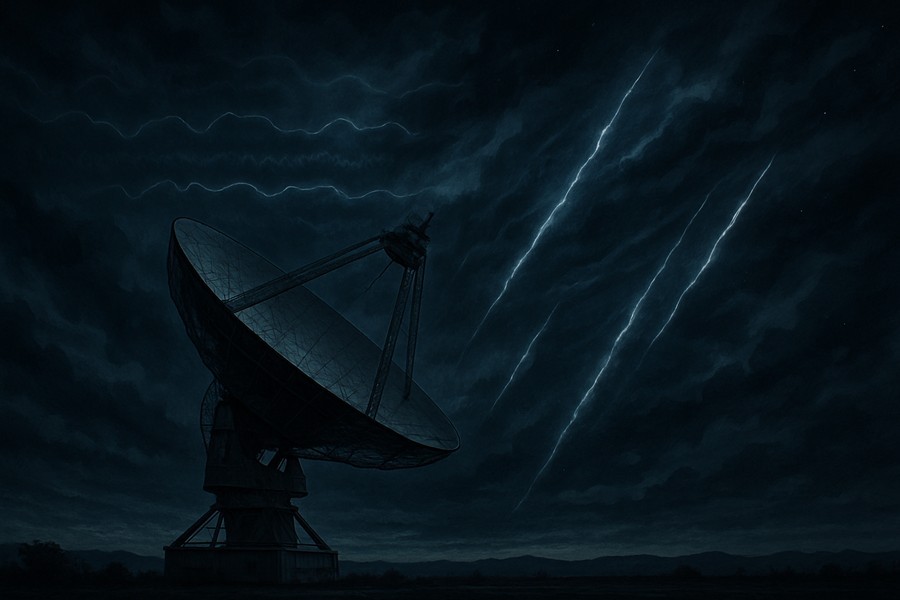
According to a research study conducted by a renowned institute dedicated to finding extraterrestrial intelligence, chaotic space weather can distort radio signals from the far reaches of the universe, making them difficult to recognize.
Space Weather and its Impact on Signal Detection
The institute, which receives funding from our national space agency, noted that events like solar storms and plasma turbulence from a star close to a "transmitting planet" can widen otherwise very narrow signals. This disperses the energy of any such transmission across a wider spectrum of frequencies, making it harder to identify with conventional narrowband searches.
"If a signal is broadened by the conditions of its originating star's surroundings, it can dip below our detection thresholds. Even if it's present, this phenomenon could account for some of the radio silence we've noticed in our searches for technosignatures," noted one of the institute's astronomers.
His findings, co-authored with a research assistant, were recently published in a highly-regarded astrophysical journal.
Challenges in the Search for Extraterrestrial Life
For many years, scientists have been monitoring the skies for signs of non-human life, trying to spot anomalies in frequency that could indicate signals unlikely to have been produced by natural astrophysical processes.
However, this new research introduces an "overlooked complication". Even if an extraterrestrial transmitter produces a perfectly narrow signal, it may not remain narrow by the time it leaves its home system.
"Plasma density fluctuations in stellar winds, as well as occasional eruptive events like coronal mass ejections, can distort radio waves at their point of origin. This effectively smears the signal’s frequency and lowers the peak strength that search pipelines depend on," the research statement explains.
In simpler words, this suggests that aliens might be trying to communicate with us. But if they are, unpredictable cosmic weather conditions have scrambled the messages, making them undetectable to us.
Future Implications of the Findings
The scientists discovered this phenomenon by studying the effects of stellar activity on radio transmissions from spacecraft within our own solar system, and then applying these observations to the environments of distant stars.
The research assistant commented that these findings will force scientists to reassess the traditional methods of searching for alien lifeforms. This includes conducting future observational surveys at higher frequencies.
"By understanding how stellar activity can alter narrowband signals, we can tailor our searches to better match what actually arrives at Earth, not just what might be transmitted," she stated.
The Great Debate: Are We Alone in the Universe?
The question of whether we are alone in the universe continues to intrigue mankind, while the potential existence of unidentified flying objects (now referred to as unexplained anomalous phenomena or UAP) has fueled countless conspiracy theories and inspired many films.
Recently, a former defense department official made an unconfirmed claim to Congress that government employees had been injured during encounters with aliens. This assertion came after a former intelligence official claimed that the Pentagon had been secretly collecting and attempting to reverse-engineer crashed UFOs for decades.
These statements were quickly downplayed by a congressman, who asserted that they were not discussing extraterrestrials or flying saucers in the hearing. He had, however, previously claimed that the U.S. had evidence of technology that "defies all our laws of physics", suggesting that alien crafts possessed technology that could "turn us into a charcoal briquette".
Last month, a former president claimed on a podcast that aliens "were real", only to swiftly backtrack on social media the next day. He clarified that he had seen no evidence of them and was merely carried away by the enthusiasm of the interviewer's questions.
This incident led the current president to declare that he was authorizing the release of all government records on aliens, UFOs, and UAP. "I may get him out of trouble by declassifying," he said, although he admitted to reporters that he was unsure of the reality of these phenomena.