
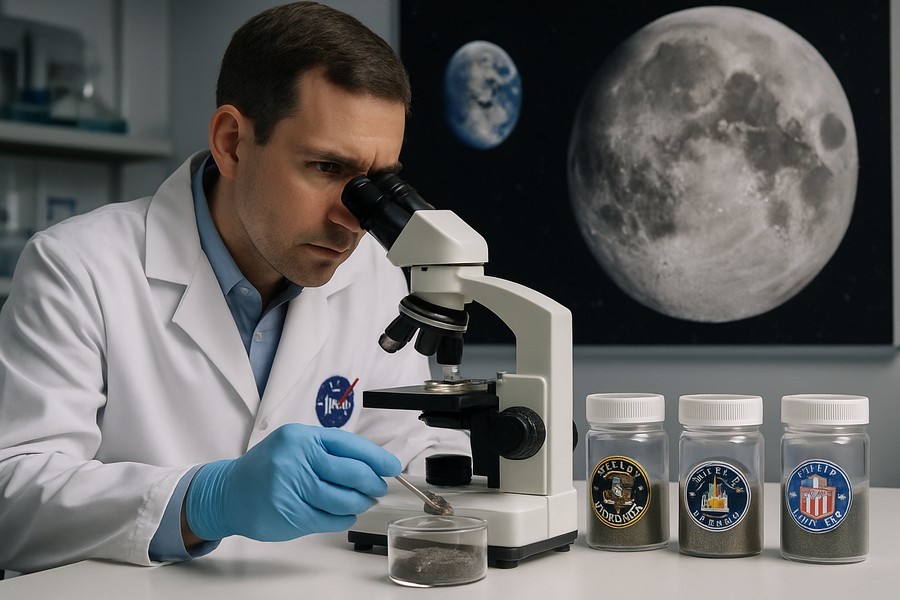
Unraveling Mysteries of Earth's Water Origin Using Lunar Soil
The origin of Earth's water has been a long-standing question that has puzzled scientists for ages. The widely accepted theory was that during the early phase of the Solar System's development, meteorites rich in water collided with the young Earth. These meteorites were believed to be largely responsible for the formation of Earth's oceans.
However, a recent study led by a group of space researchers challenges this theory. Their examination of lunar soil collected from Apollo missions presents compelling evidence suggesting that meteorites didn't contribute significantly to Earth's water content over the past four billion years.
The Moon: A Pristine Record of Meteorite Impacts
The lunar surface acts as an invaluable archive of the Earth-Moon system's impact history. Unlike Earth, which experiences constant changes on its surface due to weather and tectonic activities, the Moon's surface remains largely undisturbed. This allows it to retain a nearly unaltered record of meteorite impacts.
The team of researchers described the lunar soil as one of the few places where they can still decipher a record of what was hitting Earth's neighborhood for billions of years. To understand this history, the scientists employed a technique called triple oxygen isotope analysis.
This method centers on studying oxygen, the major component in rocks, which remains largely unaffected by impacts or other external conditions. The technique enabled the team to identify and isolate meteorite material embedded in the Moon's surface, even after repeated bombardment and soil reworking. The result revealed that only about 1% (by mass) of the lunar soil originated from carbon-rich meteorites.
Questioning the Role of Meteorites in Water Formation
The study indicates that meteorite delivery over the last four billion years could have furnished only a small portion of the water found in Earth's oceans. This contradicts the previously held belief that late-stage meteorite impacts were a significant source of Earth's water.
The team used data on the known water content of carbonaceous meteorites to calculate potential delivery rates. They then scaled these findings from the lunar data to Earth's size and impact rate. However, even after adjusting the lunar values by approximately twenty times to match Earth's exposure, the resulting water volume was still insufficient to account for the levels of our oceans.
Old Lunar Samples Keep Yielding New Insights
The conclusions drawn in this research are based on lunar soil samples collected from the side of the Moon facing Earth during the six Apollo missions. Even though these samples were gathered over fifty years ago, they continue to provide new and valuable insights.
Scientists who are part of the new generation of Apollo researchers, those who didn't participate in the missions but were trained using the samples and the questions they raised, continue to make significant contributions to lunar science. They are helping us understand more about our Earth and its history.