
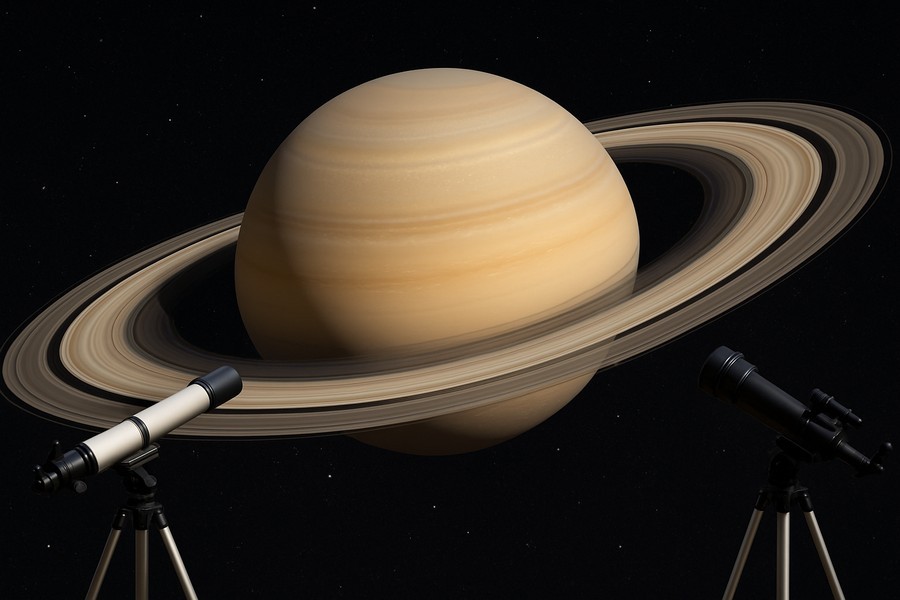
A Step Closer to Saturn’s Secrets: Novel Observations Unveil the Gas Giant
Saturn, the second largest planet in our solar system, has long captivated astronomers with its magnificent ring system and enigmatic atmosphere. However, it wasn't until now that we've been able to explore this gas giant's layers in such extraordinary detail. By harnessing the power of two telescopes, researchers have painted the most comprehensive picture of Saturn to date, offering us an invaluable glimpse into the planet's dynamic system.
Two Telescopes, One Planet: A Collaboration for the Ages
The fascinating study leverages observations from two telescopes to examine Saturn like never before. These telescopes have been used in a collaborative manner to generate a single, multi-wavelength snapshot of Saturn, showing it from multiple angles and in different light wavelengths. This has allowed us to peer into both the planet's atmosphere and its intricate ring system.
One telescope captured Saturn in visible light, showcasing its atmospheric patterns and cloud bands. The other, meanwhile, observed the planet through infrared wavelengths, revealing details that remain invisible to the naked eye — such as the temperature distribution in Saturn’s lower atmosphere and structures concealed beneath the cloud layers. This combination offers a dynamic, multi-layered view of Saturn.
According to astronomers involved in the project, each telescope narrates a unique part of Saturn's tale. The collected data not only enriches our understanding of Saturn's atmosphere, but also aids broader research into planetary atmospheres and their seasonal variations.
Bringing Saturn to Life: A Deeper Look at the Planet
With its ability to observe Saturn in visible light, one telescope has been instrumental in capturing clear images of the planet’s cloud bands and iconic rings. However, its limitations lie in its inability to see beyond the outermost layers of the atmosphere. This is where the second telescope’s superior infrared capabilities come into play. By peering deeper into Saturn’s atmosphere, it grants us a more comprehensive and layered understanding of the planet.
Visible-light images of Saturn show a bright ring system and soft atmospheric bands. However, the infrared observations reveal even more detail, including deep atmospheric structures, possible auroral activity, and storms scattered across the southern hemisphere. With this combination of visible and infrared data, scientists can "slice" through Saturn's atmosphere, offering a multi-dimensional perspective not previously achieved.
This analogy aptly demonstrates the depth of insights provided by this new data. This collaboration goes beyond the surface to uncover the complexities hidden within the planet.
Saturn’s Rings and Seasonal Changes: A Closer Look
Saturn's rings, primarily composed of water ice, are one of the planet's most distinctive features. The recent imagery provides a closer look at this ring system, displaying its intricate structures in both visible and infrared wavelengths. The rings shine brightly in reflected sunlight, while the infrared observations provide clearer views against the dark backdrop of space, revealing previously unseen details.
In addition to the rings, scientists are particularly interested in Saturn’s seasonal cycles. Since a year on Saturn is equivalent to 29 Earth years, the planet’s seasons change over a significantly longer period. These changes impact both the atmosphere and rings of Saturn, and understanding these changes is crucial for studying the planet’s evolving climate.
As Saturn nears its equinox in 2025, the new data is being used to gain deeper insights into the planet’s seasonal shifts and atmospheric patterns. This long-term study, along with these new insights, will enable researchers to refine their models of Saturn’s climate. This provides a more comprehensive view of how the planet changes over time, bringing us a step closer to uncovering the mysteries of this gas giant.