
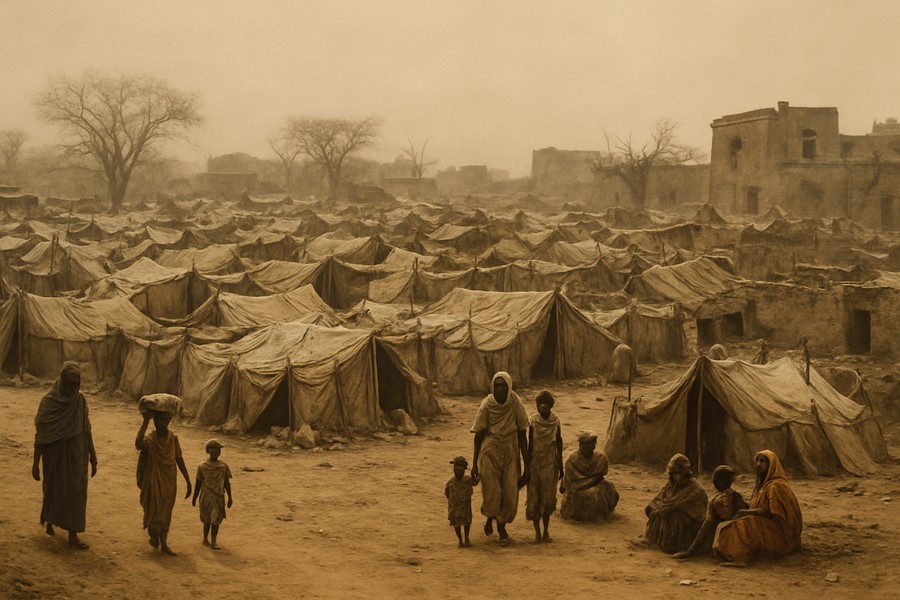
A Neglected Crisis: The Ongoing Struggle in Sudan
For the past three years, the people of Sudan have been living in a state of turmoil due to continuous conflict. The situation has been described as a "neglected crisis" because it seems to be largely ignored by the world. The war has resulted in forced displacement of approximately 13 million individuals from their homes.
The Humanitarian Crisis in North Africa
Sudan, a country located in North Africa, is currently facing the most significant humanitarian crisis in the world. The conflict, predominantly in the expansive Darfur region, has led to mass displacement and hunger, with no resolution in sight. Despite international efforts, a peace agreement has not been reached between the military and the paramilitary group known as Rapid Support Forces (RSF). The RSF is reportedly responsible for widespread devastation in the region.
There are indications that foreign powers are discreetly supporting the warring factions. However, these countries, along with the United States, seem to be more focused on the conflict in Iran, thus further complicating the situation in Sudan.
The Human Cost of War
The numbers paint a grim picture of the situation in Sudan. The war has claimed the lives of at least 59,000 people. Among these, around 6,000 people lost their lives in a three-day massacre in the Darfur region. The United Nations-backed experts have characterized this offensive as bearing "the defining characteristics of genocide". Over 11,000 have gone missing since the start of the conflict.
The war has also triggered famine across parts of Sudan. It is projected that around 800,000 people could suffer from severe acute malnutrition, the deadliest form of hunger. In total, nearly two-thirds of the Sudanese population requires assistance. Moreover, disease outbreaks like cholera are rampant due to only 63% of health facilities being partially or fully functional.
In the face of these adversities, the health personnel in a malnutrition center in the Red Sea city continue to serve. They report that the number of severely malnourished children has doubled since the war began. However, they are struggling with limited resources, with multiple children often having to share a single mattress.
Adding to the woes, the cost of fuel has surged by over 24% due to the Iran war, thereby escalating the prices of food.
Political Power Struggles and Foreign Involvement
The conflict stems from a power struggle following Sudan’s transition to democracy after the military deposition of the autocratic President Omar al-Bashir. This led to tensions between military chief Gen. Abdel-Fattah Burhan, who chairs the ruling sovereign council, and RSF commander Gen. Mohamed Hamdan Dagalo.
In this situation, Sudan's citizens feel powerless and at the mercy of foreign influences. Countries like Germany have tried to rally humanitarian donors and promote a ceasefire, but such attempts have been met with resistance from the Sudanese government.
Sudan is currently split between a military-backed government recognized internationally in the capital, Khartoum, and an RSF-controlled administration in Darfur. While some countries support Sudan's military, others are accused of providing arms to the RSF.
The Potential for Wider Conflict and War Crimes
Analysts warn that the conflict in Sudan could become even more complex and potentially spill over the country's borders. The past three years have witnessed widespread atrocities, including mass killings and sexual violence. Over 2,000 people have died from attacks on hospitals, ambulances, and medical workers.
The International Criminal Court has stated that it's investigating potential war crimes and crimes against humanity, mainly in Darfur. Most of the recent atrocities have been attributed to the RSF and their allies.
Despite the ongoing conflict, the military's takeover of Khartoum and other central areas in Sudan has allowed approximately 4 million people to return to their homes. However, they continue to face challenges such as damaged infrastructure.
As the CEO of an aid group put it, they're not returning to normal but trying to survive amid a new normal. The struggle in Sudan continues, and the world must not forget this neglected crisis.