
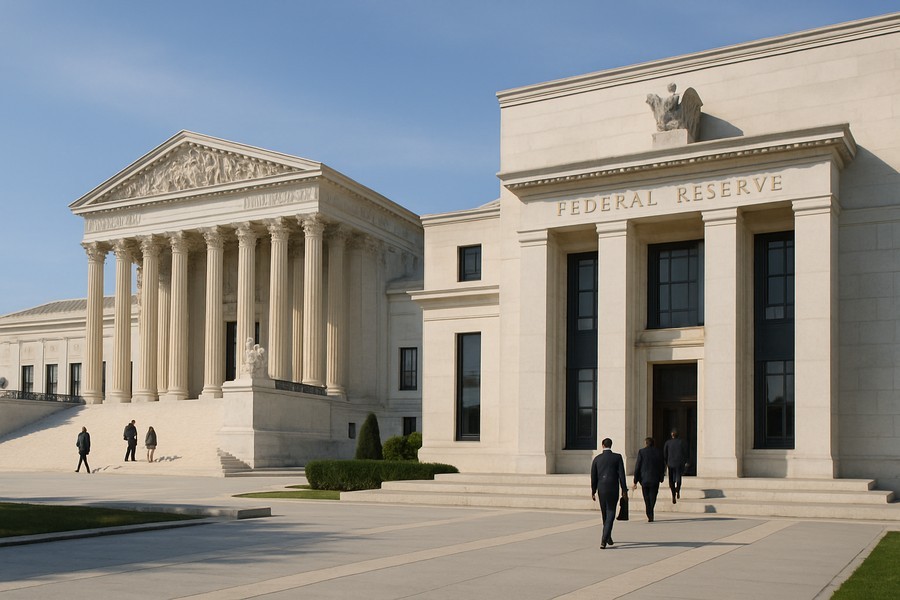
Is the Highest Court Prepared to Challenge a President Over Central Bank Attacks?
The tactics of a certain president to persuade the United States Central Bank to reduce interest rates have been quite noticeable. If gentle persuasion fails, he resorts to intimidation, and if that doesn’t work, he fires. He has subjected the central bank to an unprecedented attack, labeling the Chair of the bank as “foolish” and even threatening to dismiss him for not lowering the interest rates at the pace he desires.
The president's approach towards the Central Bank mirrors his overall strategy for restructuring the national government. His tactic is simple: push hard enough until he gets what he wants. And he has been quite successful so far. However, when it comes to the Central Bank, he might have encountered a formidable foe.
Doubts from the Supreme Court
It appears that the Supreme Court may be ready to stand up to the president. During oral arguments, the justices seemed to be highly doubtful about the president's dismissal of the Central Bank governor. This skepticism could be seen as the court putting a check on the president’s authority. However, legal experts caution that any ruling against the president may not be a severe check on his power.
Instead, it seems the court is creating a unique exception for the Central Bank while the independence of other governmental agencies continues to be threatened. This situation could lead to damaging consequences.
Allegations and Questions
The president ousted the Central Bank governor, citing allegations of mortgage fraud. These charges were initially made on social media, and a few days later, she was removed from her post. The president’s dismissal of the governor was abrupt, without any formal investigation or hearing regarding the alleged mortgage fraud. This has raised several questions that the court must answer in its ruling.
Was there a violation of the governor's due-process rights because she didn’t receive a hearing? Does mortgage fraud, even if it happened before she became a Central Bank governor, justify her removal? Should a lower court have ruled on this case before it was escalated to the Supreme Court?
The Special Case of the Central Bank
The Central Bank was established to be a semi-private, independent government agency that is intended to be free from political influence. Officials of the Central Bank can only be dismissed by the president “for cause”, but the law doesn’t provide a clear definition of what “cause” means.
One significant question that could affect the global economy looms in the background: how much authority will the Supreme Court allow a president over the Central Bank?
Consequences of Power and Independence
Typically, constitutional experts examine how the Supreme Court has decided similar cases. The president's dismissal of the Central Bank governor was not the first time his executive powers were tested. In the past, he has dismissed independent officials, including members of the board overseeing unions and a commissioner of a commission regulating telecommunications and media.
Some conservative legal scholars in the United States advocate for the “unitary executive” theory, which implies that the president should have the power to dismiss any executive branch officers at will. According to this theory, the votes of the American people should be the only limit on the president. For conservative justices on the Supreme Court who support this theory, the president's second term has presented them with an ideal opportunity.
The Exception of the Central Bank
Despite the apparent inclination of conservative justices to give the president more power, there seems to be one exception: the Central Bank. The Supreme Court has even mentioned the Central Bank when it allowed the president's previous dismissals to proceed.
Many interpreted this as a signal from the court indicating that if the president attempts to dismiss an executive within the Central Bank, they would resist. Legal experts note that, by law, the Central Bank's structure within the federal government is no different than other semi-private, independent agencies.
Dealing with the Delicate Balance
The Central Bank's power largely comes from its ability to adjust interest rates. High interest rates make borrowing more expensive, which can curb inflation but risk boosting unemployment. It's not surprising that a president would want lower interest rates: they can provide a short-term economic boost, but risk causing higher prices later on.
Striking the right balance requires careful examination of economic data and prioritizing the long-term stability of the economy over the political success of those in power. Interfering with the Central Bank's independence could trigger economic shocks like a recession.
Waiting for a Decision
The outcome of the case against the Central Bank governor is still uncertain. Although the Supreme Court has been generally accommodating of the president's executive power, this case might pose a unique challenge. A ruling is expected to be issued by mid-year.