
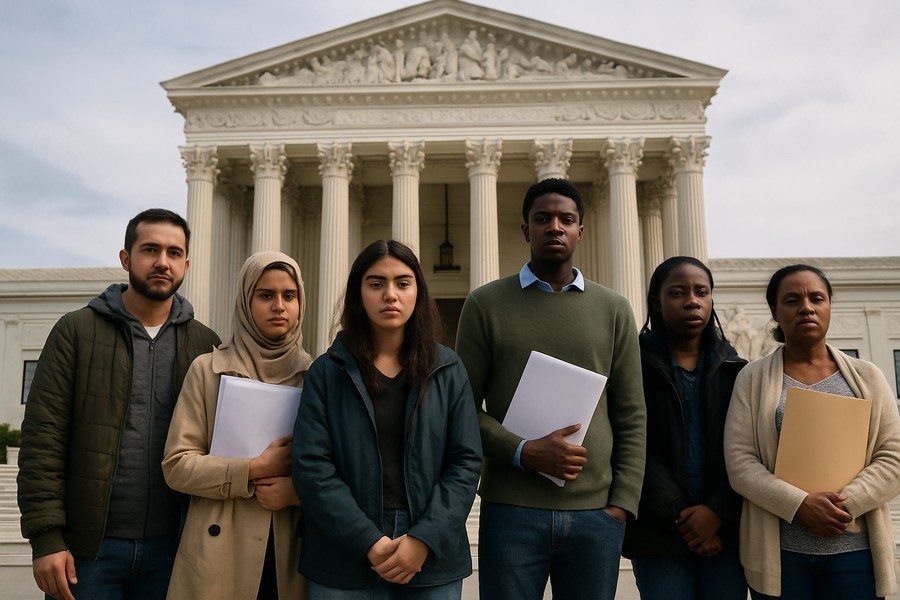
Supreme Court to Examine Efforts to Revoke Temporary Deportation Safeguards for Syrians, Haitians
The Supreme Court has declared its intention to look into the efforts to abolish temporary deportation safeguards for immigrants from Syria and Haiti. This move comes amidst a bitter legal struggle over the Temporary Protected Status (TPS) granted to these two nations. However, the Supreme Court has not given the go-ahead for these protections to be ended while the case is under consideration.
The plea for emergency relief and the suspending of lower court orders that prevented the termination of TPS for over 6,000 Syrian and 350,000 Haitian immigrants was put forth by the Justice Department. The Supreme Court, in a concise unsigned order, has chosen to hold off on considering these requests, allowing the rulings of the lower courts to stand for the time being. The cases will be orally argued in late April.
Legal Protections for Immigrants: A Continuing Debate
The controversies surrounding the legal protections for immigrants from Syria and Haiti are the most recent in a series of issues related to immigration to reach the Supreme Court. The legality of the plan to eliminate birthright citizenship will also be debated on April 1. The final decisions for these cases are expected to be announced by late June or early July.
The Supreme Court has previously permitted the removal of deportation protections for over 300,000 Venezuelans in the U.S. while the legal proceedings were ongoing. The Department of Homeland Security has also taken steps to end TPS designations for several other countries including Afghanistan, Nicaragua, Somalia, and Yemen. The argument put forth is that the courts do not have the authority to review TPS determinations.
Understanding Temporary Protected Status
Temporary Protected Status was established by Congress in 1990. It offers temporary immigration protections for individuals from countries experiencing armed conflicts, natural disasters, or other "extraordinary and temporary" conditions that make it unsafe for deportees to return. Those from a country designated for TPS generally cannot be removed from the U.S. and are authorized to work for the duration of the designation, which typically lasts 18 months but can be extended.
The Situation in Haiti
Haiti was first granted TPS in 2010 after a massive earthquake that caused widespread destruction and led to the death of over 300,000 people. The program has been extended multiple times for Haitian immigrants, including in response to the assassination of the then-President and due to ongoing economic, political, security, and health crises. However, steps were taken to revoke TPS for Haiti last year.
Despite acknowledging that certain conditions in Haiti remained "concerning," the decision to terminate the protections was justified on the grounds of certain parts of the country being "suitable" for return. This move was challenged by a group of five Haitian nationals, leading to a federal district court granting their request. The court found that the decision to revoke the protections was likely driven by racial bias.
The Situation in Syria
Syria was designated for TPS in 2012 following a brutal crackdown by the former Syrian President. Protections for Syrian immigrants were extended several times. However, efforts to end the program for Syrians were made last year, citing the collapse of the former regime and the lifting of sanctions against the country.
The termination of deportation protections for Syrian nationals in the U.S. was supposed to happen last November. However, after a group of seven Syrians challenged this decision, a federal district court delayed the termination. The judge found that the move to rescind the protections was based on a political decision to end TPS altogether.
