
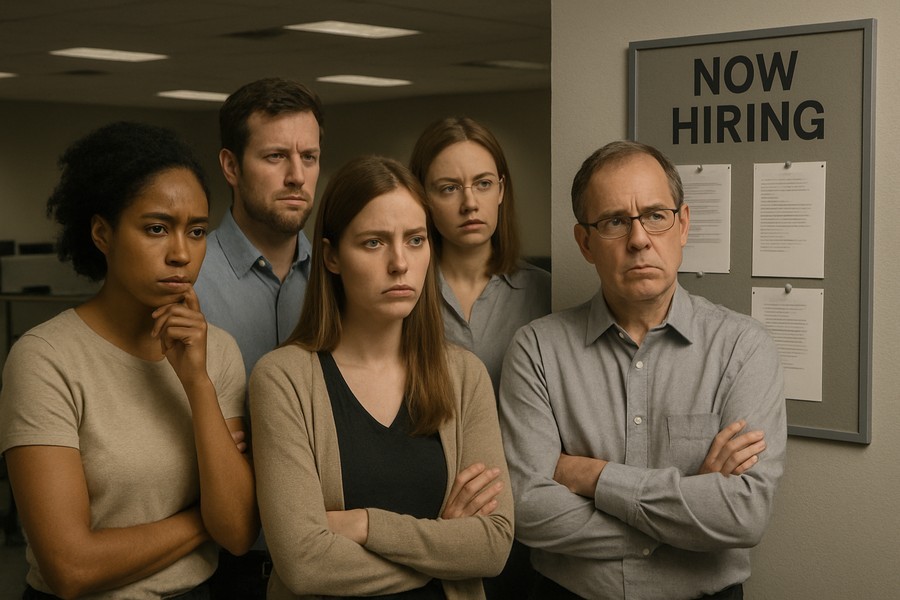
Recent Survey Reveals Dim Job Prospects, According to US Workers
In a striking turn of events, American workers are becoming more negative about the state of the job market. This unwanted change in sentiment is quite unexpected, considering the current low unemployment rates, yet it seems to reflect a persistent lack of new hiring opportunities.
Only a little over a quarter of workers who participated in a late-year quarterly survey believed it was a favorable time to land a high-quality job. This is a drastic change from a few years ago when the majority of workers expressed positive views about job hunting.
The surprising shift in attitude happened fairly quickly. Just a year ago, close to half of workers still thought it was a good time to look for a job. The survey took place just before a conflict in the Middle East led to escalating oil and gas prices, which could potentially slow down the economy as people have to spend more on fuel and less on other things.
College Graduates Particularly Gloomy
College-educated workers are showing a high level of job market pessimism. This is likely due to the weak hiring trends in many professional sectors over the past couple of years, including software development, customer service, and advertising. The survey revealed a disparity based on education levels: less than a fifth of workers with a college degree believed it was a good time to find a quality job, whereas over a third of workers without a degree felt optimistic.
An additional survey involving American adults in general discovered that college graduates' optimism about the job market is at its lowest since 2013. Interestingly, the gap in job market sentiment between Americans with and without a college degree has never been wider since the survey began in 2001.
Young Workers Express Dissatisfaction
Only about 20% of workers aged 18-34 believe now is a good time to find a job, compared to about 40% of workers aged 65 and older who express the same sentiment. This aligns with what experts term the "low-hire, low-fire" job market where businesses are largely retaining their employees and layoffs remain quite low. As a result, older workers feel secure in their jobs. But hiring is also sluggish, making it challenging for younger workers to secure stable employment.
The survey also found that younger workers are much more likely than older workers to say they are actively seeking a new job or keeping an eye out for opportunities. While most Gen Z and Millennial workers are at least on the lookout for opportunities, about three-quarters of baby boomers say they're not looking at all.
Other Indicators Point to Negative Economic Views
The survey's results coincided with government data revealing that overall hiring is at its weakest in more than a decade. The hiring rate was just 3.2% last November, the lowest since March 2013. This low hiring rate suggests that finding a job now may be much harder than the low unemployment rate would suggest.
Government data also shows there are more people out of work, about 7.4 million, than there are available jobs, approximately 6.9 million. This is a significant shift from the initial years following the pandemic when job vacancies outnumbered those unemployed.
The survey also found that workers have a less positive view of their current life and future prospects than at any point since 2009. Other surveys reflect a similarly gloomy outlook on the economy. Although more people believe jobs are 'easy to get' than 'hard to find', the gap between these two groups has been steadily closing in recent years.
The extensive survey involved over 22,000 American adults working both full-time and part-time. The margin of error for all respondents was within 1.0 percentage point.