
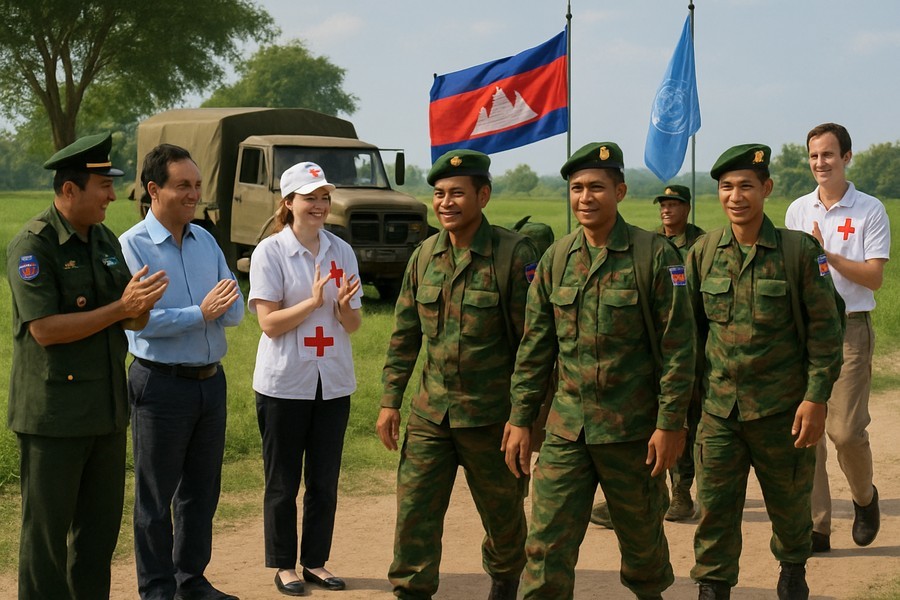
Soldiers from Cambodia Freed Amidst Ongoing Ceasefire
In a show of goodwill, 18 soldiers from Cambodia, who had been held captive, were set free. This move comes shortly after a ceasefire deal between two nations experiencing weeks of intense border conflicts.
Return to Homeland
The National Defense body of Cambodia confirmed that the soldiers touched down on their home turf at a designated time. They had been held captive for over 150 days.
The Foreign Affairs department of the other nation corroborated this event, describing it as a "demonstration of goodwill and confidence-building". The release was successfully coordinated with the help of the International Committee of the Red Cross.
Praise for Peace
The handover of the captive soldiers was met with applause from the International Committee of the Red Cross. The President of the committee highlighted that the release and repatriation of the soldiers allowed families to be reunited and was a significant move in executing the agreements reached in the ceasefire deal.
The President further underscored the importance of adhering to international humanitarian law, which includes repatriating prisoners of war at the end of active hostilities, in building confidence between the conflicting parties and facilitating lasting peace.
In addition to coordinating the handover, the International Committee of the Red Cross had also paid visits to the prisoners a few times since their capture to ensure their conditions were in alignment with international law.
Relief and Reservations
A policy researcher from a Cambodian think tank expressed relief at the soldiers' release, stating that it was long overdue. However, he also raised concerns about the captor nation's use of the soldiers as leverage, and questioned their commitment to humanitarian law.
He conveyed that the release was a significant relief for the people of Cambodia and a rare piece of good news following weeks of deadly conflict. Despite this, he noted that the event did little to mend the deeply strained relations between the two nations, and that resentment was still high among Cambodians.
Conflict and Ceasefire
The border conflict between the two nations flared up again recently, following the collapse of a ceasefire deal that was brokered with the help of the United States President and the Malaysian Prime Minister to end a previous round of conflict.
The recent clashes, which went on for 20 days, resulted in the death of over 100 people and the displacement of more than half a million people on both sides. The fighting involved exchanges of rocket fire, artillery barrages, and fighter jet sorties.
Yet another ceasefire was agreed upon by the two nations over the weekend, which was put into effect shortly thereafter. The captive soldiers were supposed to be returned earlier, but the handover was delayed due to alleged breaches of the ceasefire agreement, a claim which Cambodia refuted.
Border Dispute
The two nations have also agreed to halt troop movements and collaborate on the demining of their disputed 800-kilometer border. This longstanding disagreement over border demarcation dates back to the early 1900s when France occupied Cambodia.
Earlier conflicts along the disputed border resulted in numerous casualties and the displacement of hundreds of thousands of people. Both Cambodia and the other nation blamed each other for instigating the conflict.
The Prime Minister of the other nation was ousted from office after being accused of mishandling border talks with the former leader of Cambodia. The border has been a point of contention and the site of clashes between the two nations for several years.
The disputed border zone is home to ancient temples built by the Khmer Empire, one of which is a UNESCO World Heritage Site and has been the subject of an International Court of Justice case between the two nations. The court ruled in favor of Cambodia in both 1962 and 2013.