
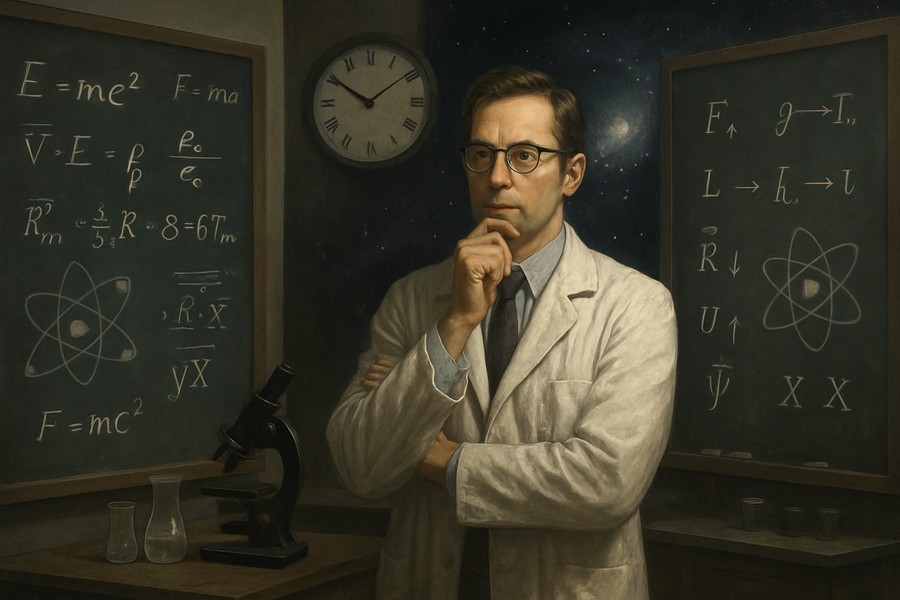
Why We Likely Won't Live to See a Unified Theory of All Forces
At the age of 13, a future physicist received a science book signed by Albert Einstein. This book, co-authored by Einstein, sparked his curiosity about the inner workings of atoms. This curiosity led him to solve a mystery that had long puzzled particle physicists: could the fundamental elements of protons and neutrons, known as quarks, be separated?
Alongside two other scientists, he developed the principle of asymptotic freedom. This showed that the forces between quarks lessened as they got nearer to each other and increased as they moved apart. This principle became a crucial part of a larger model called quantum chromodynamics, which was key to unifying the strong, weak and electromagnetic forces. This achievement completed the Standard Model of particle physics and earned the trio the Nobel prize in physics in 2004.
Switching Focus to Unifying Gravity
For many years now, this physicist has shifted his attention from studying atom parts to developing string theories that could unify the fourth force, gravity, with the other three. He was the director of a renowned institute for theoretical physics and received a $3 million Special Breakthrough Prize in Fundamental Physics, recognizing his lifetime of achievements in physics.
He explained that his interest in physics began with his fondness for math puzzles. Reading the Einstein-signed book at his bar mitzvah made him realize that mathematical puzzles were far more interesting when applied to the real world. This realization led him to decide to become a theoretical physicist.
After developing the theory of asymptotic freedom and winning the Nobel prize, the physicist turned his attention to string theory. He explained that string theory presents the best chance of understanding how the universe began. However, he admitted that testing these theories is challenging due to the extremely high energy levels required.
The Danger of Nuclear War
Despite his ongoing work in theoretical physics, the physicist expressed his concerns about the survival of humanity. He estimated that due to the threat of nuclear war, humans have approximately 35 years left. He believes the likelihood of a nuclear war happening each year is about 2%, which implies an expected lifetime of about 35 years.
To mitigate this risk, he suggested nations take certain steps, such as engaging in diplomatic conversations and avoiding arms races. He expressed worries about the increasing number of nuclear powers and the automation of weapons, fearing that artificial intelligence (AI) could soon control these instruments. He warned that AI could make mistakes and emphasized the importance of maintaining human control over such decisions.
He concluded by expressing his hope for the eventual elimination of nuclear weapons, as keeping them would always pose some risk. He fears that if humans don't manage to survive for much longer, it could answer the question posed by physicist Enrico Fermi: "Where is everybody?" The worrying answer might be that other civilizations in the galaxy have already destroyed themselves.
Finally, he emphasized that while the problem of nuclear war might seem overwhelming, people have the power to make a difference, just as they have done with climate change. He asserted that humans created nuclear weapons, and it's within our power to stop them.
Note: This conversation has been simplified and condensed for clarity.