
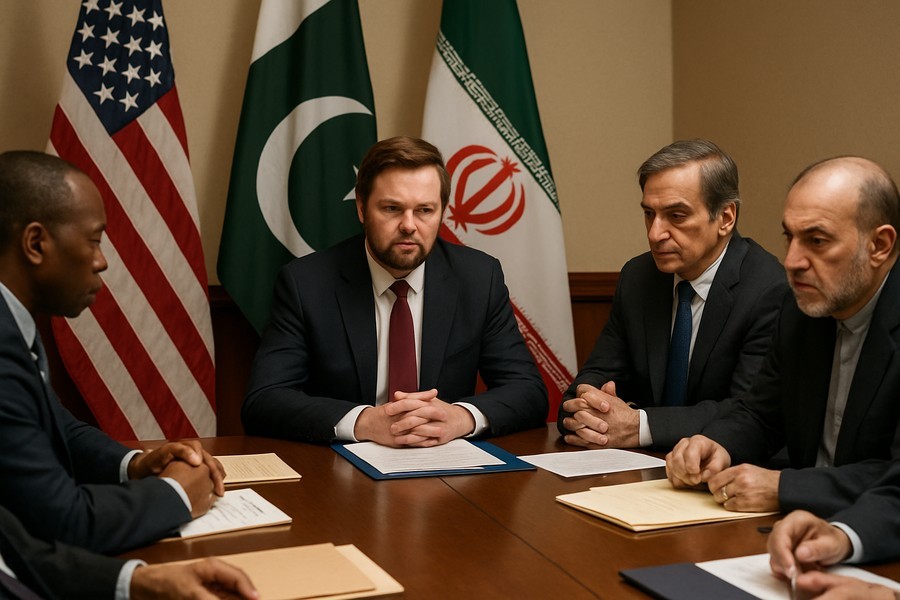
A Complex Mission for Vice President Vance
During a recent Easter celebration at the nation's capital, the current president humorously tossed the responsibility for a successful peace deal with Iran squarely onto Vice President JD Vance's shoulders. The president mentioned Vance's role in a major negotiation to bring an end to the ongoing conflict in Iran, stating that if the deal doesn't come together, it's Vance's fault. However, if it does, the credit goes to the president.
Vance’s Diplomatic Challenge
This quip underscores the challenging situation Vance finds himself in. As the head of the US delegation in Pakistan, Vance is navigating tense talks with Iran. This task is the most demanding one Vance has faced during his vice-presidency - a task that brings with it high stakes and potential pitfalls if the negotiations collapse.
The diplomatic mission in Pakistan is filled with political traps. To achieve a lasting agreement to end the conflict, Vance needs to appease multiple parties with conflicting interests, all of whom have grown mistrustful after a six-week military campaign that has disrupted the Middle East and the global economy.
Crucial Stakeholders
Each party in this situation has its own unique concerns. The president has wavered between calling for peace and threatening to obliterate Iran's civilization. Any agreement will need to win his approval. It will also have to satisfy Tehran, which has fortified its control over the Strait of Hormuz. The support of an Israeli ally, cautious of a region-wide ceasefire, and European allies who have been hesitant to support America in reopening the strait must also be secured.
On top of that, Vance will also have to respond to the domestic pressures and satisfy the president's base, many of whom are against foreign interventions. They will be closely monitoring this trip for hints about how Vance might handle foreign policy if he decides to run for president in 2028.
High Stakes and Expectations
As Vance left for Islamabad, he managed to keep expectations in check. He emphasized the importance of Iran negotiating in good faith, and was forthright in warning Iran not to attempt to manipulate the situation. He also mentioned the president's clear directives to the US negotiating team.
However, the president is known for his capricious nature and unpredictable changes of mind. Therefore, Vance and the rest of the US team will have to manage the challenge of representing a changeable president, especially since the president has offered a multitude of reasons for the conflict since it started.
A New Role
As a former Marine and outspoken critic of past US interventions, this mission is a new role for Vance. But he has shown his ability to handle tough situations and confrontations in the past. The question now is whether he can adapt his approach to handle the delicate and complex diplomacy needed in these negotiations.
The stakes are high, and the issues to be addressed, such as reopening the Strait of Hormuz and ending Iran's nuclear program, are intricate with no straightforward solutions. Despite these challenges, many see this as an opportunity for Vance to demonstrate his leadership and diplomatic skills on the international stage.
A Relative Newcomer
Despite some observers questioning the president's decision to assign such a high-stakes task to Vance, others see it as a sign that the administration is serious about achieving a peace deal. This mission, however, won't be an easy one. Vance will need to rely not just on his negotiation skills but also on his capacity to navigate complex relationships with foreign leaders.
While he may be a relative newcomer to the world of international relations, Vance has already proved himself to be a loyal and trusted lieutenant to the president. This assignment gives him a chance to highlight his ability to represent the country's interests on the global stage and to secure an agreement that the president can support.