
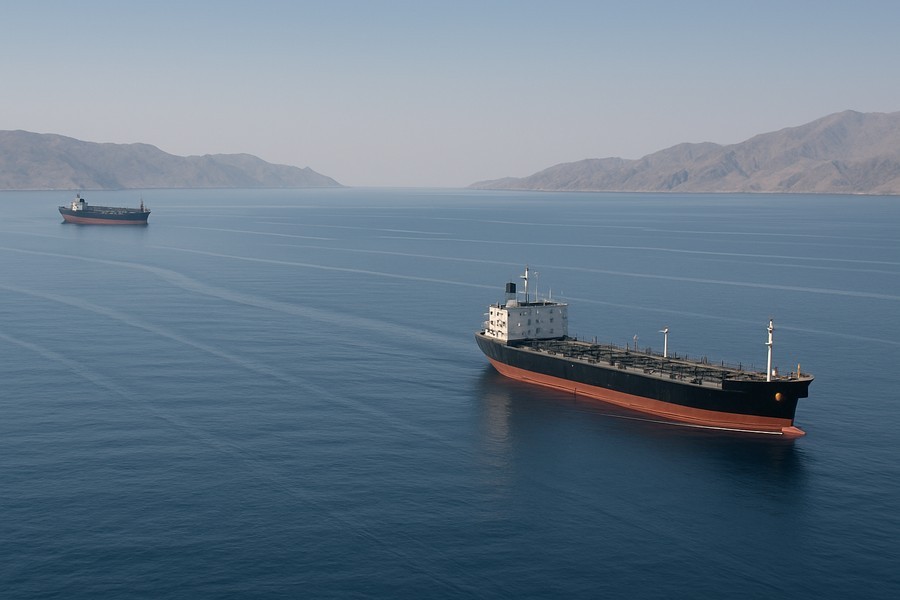
Efforts to Revive Shipping in the Hormuz Strait Fall Short
Despite promises to secure free energy flow globally, only two ships unrelated to Iran or Russia have dared to navigate the Hormuz Strait. This comes after the announcement of urgent measures to revive shipping through this critical water passage. One of the brave vessels that undertook this journey went silent by turning off its tracking device, while the other indicated it was Chinese-owned and manned.
The Vital Hormuz Strait
The Strait of Hormuz is an essential waterway that typically sees around 100 vessels daily, either leaving or entering the Gulf. However, due to recent hostilities, Iran has effectively closed the strait, attacking at least ten ships attempting to pass through in the early stages of the conflict.
In an attempt to reactivate shipping through the strait, a $20bn reinsurance plan was announced. The instigator of the plan also urged shipowners to show courage and sail through the conflict zone.
Tankers Venture Through the Strait
Despite the precarious situation, a handful of tankers and dry goods carriers have dared to cross the strait since the announcement, employing various strategies to lessen the risk. One such vessel, a Chinese-made ship operated by a Greek company but sailing under a Liberian flag, crossed the narrow strait to leave the Gulf. The ship turned off its tracking device as it neared the strait and then resumed signalling near India's coastline en route to Mumbai.
A second vessel, a bulk carrier also sailing under a Liberian flag, signified it was entirely Chinese as it crossed the strait after picking up its cargo from a port in the United Arab Emirates.
A Sparse Number of Vessels
Only eight other ships are thought to have entered or exited the Gulf via the strait over the weekend, all of which appear to have ties to Iran or Russia. These include an oil tanker sailing under the Iranian flag and another oil/chemical tanker identified by the US authorities as having transported Iranian oil.
On Monday, another tanker known to have shipped Iranian crude oil and previously sanctioned by the US, left the Gulf through the strait. Two vessels carrying liquefied petroleum gas (LPG) also navigated the strait over the weekend. One of these ships is part of the Iranian "dark fleet," and the other has been under US sanctions for aiding the Russian energy industry.
Impact of the Conflict
Before the recent attacks, approximately 20% of the world's petroleum consumption and nearly a fifth of the world's liquefied natural gas passed through the Strait of Hormuz daily. Monday saw oil prices surging to their highest levels since 2022, at $119 a barrel, before falling below $90 after news of a potential truce with Iran.
Along with the insurance plan for ships embarking on the journey, it was suggested that naval escorts could provide safe passage for tankers in the Gulf. However, insurers have cautioned that such escorts would likely make the tankers more of a target.
The Uncertain Future
Shipping experts note that, despite the high freight rates companies could charge, insurance premiums are not the main concern. The primary worry is the risk of missile or drone attacks. Unless there is a significant improvement in the security environment, shipping flows are likely to remain exceedingly limited. Iran still has the ability to strike targets and vessels if they choose to do so.
A diplomatic solution could restore flows within a few weeks, with China likely being the main negotiator due to their huge economic risk. If no solution is found and Iran adopts a more decentralized warfare approach, this situation could persist for months, posing a significant concern for energy flows.