
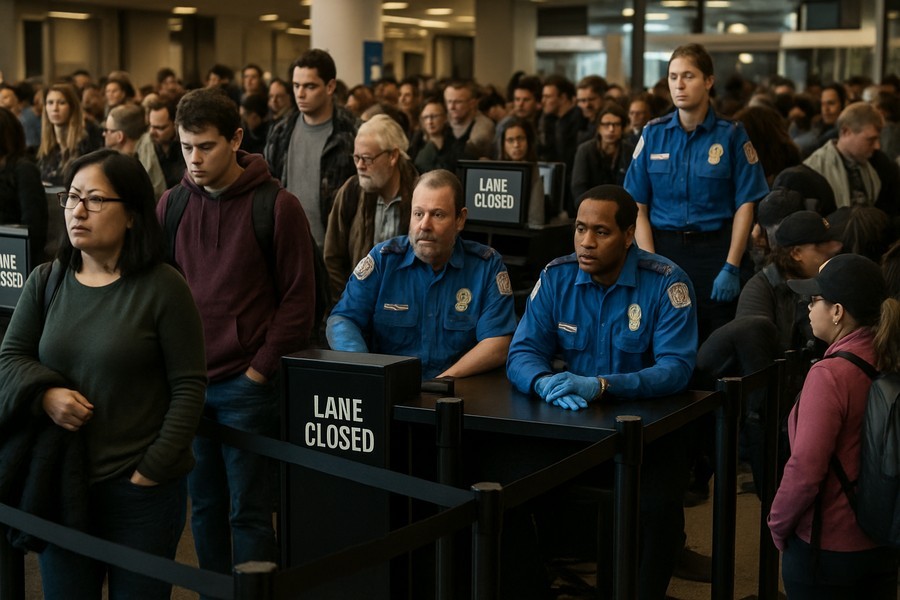
Security Screening Workers Continue Duties Unpaid Amidst Government Standstill
Amidst a government shutdown, security screening staff at a major airport in Atlanta are continuing to work without pay, leading to a noticeable reduction in personnel. This resulted in long waiting times of up to two hours for passengers.
As the busy season for spring break travel gets underway, many security officers are working unpaid shifts, causing extended queues at several airports across the country. This situation was particularly noticeable at an international airport in Houston, where over half of the security staff did not report to work.
Government Employees Falling Victim to Funding Deadlock
These security personnel are part of a larger group of 61,000 government employees from the Department of Homeland Security, who have found themselves caught in the crossfire as lawmakers fail to agree on funding for the agency.
According to a union president in Atlanta, passengers have been understanding of the situation. However, it appears that many are unaware of the ongoing government shutdown. Meanwhile, the unpaid employees are facing severe financial challenges, including eviction notices, vehicle repossessions, and overdrawn bank accounts.
The current shutdown has already driven at least 366 security officers to resign. These employees have experienced three instances of pay disruption due to funding lapses in the past six months.
The Impact of Continuous Shutdowns
Last year, the U.S. experienced the longest government shutdown in its history, during which federal employees, including security officers and air traffic controllers, went without pay for 43 days. This resulted in some employees leaving their jobs to find alternative sources of income, causing disruptions in travel. Although back pay was provided after the shutdown ended, some employees were still dealing with debt until February.
Unfortunately, another brief shutdown occurred in late January, and the temporary funding provided by Congress ran out by mid-February, leading to more missed paychecks for these workers. The union president shared stories of officers unable to afford crucial medical treatments due to the financial strain.
Community Support Amidst Crisis
Many airports have called upon travelers to assist the unpaid security officers. Airports in Denver, Seattle, and Las Vegas are requesting donations of items such as grocery and gas gift cards, food, hygiene products, and baby supplies.
The city of Atlanta has also shown support, providing two meal vouchers per shift and free parking to the security officers. In Austin, a burger truck was brought in to feed the unpaid staff, while in Baltimore, a local food bank delivered food boxes for the 600 security officers on duty.
Despite the overwhelming support, it is not enough for these workers who are losing thousands of dollars needed for survival. One representative described the donations and assistance as applying Band-Aids to a patient who lost a limb, indicating that the situation needs a proper solution and not just temporary fixes.
Public Misconception and Low Pay Add to the Struggle
Public confusion about who pays the security officers - the federal government, airport, or airline - adds to the struggle. Travelers tend to blame everyone when the process doesn't work, further complicating the issue.
Moreover, security officers are among the lowest-paid federal workers. While the loss of paychecks would hurt any worker, it's especially difficult for these employees. The starting salary for these positions is roughly $40,000, with some areas offering slightly higher wages. Despite a pay increase in 2024 to match other federal employees, the financial strain of working without pay is substantial.
Awaiting the End of the Shutdown
Much like passengers at the end of a lengthy security line, it seems that an end to the current shutdown is not in sight. Negotiations are ongoing, but no significant progress has been made. In the meantime, airlines, passengers, and especially unpaid security officers continue to face high levels of stress and uncertainty.