
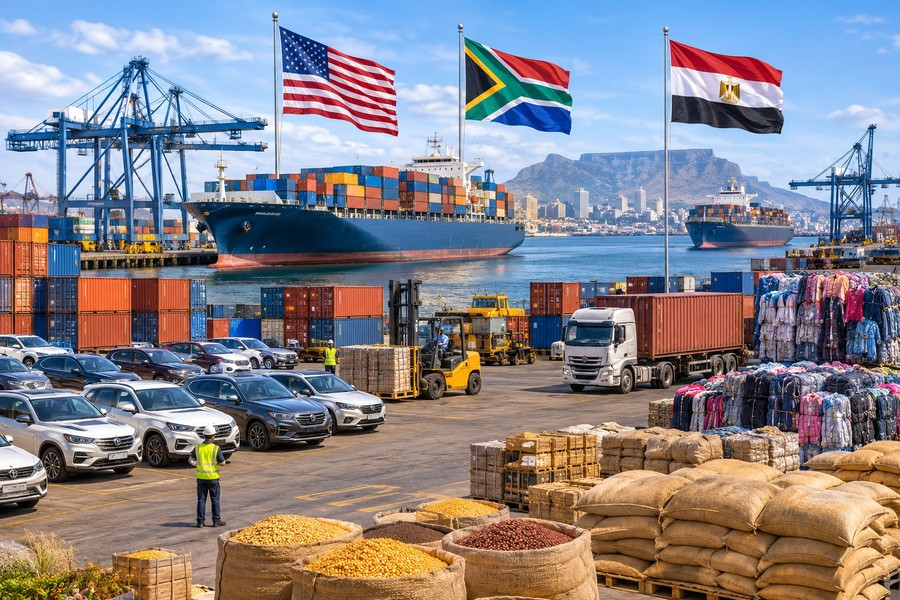
U.S. Changes Trade Policy With South Africa While Expanding Economic Ties With Egypt
The United States is changing its economic approach in Africa as competition with China and Russia grows. Washington plans to remove South Africa from a major duty-free trade program while signing a large development agreement with Egypt.
South Africa Could Lose Duty-Free Trade Access
The U.S. government plans to end South Africa’s access to duty-free trade benefits under the African Growth and Opportunity Act. The change is scheduled to take effect at the start of the planned cutoff period.
South Africa is the largest beneficiary of the program. During the most recent year covered by the trade figures, South African businesses sent about $1.7 billion in goods to the United States without paying import duties.
Those exports included several important product groups, such as:
- Vehicles and vehicle parts
- Textiles and clothing
- Agricultural products
U.S. Trade Representative Jamieson Greer said the governments of South Africa and Rwanda had taken actions that did not match the program’s requirements. The trade program includes eligibility rules covering government practices and economic cooperation.
South Africa has said it wants to settle the disagreement before the trade benefits end. U.S. representatives have also made clear that trade between the two countries will continue, even if South African products no longer receive special treatment.
Without the duty-free arrangement, South African goods entering the American market could face higher import taxes. That could raise prices, reduce sales and make it harder for some South African companies to compete with suppliers from other countries.
Washington Signs a Major Agreement With Egypt
At the same time, the United States has signed a five-year framework agreement worth $625 million with Egypt. The plan is designed to support economic growth and increase cooperation between the two countries.
Egyptian foreign affairs officials and U.S. Chargé d’Affaires Robert Silverman attended the signing. The agreement focuses on several areas that affect daily life, long-term development and business activity.
The main areas include:
- Water management
- Clean energy
- Healthcare
- Artificial intelligence
- Agriculture
The agreement is expected to support projects that use American technology. It may also create new opportunities for American companies to sell equipment, provide services and take part in development projects in Egypt.
The deal comes as the United States works to strengthen its economic connections across Africa. China and Russia have also expanded their presence through investment, loans, construction projects and other partnerships. As a result, African countries have become an important area of competition among major world powers.
Egypt Maintains Relationships With Several Powers
Egypt has taken a different path from the Alliance of Sahel States, a group that has moved away from Western influence and developed closer ties with Russia. Cairo has instead maintained relationships with the United States, China and Russia at the same time.
Egypt recently completed a joint air exercise with China called “Eagles of Civilization.” The exercise showed that military cooperation between Cairo and Beijing continues to grow.
Russia also plays a major role in Egypt’s energy sector. Moscow is funding 85% of the El Dabaa nuclear power plant through long-term state loans. The project gives Russia an important economic and strategic connection to Egypt.
Even with these growing relationships, Egypt continues to maintain a strategic partnership with Washington. The United States recently removed human rights conditions tied to $320 million in military aid to Egypt. This allowed the funds to be released as Washington sought to strengthen security cooperation with Cairo during rising conflict involving Iran.
Africa Becomes a Key Area of Global Competition
The United States has increasingly used trade benefits, foreign aid and security assistance to build partnerships with important African countries. These tools can support local development while also helping Washington protect its economic and security interests.
Egypt’s position makes it especially important. The country has a large population, a major regional military, a key location between Africa and the Middle East, and strong connections to several global powers.
Egypt’s strategy of working with the United States, China and Russia has increased competition among those countries. Each power is trying to gain influence through defense agreements, investment, loans, technology and large construction projects.
The changing relationships show that economic agreements are also part of a wider struggle for global influence. When one country strengthens its partnership with an African government, rival powers may lose some of their ability to shape decisions in that region.