
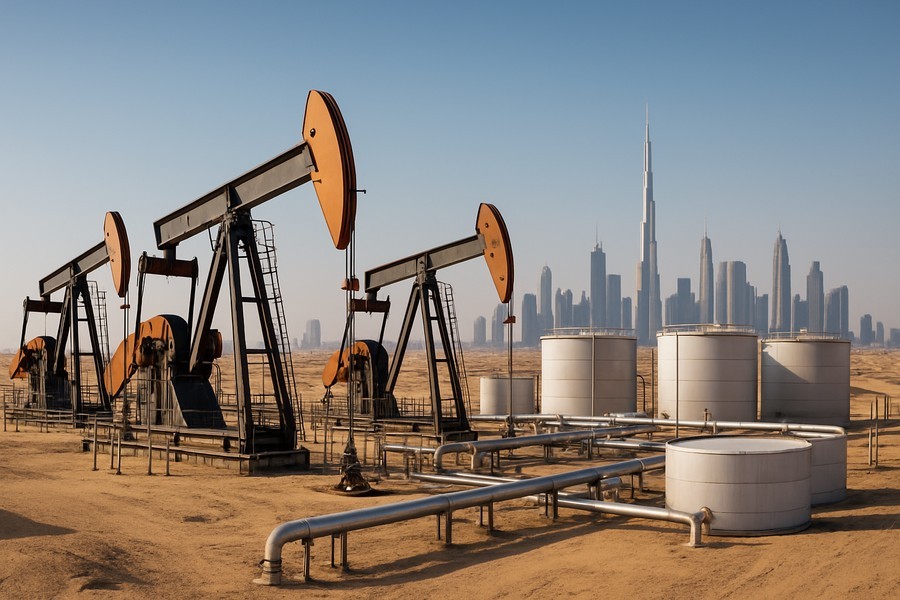
Why the UAE Decided to Leave OPEC: An Economist's Perspective
The United Arab Emirates' (UAE) decision to leave the Organization of the Petroleum Exporting Countries (OPEC) was not openly linked to any conflicts in the Gulf. Instead, the UAE explained its departure as a strategic move towards a more diversified energy portfolio and economic growth. The main aim is to increase their oil production gradually, matching the demand and conditions of the market.
An Economist's Insight into the UAE's Decision
An economist, who had previously worked with the UAE's Financial Advisory Council, was not taken aback by this decision. He had developed an economic model that suggested how swiftly an oil-rich country should increase production depending on the rate of decline in the actual price of oil after adjusting for inflation. The model indicated that the longer the oil reserves stayed underground, the faster they lost value. The speed of production would therefore depend on the anticipated decline in the price of a barrel of oil in the global market. If the price was expected to drop, the country should increase production quickly to maximize profits. This concept resonated with the UAE's economic leaders.
From 2021 onwards, the UAE started advocating for a larger share of OPEC's overall output. The rationale behind this was quite simple. With the rise of renewable energy, the price of fossil fuels was expected to continue to decrease. The UAE saw a lot of potential in green energy and hence invested heavily in projects ranging from solar farms to sustainable aviation fuel and low-emission hydrogen. This led to an aggressive strategy of increasing oil production. The UAE not only increased investments in oil but also sought to utilize its new capacity by urging OPEC to increase its production limit by around 50%, equivalent to nearly 5 million barrels per day. This, however, led to tensions with Saudi Arabia and differences over support for conflicting parties in Yemen and Sudan. Additionally, the UAE's move towards recognizing Somaliland and its role in pushing Israel to grant official recognition irritated Saudi Arabia further.
The Impact of an Attack on UAE's Oil and Gas Facilities
The situation took a drastic turn when the UAE's oil and gas infrastructure was targeted by drones and missiles from Iran, another member of OPEC. This came as a shock, especially considering the UAE's previous attempts at establishing relations with countries like the United States and Israel, and joining international agreements like the Abraham Accords. The attack severely damaged several major UAE facilities, including one of the world's largest refineries and an important oil export hub. The conflict has hindered the UAE's ability to transport crude oil and gas from its wells to global markets.
According to the previously mentioned economist, the problem shifted from a long-term decline in the actual price of oil to the possibility of not being able to sell oil at all, or only being able to sell much less. This is due to Iran's control over the Strait of Hormuz and the potential for further attacks on infrastructure. As a result, the future value of oil produced is expected to be much lower than before the conflict. Therefore, there is now a significant incentive for the UAE to increase oil production in the present rather than in the future. Departing from OPEC and its production quotas allows for this. This conflict has led to many unexpected outcomes, the most significant being the UAE's decision to leave OPEC after nearly sixty years of membership.